When selecting a Stainless Steel Welded Mesh exporter for architectural façade projects, rigorous testing protocols are non-negotiable—especially for global buyers relying on ASTM standard steel pipe compliance, angle stainless steel Europe specifications, and certified pipe stainless steel supplier traceability. As a leading H-beam manufacturer China and trusted Profile steel distributor, Hongteng Fengda applies multi-stage quality verification—including tensile strength tests, intergranular corrosion resistance (per ASTM A262), weld integrity inspection, and dimensional accuracy checks—to ensure every mesh panel meets EN, ASTM, and GB standards. Whether you’re a project manager, procurement specialist, or quality control professional, our transparent, standards-driven process minimizes risk and maximizes façade performance.
What Testing Protocols Actually Matter for Façade-Grade Stainless Steel Welded Mesh?
Architectural façades demand more than aesthetic consistency—they require structural integrity under thermal cycling, wind load, UV exposure, and long-term corrosion stress. For stainless steel welded mesh used in high-rise cladding, curtain walls, or ventilated façade systems, exporters must implement at least five core testing phases before shipment. These include raw material certification validation, weld seam metallurgical analysis, mechanical property verification, surface finish assessment, and full-panel dimensional tolerance mapping.
Hongteng Fengda conducts all tests in-house using ISO/IEC 17025-accredited laboratories. Each batch undergoes 100% visual weld inspection via ISO 17637-compliant procedures, followed by random sampling for destructive testing. Tensile strength is verified across ≥3 specimens per lot, with elongation measured at both room temperature (20°C) and low-temperature (-20°C) conditions to simulate winter installation environments in Europe and North America.
Critical non-destructive tests include dye penetrant inspection (DPI) for surface cracks and ferrite content measurement (per ASTM E562) to confirm austenitic microstructure stability—key for preventing sensitization during welding. All test reports are digitally archived and traceable to individual coil heat numbers, enabling full chain-of-custody transparency for auditors and specifiers.
How Do International Standards Shape Testing Requirements?
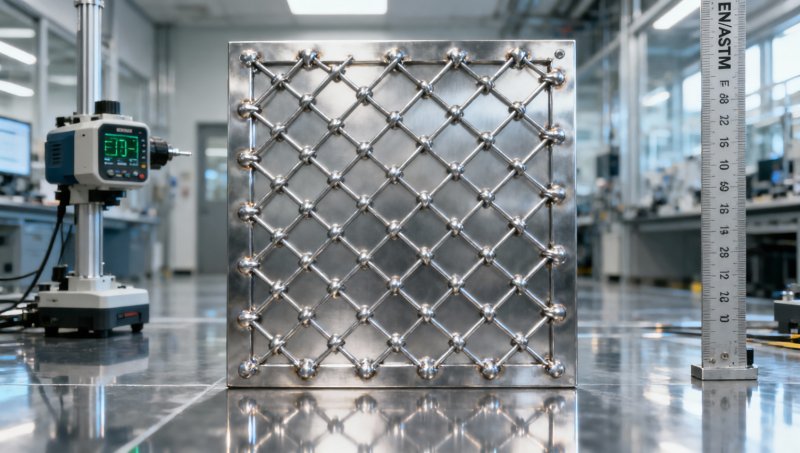
Testing isn’t uniform across markets—and misalignment between regional standards is a top cause of façade rejection at customs or site handover. EN 10219-2 (for cold-formed hollow sections) and ASTM A1085 (for structural welded mesh) define divergent acceptance thresholds for yield strength deviation (±5% vs ±7%), bend test radius (2× vs 3× thickness), and intergranular corrosion pass/fail criteria (ASTM A262 Practice E vs EN ISO 3651-2).
To serve clients across 30+ countries, Hongteng Fengda maintains dual-certified production lines: one optimized for EN/BS/DIN compliance (with S355J2H-grade Tube Carbon Steel feedstock), and another calibrated for ASTM/ASME/JIS requirements. This avoids costly rework or third-party retesting delays—reducing average lead time from order confirmation to documentation release to 7–12 working days.
Key Standard-Specific Test Parameters
This table reflects real-world specification divergence—not theoretical differences. Clients specifying EN-compliant façade mesh for London or Berlin projects will receive tighter dimensional tolerances (±0.3mm vs ±0.5mm) and stricter surface roughness limits (Ra ≤ 0.8μm). Meanwhile, U.S.-based developers requiring ASTM A1085 approval prioritize weld fusion depth verification (≥95% parent metal penetration) and Charpy V-notch impact energy reporting at -20°C (≥27J).
Why Procurement Teams Overlook Critical Pre-Shipment Verification Steps
Three common oversights increase façade project risk: skipping pre-shipment dimensional audits (leading to on-site fit-up failures), accepting mill certificates without cross-referencing heat numbers to physical samples, and assuming “stainless” implies universal corrosion resistance—ignoring chloride-induced pitting susceptibility in coastal installations.
Hongteng Fengda addresses these gaps through its 4-Stage Verification Framework: (1) Raw material traceability audit (heat number → chemical composition report), (2) In-process weld seam ultrasonic testing (UT) at 100% coverage, (3) Final panel flatness check using laser scanning (±0.15mm/m² tolerance), and (4) Third-party witnessed testing (optional, per client request) at CNAS-accredited labs in Shanghai or Guangzhou.
For example, when supplying mesh panels for the Dubai Frame façade upgrade, we conducted accelerated salt-spray testing (ASTM B117, 5000-hour cycle) on prototype batches—validating resistance to marine atmospheric corrosion where conventional 304 stainless would degrade within 3 years.
How to Request Full Test Documentation & Customize Your Verification Scope
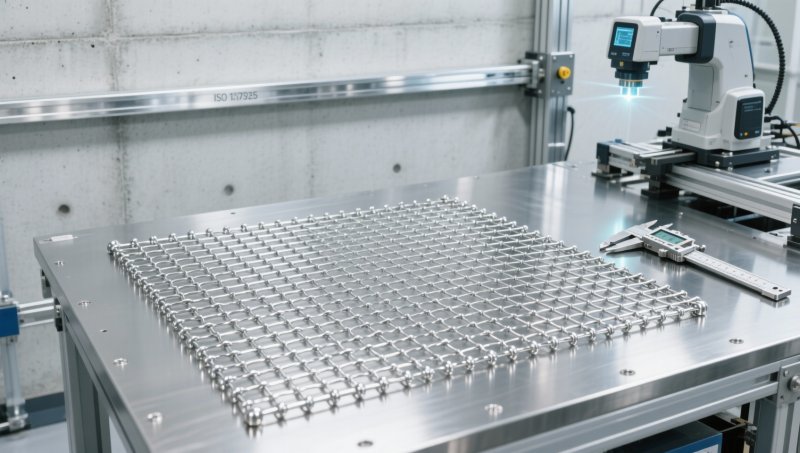
Every export order includes a digital Quality Dossier containing: raw material mill test reports (MTRs), weld procedure qualification records (WPQR), dimensional inspection reports with annotated CAD overlays, and corrosion test summaries. You can specify additional requirements during RFQ—such as inclusion of EN 10204 3.2 certification, ISO 14644-1 Class 8 cleanroom handling documentation, or laser-marked serial numbering for panel-level traceability.
We support rapid turnaround for urgent validation needs: expedited DPI + tensile reports in 3 working days; full EN/ASTM dual-standard compliance packages in 7–10 days; and custom environmental simulation testing (e.g., thermal shock cycling from -40°C to +80°C) upon request.
Ready to align your façade project’s technical specs with proven testing rigor? Contact Hongteng Fengda today to: (1) Confirm exact test scope for your EN/ASTM/GB mix, (2) Request sample MTRs and dimensional tolerance reports, (3) Discuss OEM labeling, packaging, and logistics integration, or (4) Schedule a virtual lab tour of our Qingdao quality center. Let’s build façades that perform—certifiably.
Please give us a message


Please enter what you want to find