When evaluating steel for outdoor projects, understanding what hot dipped galvanized steel coil SGCC Z275 really delivers in field conditions matters.
This coating grade is widely selected for corrosion control, budget balance, and dependable availability in construction and manufacturing environments.
This article explains how hot dipped galvanized steel coil SGCC Z275 performs outdoors and what should be checked before sourcing.
What SGCC Z275 means in practical steel use
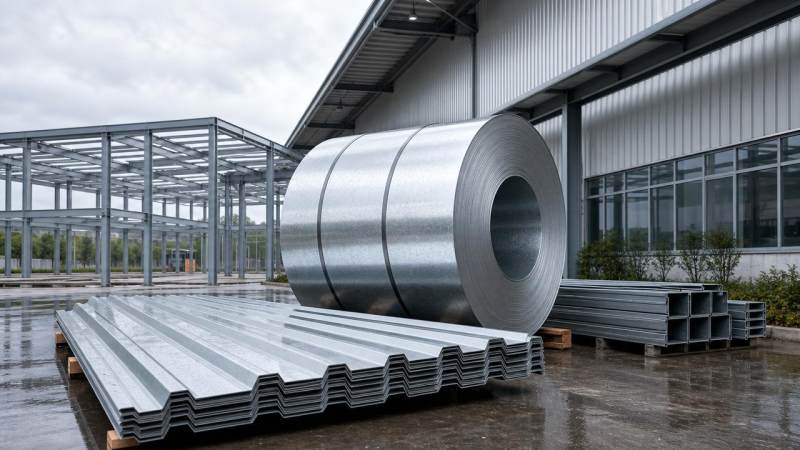
SGCC is a common JIS designation for commercial quality galvanized steel sheet or coil used in forming and general fabrication.
Z275 refers to the nominal zinc coating mass of 275 g/m² on both sides combined.
In simple terms, hot dipped galvanized steel coil SGCC Z275 offers a thicker zinc layer than lighter coating classes.
That extra zinc acts as a sacrificial barrier, slowing red rust when the surface faces rain, humidity, and changing temperatures.
However, coating mass alone does not guarantee the same service life in every outdoor condition.
Local climate, design details, drainage, cut edges, and maintenance all affect actual durability.
How outdoor exposure changes corrosion behavior
Outdoor steel does not corrode at a fixed rate.
Dry inland zones are very different from marine coastlines, industrial areas, or tropical regions with long wet periods.
Hot dipped galvanized steel coil SGCC Z275 generally performs well in moderate atmospheric exposure.
Its zinc layer gradually forms protective corrosion products, helping reduce direct attack on the base steel.
Still, several environmental factors can shorten coating life:
- Salt in coastal air accelerates zinc consumption.
- Sulfur dioxide and industrial pollutants increase corrosion activity.
- Water traps at overlaps or fasteners keep the surface wet longer.
- Frequent abrasion can remove local coating protection.
- Poor edge sealing exposes cut areas earlier.
Because of this, hot dipped galvanized steel coil SGCC Z275 should be evaluated by exposure category, not by coating label alone.
Current market focus around SGCC Z275 selection
In today’s steel supply chain, buyers usually compare outdoor performance, processing stability, and delivered cost at the same time.
For many fabricated parts, hot dipped galvanized steel coil SGCC Z275 remains a practical middle-ground option.
These points matter because corrosion resistance has value only when the steel also fits fabrication and delivery needs.
What real outdoor use usually looks like
In common field use, hot dipped galvanized steel coil SGCC Z275 is often processed into roofing parts, wall components, enclosures, purlins, brackets, and light structural sections.
It works best when the design avoids standing water and allows surfaces to dry after rain.
For example, open-air agricultural buildings and light industrial covers often gain good service life from this coating class.
By contrast, coastal splash zones or chemically aggressive sites may require heavier galvanizing or additional paint systems.
Mid-project steel selection also links to larger structural members.
Where heavier framing is needed, H Girder solutions support applications including steel structures, bridging, shipbuilding, and automobile chassis.
Typical material choices include Q235, Q345B, SS400, S275JR, S355JR, A572, and A992, with galvanized options also available.
Its flange thickness ranges from 8-64mm, web thickness from 5-36.5mm, and length from 1m-12m or as required.
That makes it suitable when projects combine sheet-based galvanized components with larger load-bearing sections under ASTM, EN, or JIS references.
Application value in construction and manufacturing
The practical value of hot dipped galvanized steel coil SGCC Z275 comes from balancing several project demands at once.
- It lowers initial corrosion risk for exposed fabricated parts.
- It reduces the need for immediate secondary protection in mild environments.
- It supports common roll forming, bending, and panel production.
- It often offers better cost efficiency than heavier specialty coatings.
- It is widely recognized in international steel sourcing discussions.
For structural steel exporters, this coating grade also helps standardize communication with overseas projects.
Hongteng Fengda, a structural steel manufacturer and exporter from China, supports such demand with stable production and customized steel solutions.
Its product range covers angle steel, channel steel, steel beams, cold formed profiles, and tailored components for global construction and industrial use.
Compliance with ASTM, EN, JIS, and GB standards helps reduce mismatches between order specifications and project requirements.
Typical outdoor scenarios and suitability signals
This table shows why outdoor suitability should always be matched to actual exposure, not assumed from galvanizing alone.
Practical checks before sourcing
Before placing an order, several checks help confirm whether hot dipped galvanized steel coil SGCC Z275 fits the intended service conditions.
- Confirm the governing standard and test documents for coating mass.
- Review base steel grade, thickness, and forming requirements.
- Ask whether passivation, oiling, or skin pass is required.
- Check storage and transport protection to avoid white rust.
- Consider cut-edge treatment for outdoor fabricated parts.
- Match expected service life with local corrosion conditions.
It is also useful to define whether the material will remain bare galvanized or receive paint after fabrication.
A duplex system can significantly extend outdoor durability where SGCC Z275 alone may be borderline.
Choosing based on real performance instead of label only
Hot dipped galvanized steel coil SGCC Z275 is a practical and widely used outdoor steel option when exposure is understood correctly.
Its main strength is balanced performance across corrosion resistance, processability, cost control, and supply reliability.
The best results come from combining the right coating with sound design, proper storage, and realistic environmental assessment.
For projects involving galvanized sheet, formed profiles, or larger structural members, comparing standards and application details early saves time later.
If the application requires stable structural steel supply, customized specifications, or coordinated export support, a detailed specification review is the next practical step.
Please give us a message


Please enter what you want to find