A safe steel beam for bridge use must deliver the right strength, stability, and long-term durability under demanding loads and harsh environments. For buyers comparing structural steel beams for construction or selecting a steel beam for bridge projects, understanding material grade, design standards, fabrication quality, and corrosion protection is essential to reduce risk, control cost, and ensure reliable performance.
Understanding What Bridge Beam Safety Really Means
In bridge engineering, a steel beam is considered safe when it can carry expected loads with an appropriate design margin throughout its service life. That sounds simple, but bridge safety depends on several linked factors: material properties, section geometry, fabrication accuracy, connection quality, environmental resistance, and inspection discipline. A beam that performs well in a warehouse or factory building may not automatically be suitable for bridge use, where repeated traffic loading, weather exposure, and long spans create a more demanding operating condition.
A steel beam for bridge projects usually works under a combination of dead load, live load, impact load, fatigue cycles, wind effect, and sometimes thermal movement. In practical terms, that means the beam must not only resist one-time force, but also maintain stiffness, alignment, and crack resistance over 20, 30, or even 50 years of service. For project managers and technical evaluators, safety is not a single number; it is a system result built from design compliance, manufacturing consistency, and field performance.
This is why industry professionals pay close attention to standards such as ASTM, EN, JIS, and GB, as well as project-specific requirements for toughness, weldability, and dimensional tolerance. In many bridge applications, small deviations in web thickness, flange straightness, or hole positioning can affect installation speed and stress distribution. For procurement teams and financial approvers, early control of these details often reduces rework, schedule delays, and lifecycle maintenance cost.
Core Conditions That Define a Safe Beam
A safe bridge beam typically needs to satisfy four basic conditions. First, it must have adequate strength to carry design loads without yielding. Second, it must have enough stiffness to limit excessive deflection and vibration. Third, it must provide fatigue resistance under repeated traffic cycles, which may number in the millions over its service life. Fourth, it must be protected against corrosion, especially in coastal, humid, de-icing salt, or industrial environments.
- Strength ensures the beam can resist bending, shear, and localized bearing stresses.
- Stiffness controls serviceability, including ride quality and structural alignment.
- Fatigue performance helps prevent crack initiation at welds, holes, and stress concentration zones.
- Durability protection slows section loss and preserves long-term structural capacity.
For decision-makers, the key takeaway is that bridge safety is never determined by beam size alone. Two beams with a similar profile can perform very differently if one uses better steel chemistry, tighter rolling tolerances, more reliable welding procedures, or a coating system designed for 10 to 15 years before major maintenance.
Why the Industry Pays Special Attention to Bridge Steel Beams
Bridge structures are public infrastructure, so risk tolerance is lower than in many private projects. A structural steel beam used in a bridge often supports variable traffic loads every day, sometimes 24 hours a day, across multiple vehicle classes. Compared with standard building beams, bridge members must usually perform under more frequent fatigue loading and more severe environmental exposure. That is why bridge specifications often require stricter review of chemical composition, mechanical properties, weld procedures, and inspection records.
From a business standpoint, a safe beam also protects project economics. A low initial purchase price can become expensive if the beam requires coating repair after 3 to 5 years, if installation tolerances cause field modification, or if inconsistent supply delays the erection sequence. For distributors, contractors, and owners, the beam selection process should therefore balance upfront cost with fabrication reliability, transport efficiency, lead time stability, and expected maintenance frequency.
Manufacturers serving international bridge and heavy construction markets increasingly work across multiple standards and custom fabrication requirements. This matters for overseas buyers who need material matched to local design codes or approval workflows. A structural steel manufacturer with controlled production, traceable documentation, and export experience can reduce uncertainty across the entire procurement cycle, from technical clarification to shipment planning.
Common Risks When Safety Is Underestimated
Many bridge beam issues do not come from dramatic failure; they start with small quality gaps that grow over time. In practice, these may include lamination in the plate, insufficient weld penetration, poor camber control, unprotected cut edges, or coating defects around stiffeners and connections. If these issues are not identified before delivery or erection, later correction can cost 2 to 4 times more than factory-stage prevention.
Some buyers also focus too narrowly on nominal yield strength while overlooking low-temperature toughness, weldability, or residual stress control. In bridge conditions, especially in colder regions or long-span applications, these properties can be just as important as basic tensile capacity. Safety evaluation therefore needs a broader view than only “how strong is the steel.”
Even in related metal applications outside bridge work, material selection follows the same logic: the environment and service condition determine what is appropriate. For example, products such as 201 Stainless Steel Plate are valued in architectural decoration, kitchen equipment, transport components, and industrial hardware for their formability, surface finish options, and cost efficiency. That illustrates an important purchasing principle for bridge projects as well: material should always be selected according to real mechanical and environmental demands, not only by general familiarity or price comparison.
Key Technical Factors That Make a Steel Beam Safe for Bridge Use
Bridge beam safety is built from technical details that work together. Material grade determines baseline strength and toughness. Section design controls load distribution and deflection. Fabrication quality affects stress concentration, alignment, and fit-up. Surface protection preserves long-term capacity. If any one of these is weak, the reliability of the entire bridge system can be reduced.
For technical teams, it helps to evaluate beams using a structured set of criteria instead of isolated checks. The following overview summarizes the most important performance dimensions normally reviewed before approval, production, and shipment.
The table shows that a safe bridge beam is not a single product category but a performance package. Buyers should therefore request not only dimensions and weight, but also grade confirmation, fabrication tolerance, inspection scope, and protection method. In many international projects, these four items determine whether a beam is merely deliverable or truly bridge-ready.
Material Strength and Toughness
Strength is the most visible requirement, but it must be interpreted correctly. Yield strength supports design calculations, while tensile strength indicates the upper stress range before fracture. Toughness becomes especially important where dynamic loads, low temperatures, or welded details are involved. A higher-strength steel is not automatically safer if the project requires better weldability or impact performance under winter conditions.
Dimensional Stability and Deflection Control
Even when a beam is strong enough, excessive deflection can create serviceability problems, discomfort, drainage issues, or secondary stress in connected elements. In bridge fabrication, dimensional control often includes camber, sweep, flange flatness, and web alignment. Typical review points include section depth consistency, cut-to-length accuracy, and assembly fit for connection plates and diaphragms.
Weld and Connection Integrity
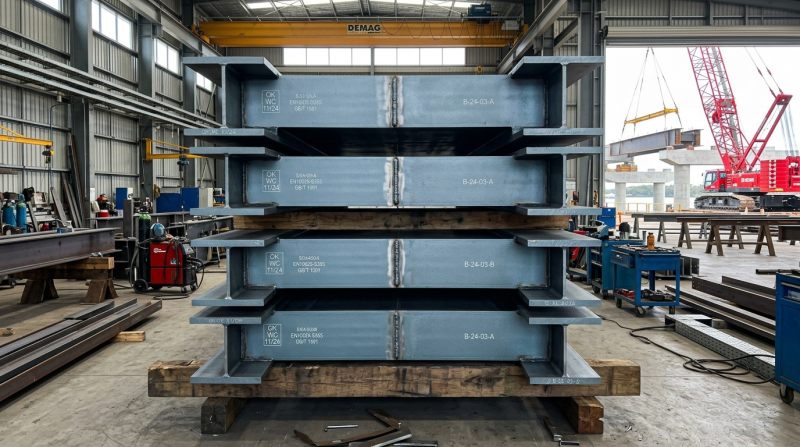
Many fatigue-sensitive areas in bridge beams are linked to welded zones and connection details. For that reason, procedures such as welding sequence planning, heat input control, and non-destructive examination are central to safety. A beam that passes dimensional inspection but has poor weld transitions or undercut at stress points may face reduced fatigue life after repeated traffic loading.
Typical Bridge Scenarios and Beam Safety Priorities
Not all bridges place the same demands on structural steel beams. The required safety priorities change depending on span length, traffic type, environment, installation method, and maintenance access. That is why a beam suitable for a short municipal overpass may not be the best option for a coastal logistics corridor or a pedestrian bridge with architectural exposure requirements.
For project owners and specifiers, classifying the application early helps reduce overdesign in some areas and underprotection in others. The following table outlines common bridge scenarios and the safety focus that usually matters most.
This type of classification is useful because it keeps safety evaluation connected to real operating conditions. It also supports better budgeting. For example, a project in a corrosive environment may justify a stronger coating specification and more detailed edge sealing, while a repetitive traffic corridor may justify stricter weld inspection and fatigue detailing.
Where Different Stakeholders Look First
Different audiences evaluate beam safety from different angles. Engineers focus on load path, code compliance, and fatigue behavior. Procurement staff focus on specification clarity, lead time, and documentation completeness. Quality and safety personnel look at inspection hold points, traceability, and coating records. Finance teams often compare total ownership cost over a 10-year or 20-year horizon rather than only ex-works pricing.
- Technical evaluators need grade, section properties, weld procedure scope, and tolerance requirements.
- Project managers need fabrication schedule visibility, shipping coordination, and erection compatibility.
- Purchasing teams need clear quotations, standard references, and realistic delivery windows such as 4 to 8 weeks for standard sections or longer for custom fabricated beams.
- Quality teams need inspection plans, material traceability, and coating or galvanizing verification.
When suppliers understand these different review points, communication becomes more efficient and project risk drops. That is particularly important in cross-border structural steel supply, where misunderstandings about standards or finishing requirements can lead to avoidable cost and schedule impact.
Practical Evaluation Steps Before You Approve a Bridge Beam
A practical beam review process should begin before production starts. Waiting until shipment inspection is too late for many structural issues. The most effective approach is a staged evaluation that combines technical clarification, shop drawing confirmation, material verification, fabrication control, and final inspection. For bridge work, each stage protects a different part of the risk profile.
In many projects, a well-managed pre-production review saves both time and money. Clarifying grade, dimensions, tolerances, welding requirements, and surface treatment at the start can reduce field adjustment and avoid procurement disputes. This is especially useful when beams are exported and replacement lead times may extend by several weeks.
The checklist below provides a practical framework for buyers, engineers, and inspectors who need to determine whether a steel beam is suitable and safe for bridge use.
- Confirm the required standard and steel grade, including any project-specific mechanical or toughness requirements.
- Review section dimensions, span assumptions, and connection details against design drawings.
- Verify fabrication capability for cutting, welding, drilling, cambering, and assembly tolerances.
- Request mill certificates, inspection records, and, where needed, non-destructive testing scope.
- Check the corrosion protection system, including coating type, surface preparation, and repair method for damaged areas.
- Align delivery sequence, packaging method, and transport constraints with erection planning.
A Note on Related Material Selection
Although bridge primary members usually rely on structural carbon steel or low-alloy structural steel, project teams often evaluate additional metal materials for cladding, accessory parts, equipment housings, or urban infrastructure elements around the bridge. In such cases, products like 201 Stainless Steel Plate may be considered where high mechanical strength, attractive surface finishes such as 2B, BA, No.4, Hairline, or Mirror, and good formability are valued. Typical thickness ranges can extend from 0.3 mm to 200 mm, with common standards including ASTM, JIS, GB, EN, and ISO, depending on application needs.
The broader lesson is that safe and economical material selection always depends on function. For bridge beams, structural performance and durability come first. For adjacent architectural or fabricated components, aesthetics, corrosion behavior, and forming characteristics may become more important. Separating these decisions helps avoid specification errors.
Documentation That Should Not Be Overlooked
A beam may look acceptable visually, yet still present project risk if documentation is incomplete. At minimum, many buyers expect traceable material certificates, dimensional inspection reports, and coating or finish confirmation. For fabricated bridge components, weld records and defined inspection points can also be important, especially when the project requires third-party review or owner approval before shipment.
In international supply, complete documents also support customs handling, on-site acceptance, and future maintenance records. This is one reason experienced structural steel exporters add value beyond manufacturing alone: they help align the product with the approval logic of the destination market.
Why Reliable Manufacturing and Supply Support Matter
Even the best beam design can be compromised by inconsistent manufacturing or unstable delivery. Safe bridge use depends on a supply chain that can maintain section accuracy, repeatable quality, and dependable lead times. For global construction and infrastructure buyers, this often means choosing a structural steel partner that understands export documentation, standard conversion, packaging protection, and custom fabrication communication.
Hongteng Fengda is a professional structural steel manufacturer and exporter from China, serving global construction, industrial, and manufacturing projects with structural steel beams, angle steel, channel steel, cold formed steel profiles, and customized steel components. With modern manufacturing facilities and strict quality control, the company supports buyers who need products aligned with common international standards such as ASTM, EN, JIS, and GB, while also requiring practical support on specifications, OEM production, and delivery coordination.
For bridge-related procurement, that type of support can make a measurable difference. Stable production planning helps contractors maintain erection schedules. Consistent quality reduces rejection risk. Clear technical communication helps engineers and purchasers align on material grade, dimensions, coatings, and connection requirements before production begins. Over a project cycle of several months, these operational advantages often matter as much as the nominal tonnage price.
Why Choose Us for Structural Steel Supply
If you are evaluating what makes a steel beam safe for bridge use, we can support you with practical and technically grounded guidance rather than generic quotations. Our team can help confirm beam parameters, review suitable structural steel grades, discuss fabrication feasibility, and align product specifications with your project standard requirements.
We also support discussions on delivery cycles, custom processing options, corrosion protection approaches, sample or document preparation, and export coordination for different markets. Whether you are a contractor, distributor, project owner, or technical evaluator, early clarification can reduce sourcing risk and improve budget control.
Contact us to discuss structural steel beam selection, customized bridge-related steel components, certification and documentation needs, production lead time, or quotation details. If you already have drawings, material standards, or target dimensions, we can help you review them and propose a practical supply solution matched to your project.
Please give us a message


Please enter what you want to find