Stainless steel plates suit heavy-duty industrial equipment because they retain useful mechanical strength while resisting the environmental damage that shortens the service life of ordinary carbon steel. In equipment exposed to moisture, washdown chemicals, process fluids, heat, abrasion, or repeated cleaning, the material is valued for its ability to keep a stable surface and structural form over time.
The result does not come from the word “stainless” alone. Plate performance is shaped by alloy grade, plate thickness, operating temperature, fluid chemistry, weld design, surface finish, and the way the part is supported. A plate that performs well as an equipment cover may be unsuitable for a hot chloride-bearing vessel, even when both are described as stainless steel. Heavy-duty applications require the material and fabrication details to be evaluated together.
Corrosion resistance protects more than appearance
Stainless steel contains chromium, which forms a thin passive oxide layer at the surface. When that layer remains intact and oxygen is available, it limits further corrosion. This behavior is especially useful on process tanks, ducting, housings, conveyors, screens, guards, chutes, and machine frames that face humid air, water, food residues, mild chemicals, or outdoor exposure.
Corrosion resistance matters because deterioration is rarely limited to visible staining. Local attack can reduce wall thickness, create leak paths, contaminate a process stream, weaken connections, or make cleaning difficult. Equipment often fails first at crevices, lap joints, threaded areas, under deposits, and near welds rather than across a broad open surface. Plate selection should therefore account for locations where liquid can remain trapped after shutdown or cleaning.
Chloride exposure changes the assessment. Salt, brine, coastal air, chloride-containing cleaners, and some process liquids can cause pitting or crevice corrosion in grades that perform adequately in fresh water. Austenitic grades containing molybdenum are commonly considered when chloride resistance is needed, while a basic chromium stainless grade may be sufficient for dry indoor guards or low-corrosion service. The relevant question is the actual contact condition: splash exposure, full immersion, hot vapor, drying deposits, and intermittent wetting do not impose the same demand.
Strength must be considered with stiffness and geometry
Heavy-duty equipment is often described as requiring “strong plate,” but strength alone does not determine whether a fabricated component will remain serviceable. Yield strength relates to permanent deformation; tensile strength relates to resistance before fracture; stiffness governs how much a panel, hopper wall, or cover deflects under load. A thin plate can have a high strength grade and still flex excessively if the unsupported span is large.
Thickness, fold geometry, ribs, channels, formed edges, and support spacing may contribute more to panel rigidity than a small change in alloy grade. A flat plate used as a wide tank wall may need formed stiffeners or external framing. In contrast, a smaller wear liner attached to a rigid substrate receives support from the surrounding structure and can be selected primarily for corrosion, abrasion, and fastening requirements.
Load direction also matters. Equipment plates may carry internal pressure, stacked material, vibration, impact, thermal expansion, or concentrated loads from brackets and rollers. Stress becomes much higher near square internal corners, narrow tabs, poorly located holes, and abrupt transitions between thick and thin sections. Rounded corners, adequate edge distances, and well-distributed supports reduce local stress without changing the plate material.
Grade selection follows the service environment
Stainless steel grades are families of alloys rather than interchangeable labels. The grade chosen for a plate should reflect the corrosion environment, temperature range, required forming behavior, weld condition, magnetic response where relevant, and cleaning regime. A specification based solely on nominal plate thickness leaves too much uncertainty.
A low-carbon grade can be useful in welded structures because it reduces the risk associated with chromium carbide precipitation in the heat-affected zone. That does not remove the need for suitable welding procedures, filler compatibility, cleaning, and post-weld surface treatment. Weld discoloration and heat tint can be less corrosion resistant than the parent plate if they are left untreated in severe service.
Grade names should not replace a review of composition and product form. Plate, sheet, bar, wire, and cast parts made from related alloy designations may have different delivery conditions and practical behavior. Material documentation should correspond to the supplied plate rather than a general description used elsewhere in the equipment.
Heat resistance has practical limits
Stainless steel plates are frequently used around ovens, exhaust systems, dryers, thermal processing lines, and hot fluid equipment because they resist oxidation better than unprotected carbon steel. Yet “heat resistant” is not a universal condition. At elevated temperatures, strength declines, thermal expansion becomes more significant, and prolonged exposure can alter microstructure and corrosion behavior.
A plate fixed rigidly at both ends can develop substantial thermal stress when its temperature changes. Expansion joints, slotted connections, flexible supports, or clearance around bolts may be needed when large temperature differences occur. A thick plate does not automatically solve this problem; greater section thickness can slow heat transfer and create temperature gradients through the component.
Thermal cycling adds another concern. Repeated heating and cooling can fatigue weld toes, attachment points, and sharp corners. When a hot plate is joined to a cooler structural frame, the joint design must accommodate different temperatures across the assembly. Surface scale, deposits, and insulating residues can create local hot spots that are not visible during normal operation.
Surface condition affects cleanability and corrosion behavior
The surface finish of stainless plate is often treated as an aesthetic choice, but it can influence equipment performance. A smoother, properly finished surface is generally easier to clean and less likely to retain product residues. This is relevant for process contact surfaces, washdown equipment, chemical handling areas, and assemblies exposed to fine powders or sticky materials.
A roughened surface is not always undesirable. Certain non-slip floors, abrasion-prone liners, and mechanically gripped interfaces need texture or pattern. The correct choice depends on whether residue retention, slip resistance, wear, and cleanability are competing requirements. A highly polished surface may reduce deposit buildup yet be impractical where scratch visibility or traction is a greater concern.
Contamination during fabrication can undermine an otherwise suitable plate. Carbon steel grinding dust, embedded iron particles, unsuitable wire brushes, and handling on dirty work surfaces can lead to rust staining. That staining is often mistaken for failure of the stainless alloy itself. Segregated fabrication tools, clean storage, and appropriate post-fabrication cleaning prevent many of these problems.
Fabrication details determine whether the plate keeps its advantages
Stainless steel plate can be cut, bent, drilled, machined, and welded into complex equipment, but its response differs from carbon steel. Austenitic grades work harden during forming. Tight bends, deep drawing, or repeated corrections can increase hardness and make further forming more difficult. Bend radius, grain direction, tooling condition, and sequence of operations should be set before production rather than adjusted through repeated rework.
Heat input during welding deserves similar attention. Excessive heat can distort broad panels, particularly thin plate used in tanks and enclosures. Distortion is not only a cosmetic issue: warped flanges may prevent gasket compression, misalign covers, create gaps that trap liquid, and interfere with rotating components. Balanced weld sequences, intermittent weld placement where permitted, fixturing, and controlled heat input limit movement.
Joint shape has a direct effect on hygiene and corrosion. Continuous welds may be appropriate for liquid-containing or washdown zones, while intermittent welds can leave inaccessible crevices if used where fluid enters the joint. Seal welding should not be used casually on a structure that needs venting during galvanic exposure or thermal cycling. The geometry must match the service condition.
Where plate components are joined to dissimilar metals, galvanic corrosion requires attention. Electrical contact, moisture, and an electrolyte can establish a corrosion cell. Insulating washers, compatible fasteners, drainage, coatings on the less noble component, or a redesigned connection may be appropriate depending on the assembly. The risk is lower in dry conditions and higher where saltwater or conductive process fluids are present.
Plate and mesh often work together in equipment assemblies
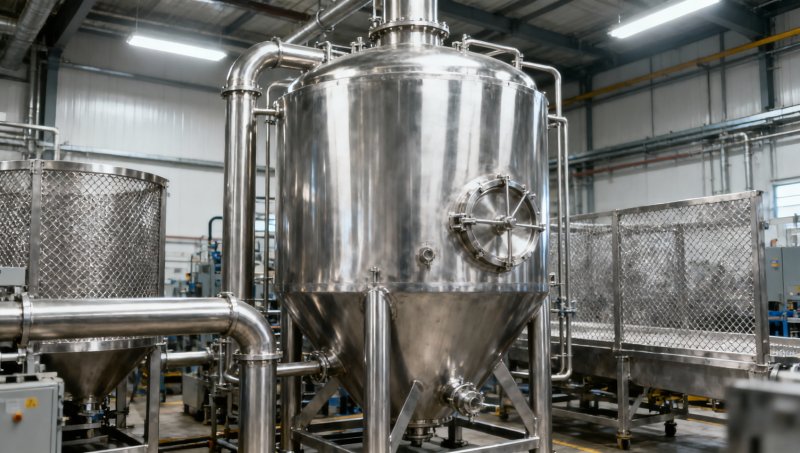
Many industrial machines use solid plate for containment, impact resistance, mounting faces, or load-bearing walls while using wire mesh for separation, ventilation, screening, or filtration. The two materials should be selected as part of the same operating environment. A corrosion-resistant housing can still develop maintenance problems if its screen panel traps residues, has an unsuitable opening size, or uses a wire alloy that is poorly matched to the process fluid.
For filtration and screening sections, Stainless Steel Welded Mesh can be specified in grades such as 201, 304, 304L, 316, 316L, or 430, with wire diameter, mesh count, opening area, and roll dimensions selected around the required retention and flow characteristics. A finer opening improves particle capture only when the pressure drop, cleaning method, and risk of blinding remain acceptable. Solid stainless plate around the mesh must provide sufficient support so vibration or differential pressure does not deform the screen.
Common assumptions that lead to poor equipment performance
One frequent mistake is equating thicker plate with greater durability in every respect. Greater thickness can improve load capacity and wear allowance, but it increases weight, forming force, weld volume, and thermal distortion potential. It may also hide a poor support design rather than correct it. Thickness should be based on the actual loading condition and permitted deflection, not on a broad “heavy-duty” label.
Another mistake is evaluating corrosion resistance only by the bulk liquid. A mildly corrosive liquid may leave concentrated residues as it evaporates. Cleaning chemicals may be harsher than the material being processed. The underside of a plate can see a different environment from the product-facing side because of condensation, insulation, trapped moisture, or contact with a support frame.
Surface rust near a weld can have different causes. It may be heat tint, embedded iron, a chloride deposit, incomplete cleaning, or local crevice attack. Treating all discoloration as the same issue can result in ineffective corrective work. Inspection should identify whether the attack is superficial staining, localized pitting, cracking, or material loss before repairs are selected.
Specification information that reduces uncertainty
A useful plate requirement identifies the alloy grade, thickness tolerance, plate dimensions, finish, flatness requirement, cutting condition, and any required material records. For fabricated equipment, drawings should also state weld extent, surface preparation after welding, critical bend radii, allowable distortion, drain direction, and areas where crevices must be avoided.
Service information should accompany the material requirement when corrosion or temperature exposure is material to the design. Relevant details include the process medium, concentration where known, temperature range, exposure duration, cleaning chemistry, wet-dry cycle, presence of chlorides, abrasive solids, pressure, and whether the plate is structural or only a cover. These conditions make it possible to distinguish a reasonable grade selection from a generic stainless specification.
Stainless steel plates remain dependable in heavy-duty equipment when their corrosion resistance, mechanical role, fabrication route, and installed environment are treated as connected decisions. A correctly matched plate is not simply resistant to damage at delivery; it is designed to retain its form, surface condition, and functional integrity through the operating conditions the equipment will actually experience.
Please give us a message


Please enter what you want to find