For technical evaluators, material selection is rarely about one property alone. A spring must store energy, return shape repeatedly, resist surface damage, and remain stable after many load cycles. That is why high carbon steel wire for spring making continues to be a practical reference point in industrial design. It is not chosen because it is simple, but because its balance of strength, hardness, and elastic response makes it dependable when springs are expected to work hard and last.
In many applications, the real question is not whether the wire can be formed into a spring, but whether it can survive the conditions around it: vibration, repeated compression, torsion, temperature change, and occasional overload. High carbon steel wire is valued because its chemistry and processing route support the kind of controlled deformation spring manufacture depends on.
Why spring manufacturers still rely on high carbon steel wire
Spring performance begins with the wire’s ability to deform within a controlled range and then recover without permanent set. High carbon steel has a higher carbon content than mild steel, which allows it to achieve greater hardness and tensile strength after suitable drawing and heat treatment. That makes it suitable for springs that need a firmer response and stronger resistance to fatigue.
Another reason is consistency. Spring designers need predictable behavior from coil to coil and batch to batch. A wire with stable dimensions, controlled surface condition, and uniform mechanical properties reduces variation during winding, setting, and final testing. For technical evaluators, that consistency often matters as much as peak strength.
The material is also well understood in fabrication. Its processing window is familiar to many manufacturers, so engineers can match wire condition to the intended spring type, whether it is a compression spring, extension spring, torsion spring, or a small formed component used in precision assemblies.
What actually gives it spring suitability
The suitability of high carbon steel wire is tied to several linked factors. Carbon content improves hardenability and strength response. Cold drawing refines the microstructure and increases tensile performance. Heat treatment then adjusts the balance between hardness and toughness, so the finished spring is not too brittle and not too soft.
Surface condition is another important point. Springs often fail at the surface before they fail in the core, especially under repeated stress. That is why clean finish, tight diameter control, and careful inspection are not cosmetic details; they are part of performance control. Even small scratches or scale marks can become fatigue initiation points.
For many users, corrosion protection also enters the discussion. In humid, outdoor, or industrial environments, a spring may need extra surface treatment to maintain durability. Depending on the end use, galvanizing, coating, or other protective approaches may be considered after the base wire has been selected.
When dimensional control changes the outcome
In spring making, diameter tolerance can affect winding accuracy, load behavior, and final consistency. If the wire varies too much, the spring rate can drift and assembly fitting becomes less reliable. This is especially noticeable in small springs or in parts used in precision mechanisms.
That is why buyers often look beyond the steel grade itself and examine whether the supplier can maintain stable production, straightness, surface quality, and inspection discipline. In practice, those factors determine whether the wire runs smoothly through forming equipment and whether the finished spring meets specification without excessive rejection.
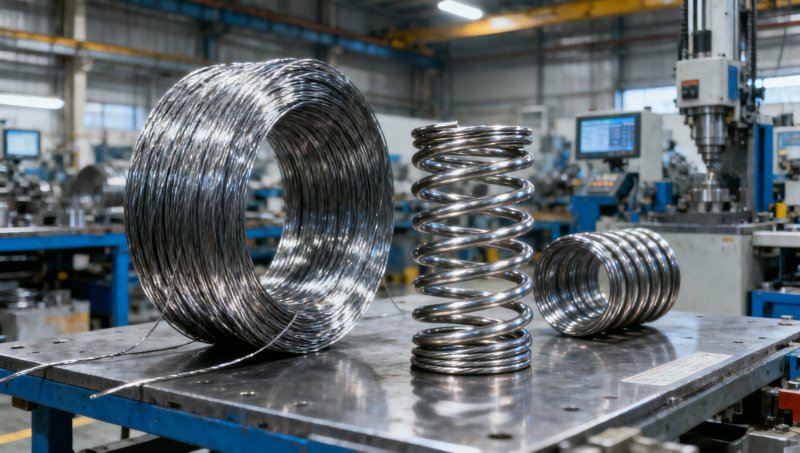
For projects that require both structural reliability and controlled processing, buyers may also evaluate products such as Galvanized Round Steel. While it is not a spring wire in every case, it shows how anti-corrosion treatment, surface consistency, and custom sizing can support downstream manufacturing needs in industrial and fabrication environments.
Heat treatment is where performance is refined
One reason high carbon steel wire remains relevant is that it responds well to post-processing. Soft annealing can improve formability. Normalizing and stress relieving help reduce internal stresses. Quenching and tempering can shift the final balance toward the strength and resilience required by the application. Spheroidizing is often used when better machinability or more stable forming behavior is needed.
Technical evaluators usually want to know whether the supplier understands not just the material, but the sequence of processing. A spring wire that looks acceptable on paper may still underperform if residual stress is too high or if the wire condition does not suit the forming method. Good selection means matching the wire condition to the spring geometry and the service environment.
Common checks before approving the material
Instead of focusing only on tensile strength, evaluators usually review a broader list of conditions:
- Consistent diameter and roundness
- Surface quality without harmful defects
- Mechanical properties suited to the spring load range
- Response to coiling and heat treatment
- Corrosion protection if the service environment requires it
- Traceable inspection and batch consistency
These checks are especially important when the spring is used in equipment that cannot tolerate drift in force or geometry. In such cases, even a small material variation can lead to early fatigue loss, noise, misalignment, or assembly issues.
Where this material fits in real industrial use
High carbon steel wire is commonly selected for springs used in automotive parts, machinery, appliances, tools, instruments, and other mechanical systems. It is also relevant in smaller precision components where repeated motion and compact design create a demanding stress profile. In these settings, the wire is expected to do more than carry load; it must do so repeatedly and predictably.
That repeatability is why the material remains part of engineering conversation even as alternative alloys and specialized wires continue to develop. For many applications, the best answer is still a well-controlled high carbon steel wire that has been properly drawn, treated, and inspected.
A practical view for evaluators
If the purpose is spring making, the material decision should be based on service life, processing behavior, and quality control—not only on initial cost. High carbon steel wire offers a strong combination of elasticity, hardness, and wear resistance, but only when the supply chain supports stable dimensions, suitable heat treatment, and clean surface condition.
In short, it is suitable because it gives engineers a workable foundation: strong enough to hold load, responsive enough to spring back, and mature enough in processing that its behavior is widely understood. For technical buyers, that balance often matters more than any single headline property.
Please give us a message


Please enter what you want to find