When specifying metal angle iron with holes for structural support—such as steel L angle, metal wall angle, or l shaped angle steel—understanding applicable load testing standards is critical for safety, compliance, and performance. Whether you're a project manager, procurement specialist, or quality assurance professional evaluating industrial steel pipes or structural steel pipe components, this article clarifies key testing requirements under ASTM, EN, GB, and JIS standards. Hongteng Fengda, a certified structural steel manufacturer and exporter from China, ensures every metal angle with holes meets rigorous mechanical and dimensional verification protocols—supporting global clients in construction, manufacturing, and infrastructure with reliable, code-compliant solutions.
Which Load Testing Standards Apply to Perforated Angle Iron?
Load testing of perforated structural angle iron isn’t governed by a single universal standard—but rather by application context, regional regulatory frameworks, and end-use requirements. For instance, ASTM A6/A6M defines tolerances and mechanical property baselines for hot-rolled structural shapes—including angle iron—while ASTM E4 outlines procedures for verifying load-testing equipment calibration. In Europe, EN 10056-1 specifies dimensional tolerances, and EN 10219-2 mandates tensile strength (≥360 MPa) and yield strength (≥235 MPa) for cold-formed hollow sections used in similar support roles.
China’s GB/T 706–2016 sets dimensional, chemical, and mechanical criteria for carbon structural steel angles, requiring minimum yield strength of 235 MPa (Q235 grade) and 345 MPa (Q345). JIS G 3101 further aligns Japanese-sourced angles with tensile ranges of 400–510 MPa for SS400-grade material. Crucially, hole placement alters stress distribution: ASTM A370 recommends testing specimens with representative hole patterns—not just solid blanks—to validate net-section strength reduction.
For structural integrity verification, three-tiered validation is typical: (1) raw material certification per ASTM A6/A6M or GB/T 706; (2) dimensional inspection of hole spacing, diameter tolerance (±0.3 mm), and edge distance (≥1.2× hole diameter); and (3) full-scale component testing under simulated service loads—often at 1.5× design working load for 10 minutes without permanent deformation.
How Hole Configuration Impacts Structural Performance & Test Requirements
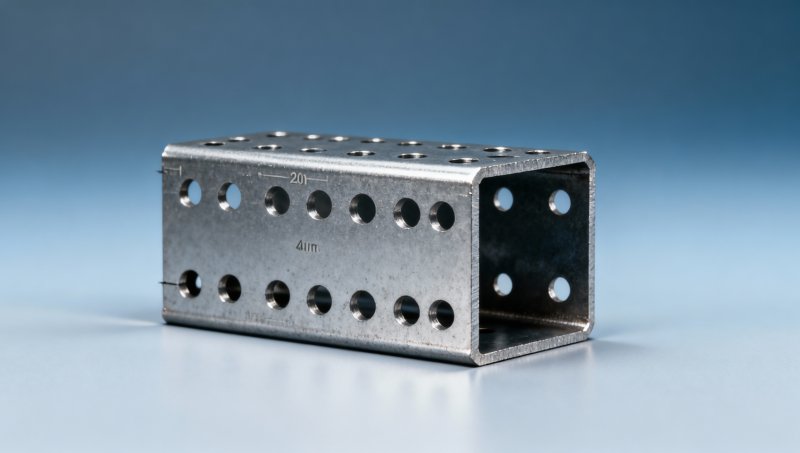
Holes in angle iron serve mounting, alignment, and weight-reduction functions—but introduce localized stress concentrations. According to EN 1993-1-8 (Eurocode 3), the net section modulus must be recalculated when holes occupy >15% of the gross cross-sectional area. ASTM F1554 Annex A similarly requires shear lag correction for bolted connections where hole rows reduce effective bearing width.
Critical parameters include hole diameter (typically 12–24 mm), center-to-center spacing (minimum 2.5× diameter), and edge distance (minimum 1.2× diameter or 12 mm, whichever is greater). Deviations beyond ±0.5 mm in positioning can increase local strain by up to 22%, per fatigue test data from the Steel Construction Institute (SCI).
Hongteng Fengda applies CNC drilling with ±0.2 mm positional accuracy across all perforated angle products. Each batch undergoes ultrasonic thickness mapping at 5 locations per meter and tensile sampling per ASTM A370—ensuring that even Q195 Carbon Steel Round Bar–derived tooling maintains consistent thermal stability during high-speed machining.
Comparative Compliance Across Key International Standards
Selecting the right standard depends on project jurisdiction, client specifications, and integration with adjacent systems (e.g., welded frames vs. bolted trusses). Below is a direct comparison of mechanical and dimensional benchmarks for perforated angle iron:
Note: All standards require hole edges to be free of burrs and cracks—verified via 100% visual inspection and random dye-penetrant testing (per ASTM E165) for critical infrastructure applications. Hongteng Fengda performs third-party witnessed load tests at certified labs in Tianjin and Shanghai, issuing traceable reports aligned with ISO/IEC 17025.
Procurement Checklist: What to Verify Before Ordering Perforated Angle Iron
To avoid field rework, delays, or non-compliance penalties, procurement teams should confirm the following before finalizing orders:
- Material certification includes mill test report (MTR) with heat number, chemical composition, and mechanical test results per ASTM A6 or GB/T 706
- Hole pattern drawings specify exact coordinates (X/Y), diameter, chamfer depth (0.5–1.0 mm), and surface finish (Ra ≤3.2 μm)
- Dimensional sampling plan covers ≥3 pieces per 20-meter lot, verified using CMM or laser scanning
- Corrosion protection method (e.g., galvanized, passivated, or PVC-coated) matches environmental exposure class per ISO 12944
Delivery lead times vary by specification: standard ASTM A36 angles ship within 7–15 days; custom EN 10219-2 perforated profiles require 3–4 weeks due to additional bending and post-hole inspection steps. Hongteng Fengda maintains stock of 12 common sizes (50×50×5 mm to 125×125×12 mm) for same-week dispatch to North America and EU ports.
Why Global Engineers Choose Hongteng Fengda for Load-Critical Structural Components
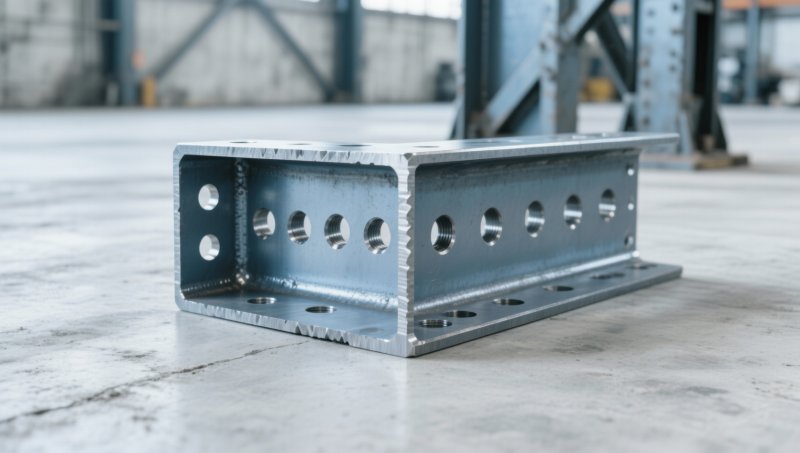
We combine precision manufacturing with full-stack compliance management—not just for angle iron, but across your entire structural steel bill of materials. Our integrated QA system tracks every batch from raw slab to finished product, with digital logs covering tensile testing, hardness mapping, and dimensional CMM scans—all accessible via secure client portal.
For projects requiring dual-standard compliance (e.g., ASTM + EN), we coordinate parallel testing at accredited labs in China and Germany—reducing approval cycles by up to 40%. And because structural integrity starts with base material quality, our Q195 Carbon Steel Round Bar feedstock is sourced from blast-furnace mills with certified low-phosphorus (<0.025%) and low-sulfur (<0.020%) content—ensuring optimal weldability and ductility.
Ready to validate your next perforated angle specification? Contact us for: (1) free engineering review of hole layout drawings, (2) ASTM/EN/GB compliance gap analysis, (3) sample shipment (lead time: 5–7 business days), or (4) factory audit scheduling. We respond to technical inquiries within 4 business hours—and provide formal quotations with breakdowns of testing, certification, and logistics costs.
Please give us a message


Please enter what you want to find