What Is Stainless Steel 304 Coil? Not Just Another Grade — It’s a Hygienic System Component
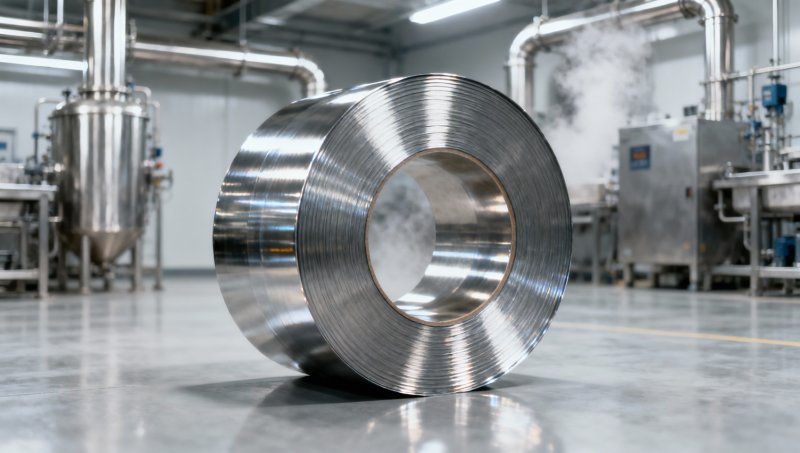
Stainless steel 304 coil isn’t just rolled metal. In food processing lines, pharmaceutical cleanrooms, or sterile packaging systems, it functions as a silent enabler of compliance — one that doesn’t corrode under repeated CIP cycles, doesn’t leach ions into sensitive formulations, and holds up to mechanical forming without micro-crack propagation. For technical evaluators sizing up material options for hygienic equipment, understanding what makes 304 coil distinct — beyond its “austenitic” label — matters more than memorizing composition percentages.
At its core, stainless steel 304 coil is cold-rolled or hot-rolled strip — typically supplied in coils ranging from 0.3 mm to 6 mm thick — with a nominal composition of 18% chromium and 8% nickel (hence “18-8”). But that shorthand misses the operational reality: its performance hinges less on textbook chemistry and more on how tightly controlled the mill annealing, surface finish, and intergranular carbon management are. A coil meeting ASTM A240 but rolled on outdated equipment may still suffer from inconsistent grain structure — which becomes visible only after welding or prolonged exposure to organic acids.
Why 304, Not 316 — And When That Choice Actually Matters
The most frequent misstep we see in technical evaluations is treating 304 and 316 as interchangeable substitutes based solely on chloride resistance claims. Yes, 316’s molybdenum content improves pitting resistance — but in ambient-temperature, low-chloride food-grade environments (think dairy tanks, sugar syrup lines, or tablet coating chambers), 304 delivers equivalent service life at lower cost and better deep-draw formability. Where 304 truly differentiates itself is in thermal stability during sterilization cycles: its austenitic structure resists sensitization up to ~425°C, unlike ferritic grades that embrittle under repeated steam-in-place (SIP) cycling.
That said, “304” isn’t a single specification. It’s a family — and confusing the variants can compromise validation. Here’s how they differ in practice:
- 304: Standard grade. Ideal for structural supports, hoppers, and non-welded contact surfaces where full annealing and pickling ensure uniform passive layer formation.
- 304L: Low-carbon variant (<0.03% C). Critical for welded fabrications — especially in pharma piping — where minimizing carbide precipitation at heat-affected zones prevents crevice corrosion beneath welds.
- 304H: Higher carbon (0.04–0.10%) for elevated-temperature applications like steam manifolds or oven linings. Not suitable for cold-formed parts due to reduced ductility.
None of these perform reliably if surface integrity isn’t verified. A BA (bright-annealed) finish on 304 coil provides superior reflectivity and smoother topography for cleaning validation — but requires strict control over final annealing atmosphere and tension leveling. A substandard 2B finish may pass visual inspection yet harbor microscopic peaks that trap biofilm.
Where 304 Coil Meets Real-World Constraints
Technical evaluators often overlook how coil geometry impacts downstream fabrication. Width tolerance matters when slitting for conveyor belts or laminating onto insulation panels. Edge condition — whether trimmed, sheared, or laser-cut — affects bending consistency and weld root penetration. And tensile strength variation across a coil’s length (common in older rolling mills) can cause unpredictable springback during roll-forming of sanitary tubing supports.
This is where sourcing discipline becomes part of the spec. As a structural steel manufacturer and exporter from China, Hongteng Fengda supplies ASTM A240- and EN 10088-compliant 304 stainless steel coil with batch traceability down to heat number, third-party mill test reports, and dimensional verification per EN 10162. We’ve seen projects delayed not by material failure — but by mismatched coil IDs between procurement docs and mill certificates. Consistent labeling, stable production runs, and documented process controls reduce that risk significantly.
For applications requiring moderate corrosion resistance alongside good formability — such as food-grade enclosures, medical equipment housings, or chemical handling components — our 430 Stainless Steel Plate offers a complementary option. With its ferritic structure, it delivers solid resistance to nitric acid attack and useful mechanical properties across thicknesses from 0.3 mm to 200 mm, backed by ISO, SGS, and BV certifications. Its lower nickel content also makes it less susceptible to price volatility — a practical consideration when scaling production across multiple facilities.
What Compliance Really Depends On — Beyond the Grade
Regulatory bodies don’t certify “304 coil.” They certify finished equipment — and that certification rests on verifiable evidence: surface roughness ≤ 0.8 µm Ra for product-contact zones, absence of embedded iron particles (verified via ferroxyl testing), and documented heat treatment history. A coil stamped “ASTM A240” means little if the supplier can’t provide batch-specific tensile data, intergranular corrosion test results (per ASTM A262 Practice E), or surface cleanliness validation.
We routinely support global engineers by supplying coil with full traceability packages — including certified mill test reports, surface finish verification records, and dimensional inspection logs. This isn’t about checking boxes. It’s about ensuring that when your validation team audits material origin, they’re reviewing evidence — not assumptions.
Next Steps — Before You Finalize the Spec
If you’re evaluating stainless steel 304 coil for a new line or retrofit, consider these three checkpoints before locking in the order:
- Confirm whether your application demands 304L (for welded assemblies) or standard 304 (for formed, non-welded parts) — mixing them risks galvanic coupling in humid environments.
- Verify surface finish requirements against your cleaning protocol: BA finish enables faster residue removal in high-pressure spray systems; NO.4 may suffice for non-product-contact structural framing.
- Request actual coil width/tolerance data — not just nominal specs — especially if slitting or precision stamping is involved.
Hongteng Fengda works with technical teams across North America, Europe, and Southeast Asia to align coil specifications with functional needs — not just catalog numbers. If your project involves custom widths, special edge conditions, or dual-standard compliance (e.g., ASTM + EN), we can coordinate directly with your QA team to define acceptance criteria upfront. No assumptions. Just documented, repeatable outcomes.
Please give us a message


Please enter what you want to find