Imagine walking across a coastal bridge at dawn—the salt-laced wind humming against steel girders, mist clinging to the underside of a maintenance walkway. Or picture a warehouse in Southeast Asia where humidity hovers near 90%, yet the structural frame remains unwavering after a decade. What makes that possible? Often, it’s something unassuming but indispensable: galvanized steel channel.
It’s not glamorous. It doesn’t headline press releases or dominate trade show booths. But in real-world infrastructure—where weather bites, chemicals linger, and time tests every joint—galvanized steel channel quietly delivers resilience. This isn’t just steel with a shiny coat. It’s engineered endurance.
What Exactly Is Galvanized Steel Channel?
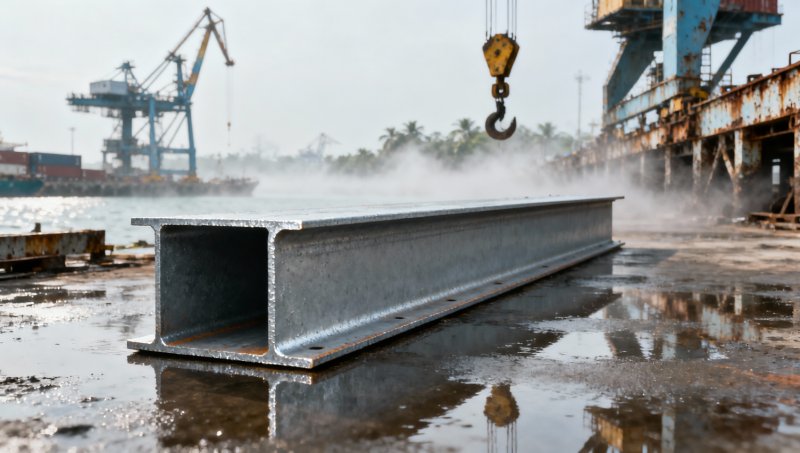
At its core, galvanized steel channel is a C-shaped structural profile—two parallel flanges connected by a vertical web—made from carbon steel and protected by a metallurgically bonded zinc coating. The “galvanized” part refers specifically to the hot-dip galvanizing process: cleaned steel is fully immersed in molten zinc (typically around 450°C), forming a series of zinc-iron alloy layers topped with pure zinc. This isn’t paint or plating—it’s molecular fusion.
Unlike painted or coated alternatives, galvanization protects both the surface *and* any cut edges or scratches through cathodic protection: zinc sacrifices itself to shield exposed steel. That means even if the coating gets nicked during installation or years later from vibration or abrasion, corrosion won’t spread beneath the surface.
Why Zinc? And Why Hot-Dip?
Zinc isn’t chosen for aesthetics—it’s selected for electrochemical intelligence. Positioned higher than iron on the galvanic series, zinc naturally corrodes first when in contact with moisture and oxygen, acting as an anode to protect the underlying steel cathode. Hot-dip galvanizing maximizes this effect because it creates thick, adherent, and self-healing coatings—typically 50–100 µm thick—far more robust than electrogalvanized or zinc-rich paints.
The result? A service life measured in decades—not years—especially in moderate to severe environments. In rural settings, galvanized steel channel may last over 70 years; in industrial or marine zones, expect 20–50 years before maintenance becomes necessary. That longevity directly translates into lower lifecycle costs: less inspection, fewer repairs, and no unplanned shutdowns.
Where Does It Stand Out? Real-World Applications
You’ll find galvanized steel channel where exposure meets expectation:
- Building frameworks—especially for canopies, mezzanines, stair stringers, and rooftop support systems where welding or bolting occurs on-site;
- Utility infrastructure—light poles, traffic signal gantries, and telecom towers exposed to UV, rain, and temperature swings;
- Industrial platforms and walkways—in chemical plants, food processing facilities, or wastewater treatment centers where splash zones demand non-porous, easy-to-clean surfaces;
- Agricultural and storage structures—grain silos, livestock enclosures, and cold-storage racking systems where condensation and ammonia vapors accelerate rust;
- Marine and offshore support—docks, fender systems, and modular offshore units where chloride ions aggressively attack unprotected steel.
What ties these applications together isn’t just location—it’s consequence. Failure here isn’t cosmetic. It’s safety-critical, operationally disruptive, and financially costly.
Beyond the Coating: Material Integrity Matters
Galvanizing enhances durability—but only if the base steel is sound. Structural integrity starts long before the zinc bath. That’s why specifications like ASTM A653, EN 10346, or GB/T 2518 matter deeply. They govern not just tensile strength and yield point, but also bendability, weldability, and uniformity of thickness—all essential for fabrication reliability.
For projects demanding higher performance under pressure or extreme temperatures, material selection becomes strategic. In boiler heat exchangers or cryogenic storage tanks, for instance, standard galvanized channel wouldn’t suffice. Instead, engineers turn to specialized grades like Carbon Sheet Steel—with variants such as Q345R for elevated-temperature resistance or 09MnNiDR for low-temperature toughness. These aren’t interchangeable substitutes; they’re purpose-built solutions where chemistry meets context.
That’s where manufacturers like Hongteng Fengda add tangible value—not just by supplying compliant galvanized steel channel, but by understanding how material choice cascades through design, fabrication, and field performance. Whether sourcing for a solar farm in Arizona or a pharmaceutical cleanroom in Germany, consistency in mechanical properties and dimensional accuracy reduces rework and accelerates commissioning.
Choosing Wisely: What to Look For
Not all galvanized steel channel performs equally—even when labeled to the same standard. Key considerations include:
- Zinc coating mass: Measured in grams per square meter (g/m²), typical hot-dip coatings range from 275 g/m² (for indoor use) to 610 g/m² (marine-grade). Ask for test reports—not just declarations.
- Base steel grade: ASTM A1011 vs. EN S235JR vs. GB Q235B—each carries different yield strengths and elongation properties. Mismatched specs risk brittle failure during cold bending or seismic loading.
- Dimensional tolerance control: Especially critical for bolted connections or pre-fabricated assemblies. Warped or out-of-square channels increase labor time and compromise load paths.
- Traceability: Batch-specific mill test reports (MTRs) should accompany every shipment—confirming chemical composition, mechanical testing, and galvanizing adherence.
And while cost matters, comparing quotes solely on unit weight misses the bigger picture. A slightly higher initial price for tighter tolerances and verified coating thickness often saves far more downstream—in reduced scrap, faster erection, and longer asset life.
More Than Just Corrosion Resistance
Galvanized steel channel also offers practical advantages beyond longevity: its matte-gray finish resists glare (valuable on highways or airports); its surface requires no primer before painting (if future color coding or topcoating is needed); and its consistent geometry supports modular design—reducing engineering iterations and speeding up approvals.
Yet perhaps its most understated benefit is predictability. In global supply chains strained by port delays and shifting compliance requirements, knowing your structural components meet ASTM, EN, JIS, *and* GB standards—and arrive with full documentation—removes ambiguity. It lets project managers focus on execution, not verification.
Hongteng Fengda’s role isn’t to sell tonnage—it’s to provide certainty. With production facilities calibrated to international benchmarks, responsive OEM support, and logistics experience across North America, Europe, and ASEAN markets, their approach reflects how structural steel sourcing has evolved: from transactional procurement to integrated partnership.
Because ultimately, galvanized steel channel isn’t about zinc. It’s about trust—woven into every alloy layer, every mill certificate, every container shipped.
When you specify it, you’re not just selecting a product. You’re choosing continuity.
Please give us a message


Please enter what you want to find