What is 2 stainless pipe? This common size—referring to a nominal 2-inch outer diameter stainless steel pipe—plays a critical role in demanding applications where corrosion resistance, strength, and compliance matter. But not all 2 stainless pipe is equal: choosing between Grade 304 and 316 can significantly impact performance, lifespan, and total cost of ownership. For engineers, procurement teams, and project managers evaluating materials for structural, industrial, or marine environments, understanding this distinction isn’t optional—it’s essential. As a trusted structural steel manufacturer and exporter from China, Hongteng Fengda delivers ASTM/EN-compliant 2 stainless pipe in both grades, backed by rigorous quality control and global delivery reliability.
Understanding Nominal Size & Real-World Dimensions
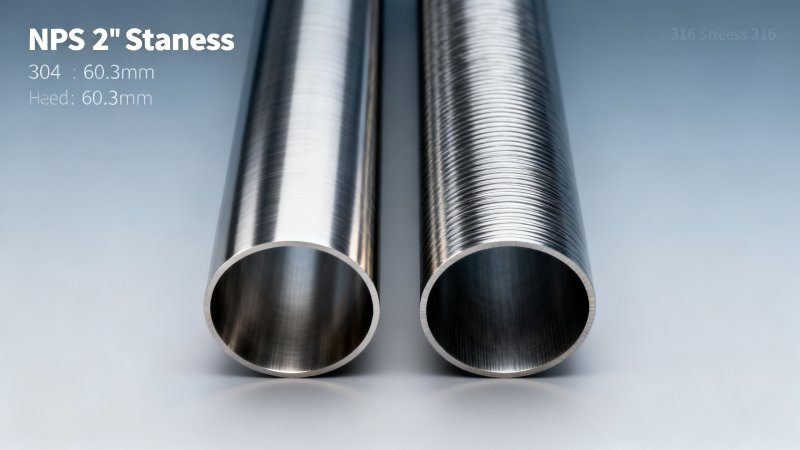
“2 stainless pipe” refers to a nominal pipe size (NPS) of 2 inches—not the actual outer diameter. In practice, NPS 2 stainless steel pipe has an OD of exactly 2.375 inches (60.3 mm), per ASTM A312 and EN 10217 standards. Wall thickness varies by schedule: Schedule 10S yields a wall of 2.11 mm, while Schedule 40S reaches 3.05 mm—directly affecting pressure rating, weight per meter (e.g., 3.6–5.2 kg/m), and load-bearing capacity in structural framing or support systems.
Unlike carbon steel pipes, stainless variants maintain dimensional stability across temperature ranges from –200°C to +800°C. This makes them indispensable in cryogenic storage, high-temperature exhaust ducting, and pharmaceutical cleanroom piping—where thermal expansion mismatch could compromise weld integrity or gasket sealing over time.
Hongteng Fengda manufactures NPS 2 stainless pipe with OD tolerance controlled within ±0.25 mm and straightness deviation ≤1.5 mm/m—meeting ASTM A999 tolerances for seamless and welded tubes. Every coil undergoes 100% ultrasonic testing (UT) and hydrostatic pressure verification at 1.5× working pressure before shipment.
The table above highlights why molybdenum—the key differentiator—makes Grade 316 superior in chloride-rich environments. While 304 resists atmospheric corrosion and mild acids, its lack of Mo renders it vulnerable to pitting in seawater, de-icing salts, or coastal fog—leading to premature failure in marine infrastructure or offshore platforms. For inland water treatment plants or food processing lines, 304 remains cost-effective and fully compliant with FDA 21 CFR §178.3570.
Corrosion Resistance: When Chemistry Dictates Longevity
Corrosion resistance isn’t binary—it’s a function of electrochemical potential, microstructure homogeneity, and environmental aggressiveness. In salt-spray tests per ASTM B117, Grade 316 withstands ≥1,000 hours before red rust appears, whereas Grade 304 typically fails after 300–500 hours under identical conditions. This 2–3× service life extension translates directly into reduced maintenance frequency: every 5 years vs. every 2 years for structural guardrails near oceanfront highways.
Critical applications demand more than lab data. Hongteng Fengda subjects finished 2 stainless pipe to real-world simulation: immersion in 3.5% NaCl solution at 50°C for 72 hours, followed by ASTM G48 Method A ferric chloride pitting test. Only batches achieving pitting resistance equivalent (PRE) ≥25 pass final inspection—ensuring consistent performance for clients in the Middle East’s oil & gas sector or Southeast Asia’s chemical plants.
For highly aggressive media—such as 10% sulfuric acid at 60°C or chlorine dioxide scrubbers—neither 304 nor 316 suffices. That’s where duplex grades like UNS S32205 enter scope. However, for 92% of architectural cladding, HVAC condensate lines, and municipal water distribution projects, the 304/316 decision hinges on location-specific chloride exposure thresholds—typically >200 ppm for 304 and up to 1,000 ppm for 316.
Procurement Considerations: Cost, Lead Time & Compliance
Grade 316 commands a 25–35% price premium over 304 due to higher nickel and molybdenum content. Yet lifecycle cost analysis reveals that upfront savings on 304 may backfire: replacing corroded 2 stainless pipe in a desalination plant costs 4.2× material cost—including labor, scaffolding, downtime, and safety permits. Hongteng Fengda offers dual-grade inventory with standard lead times of 12–18 days for ASTM A312 TP304 and 18–24 days for TP316—enabling just-in-time delivery without extended warehousing risk.
All shipments include full mill test reports (MTRs) per EN 10204 3.1, certifying chemical composition, tensile strength (≥515 MPa for 304, ≥480 MPa for 316), yield strength, and intergranular corrosion resistance (ASTM A262 Practice E). We also support third-party inspections by SGS, Bureau Veritas, or TÜV upon request—critical for North American infrastructure contracts requiring traceability to heat number and rolling date.
Beyond Pipe: Integrated Material Solutions for Structural Projects
While 2 stainless pipe serves as a vital conduit or support element, structural integrity often depends on complementary components. For filtration housings, ventilation grilles, or safety barriers, Stainless Steel Welded Mesh provides precision-engineered open-area control—from 25% to 84.6%—with absolute micron retention spanning 4–360 μm. Available in SS 304L and 316L variants, it ensures compatibility with adjacent pipe systems while resisting abrasion in mining sieves or chemical fume hoods.
Our welded mesh supports custom roll widths up to 240 inches and lengths up to 2,000 feet—ideal for large-scale façade installations or modular wastewater treatment skids. With cloth thickness options from 0.06 mm to 1.21 mm and wire diameters ranging from 0.0008″ to 0.12″, engineers can select configurations matching specific flow rates, particle capture efficiency, and structural rigidity requirements—without compromising corrosion resistance.
Choosing the Right Partner for Global Sourcing
Selecting stainless pipe isn’t just about grade—it’s about supply chain resilience. Hongteng Fengda maintains 12,000+ tons of raw material inventory across 304 and 316 billets, enabling MOQ flexibility from 500 kg to 50 MT per order. Our ISO 9001-certified production line integrates automated seam welding, solution annealing at 1040–1100°C, and pickling/passivation—all validated via ASTM A967 nitric acid testing.
From Dubai’s metro stations to Ontario’s green hydrogen facilities, our clients rely on stable pricing locked for 90 days post-order confirmation, bilingual technical documentation (English + Arabic/Spanish), and container-ready packaging with moisture-proof VCI film. For urgent needs, air freight options reduce transit time to Europe to 5–7 business days.
Whether you’re specifying NPS 2 pipe for a new offshore platform or upgrading aging infrastructure with corrosion-resistant alternatives, informed material selection starts with verified data—not assumptions. Contact Hongteng Fengda today to request certified samples, review application-specific engineering guidance, or obtain a formal quotation aligned with your project timeline and compliance framework.
Please give us a message


Please enter what you want to find