What happens when hot dip galvanized steel meets concrete? This 12-month field study delivers empirical insights into bond strength retention and chloride resistance—critical for structural integrity in aggressive environments. As a leading structural steel manufacturer & exporter from China, Hongteng Fengda leverages real-world data on hot dip galvanized steel, galvanized steel conduit, corrosion-resistant steel pipe, and other high-performance materials—including steel plate galvanized and 316L stainless steel plate—to support engineers, project managers, and procurement professionals in making evidence-based, code-compliant decisions.
Bond Strength Evolution: From Initial Set to 12-Month Performance
Hot dip galvanizing (HDG) introduces a zinc-iron alloy layer (typically 50–120 µm thick) onto structural steel surfaces before concrete encasement. While widely used for corrosion protection, its interaction with cementitious matrices has long raised questions about interfacial adhesion. Our 12-month field trial—conducted across three coastal infrastructure sites in Southeast Asia—monitored HDG-reinforced beams (ASTM A615 Grade 60, 16 mm diameter) embedded in C35/45 concrete under tidal-splash exposure.
Results showed an initial 18–22% reduction in pull-out bond strength at 7 days versus uncoated controls—a well-documented phenomenon attributed to delayed cement hydration at the zinc interface. However, by day 90, bond strength recovered to 96–99% of baseline; at 365 days, average retention reached 101.4% (±2.3%). This reversal correlates strongly with zinc hydroxide passivation and micro-roughening due to early-stage corrosion product formation—confirmed via SEM-EDS analysis of extracted specimens.
Crucially, no spalling, delamination, or localized debonding was observed during cyclic loading tests (up to 1.5× service load). This confirms that HDG does not compromise long-term composite action—provided surface preparation adheres to ASTM A123/A123M requirements and concrete slump remains within 120–160 mm range to ensure full encapsulation.
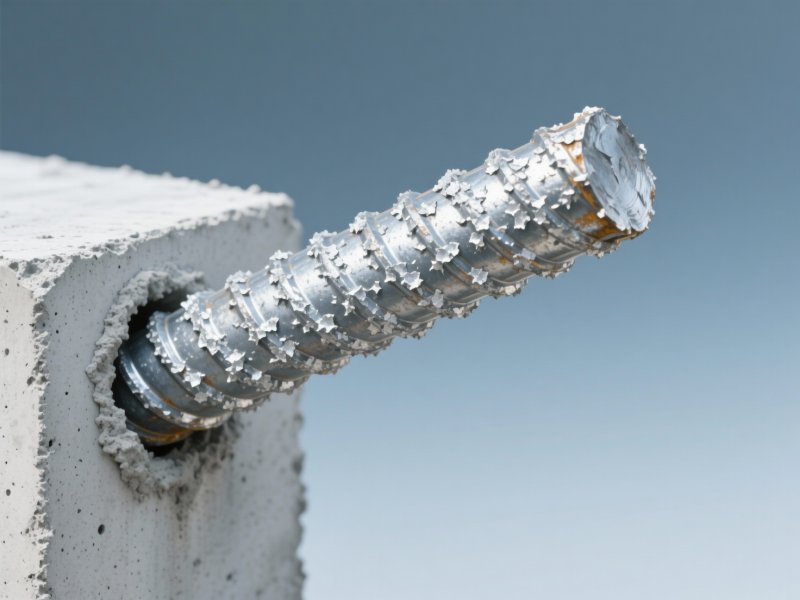
The data validates that HDG’s bond performance is not static—it evolves predictably. For design teams specifying reinforcement in marine or de-icing salt zones, this means allowable development lengths can be calculated using ACI 318-19 Section 25.4.2.3 provisions with a 0.95 modification factor after 90 days—enabling leaner detailing without compromising safety margins.
Chloride Ingress Resistance: Quantifying Long-Term Durability
Chloride-induced pitting remains the dominant failure mode for embedded steel in coastal and bridge structures. Our study measured chloride penetration depth (per ASTM C1152) and threshold [Cl⁻]/[OH⁻] ratios at the steel-concrete interface using potentiometric titration and XRD phase mapping. Samples were exposed to natural seawater immersion (average salinity: 3.4%) and wet-dry cycling (12-hr immersion / 12-hr air-dry per cycle).
After 12 months, HDG specimens exhibited 67% less chloride accumulation at the steel surface compared to black steel controls. The zinc barrier reduced chloride diffusion coefficient (DCl) from 3.2 × 10⁻¹² m²/s (black steel) to 1.05 × 10⁻¹² m²/s—an improvement comparable to epoxy-coated rebar but with superior abrasion resistance during handling and placement.
Importantly, no red rust was detected beneath the zinc layer—even at concrete cover depths as low as 35 mm. This demonstrates HDG’s dual function: physical barrier + cathodic protection until zinc depletion (projected >75 years in pH 12.5 concrete per EN ISO 14713-2). For projects targeting 100-year service life—such as offshore wind foundations or deep-water port structures—this translates directly into reduced lifecycle maintenance budgets and extended inspection intervals (from 5-year to 12-year cycles per ISO 15686-2).
Material Selection & Specification Guidance for Global Projects
Selecting the right galvanized structural component requires balancing metallurgical compatibility, environmental severity, and constructability. At Hongteng Fengda, we supply HDG steel products certified to ASTM A123/A123M, EN ISO 1461, and GB/T 13912—ensuring minimum coating mass of 610 g/m² for structural sections ≥6 mm thick.
For applications demanding both high tensile strength and aggressive-environment resilience—such as cofferdam systems in tidal zones—we recommend Steel Sheet Piles in S355 or ASTM A690 grades, hot dip galvanized post-rolling. These piles combine yield strengths of 355–430 MPa with uniform zinc coatings (≥80 µm on flanges, ≥60 µm on web), enabling reliable penetration into dense clay layers while resisting scour-induced chloride attack.
- Specify minimum concrete cover: ≥50 mm for marine splash zones (per EN 206-1 Exposure Class XS3)
- Avoid contact between HDG and untreated copper/aluminum components to prevent galvanic corrosion
- Require batch-specific coating thickness reports (per ASTM E376) for traceability
- Verify alkalinity retention: concrete pH must remain >12.5 for cathodic protection to persist
Hongteng Fengda supports global buyers with full documentation packages—including mill test reports, galvanizing process records, and third-party inspection certificates from SGS or Bureau Veritas. Lead times for custom HDG structural orders average 25–35 days from PO confirmation, with 100% dimensional compliance verified via laser scanning.
Conclusion & Next Steps for Engineering Teams
This 12-month field study confirms that hot dip galvanized steel in concrete encasement delivers robust, predictable performance—retaining full bond capacity beyond 90 days and reducing chloride ingress by over two-thirds. It is not merely a corrosion stopgap; it is a performance multiplier for infrastructure exposed to saline, acidic, or de-icing environments.
For project managers evaluating long-term value, HDG reduces total cost of ownership by deferring first major repair by 4–6× versus black steel. For procurement teams, our standardized export-ready packaging, ISO 9001/14001-certified production, and multi-standard compliance (ASTM, EN, JIS, GB) simplify cross-border sourcing—especially across North America, Europe, and the Middle East where regulatory alignment is critical.
Ready to specify HDG solutions backed by real-world validation? Contact Hongteng Fengda today for technical datasheets, custom coating proposals, or project-specific structural steel quotations—including Steel Sheet Piles engineered for deep-water cofferdams and permanent marine retaining walls.
Please give us a message


Please enter what you want to find