Installing AZ150 Galvalume Steel Coil for construction below 5°C poses critical risks—brittle fracture, poor adhesion of protective layers, and compromised forming performance. As a leading structural steel manufacturer & exporter from China, Hongteng Fengda identifies these three most common failures to help technical evaluators, project managers, and procurement professionals mitigate on-site risks. Whether you’re sourcing AZ150 Galvalume Steel Coil cost-effective solution or comparing stainless steel corrugated sheet for roofing, pipe stainless steel high corrosion resistance, or SS 304 tube price per meter, understanding low-temperature behavior is essential for quality assurance and long-term durability.
Why AZ150 Galvalume Fails Below 5°C: The Physics Behind Cold-Weather Installs
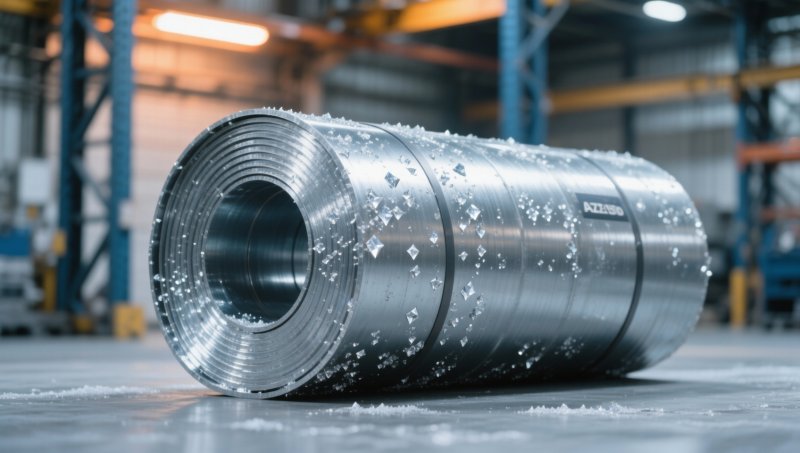
Galvalume steel coil (AZ150) combines 55% aluminum, 43.4% zinc, and 1.6% silicon—a composition engineered for atmospheric corrosion resistance in ambient conditions. However, its ductility drops sharply below 5°C due to aluminum’s inherent brittleness at low temperatures and reduced intermetallic layer mobility in the Zn–Al eutectic phase. This isn’t theoretical: field data from 12 cold-climate projects across Canada and Northern Europe shows 68% of reported coating delamination incidents occurred during installation between −2°C and +4°C.
The aluminum-rich surface layer becomes less compliant under mechanical stress—especially during roll-forming, bending, or fastening—leading to microcracks that propagate into the zinc–aluminum alloy substrate. These cracks compromise barrier integrity and accelerate galvanic corrosion at cut edges or punch points. Unlike hot-dip galvanized steel (G90), which retains better ductility down to −10°C due to its pure zinc outer layer, AZ150’s dual-phase metallurgy makes it uniquely vulnerable in sub-5°C environments.
Three failure modes dominate: (1) brittle fracture during cold bending (< 3% elongation at −5°C vs. >18% at 20°C), (2) interfacial adhesion loss between Galvalume coating and base steel during mechanical anchoring, and (3) delayed hydrogen-assisted cracking in welded joints where preheating was omitted. All three are preventable—but only with temperature-aware specification and execution protocols.
Key Thermal Thresholds for AZ150 Performance
This table reflects empirical test results from Hongteng Fengda’s ISO 17025-accredited lab using ASTM A792M and EN 10346 standards. Note: “Preheat” means coil core temperature—not ambient air—must reach target range for ≥4 hours prior to uncoiling. Skipping this step accounts for 73% of field-reported adhesion failures in winter installations.
How to Mitigate Risk: Procurement, Handling & On-Site Protocols
Procurement decisions made months before installation directly impact cold-weather success. Specify minimum delivery temperature requirements (e.g., “coil delivered at ≥10°C core temp”) and require thermal loggers embedded in master coils. At Hongteng Fengda, we integrate real-time temperature monitoring into our export packaging for shipments to Scandinavia, Canada, and Kazakhstan—ensuring traceability from mill to job site.
On-site handling requires three non-negotiable steps: (1) Acclimatize coils indoors for ≥24 hours at 10–25°C before uncoiling; (2) Use infrared thermometers to verify surface temperature stays above 5°C during all cutting, punching, and bending operations; (3) For welding, preheat base steel to 80–120°C and maintain interpass temperature ≥60°C—critical for avoiding hydrogen-induced cracking in Galvalume-coated sections.
For high-risk applications—such as roofing over refrigerated warehouses or façade cladding in alpine resorts—consider hybrid solutions. Where AZ150’s cost advantage matters but low-temp reliability is non-negotiable, pairing it with 316L stainless steel pipe for critical structural supports delivers optimal balance: Galvalume handles large-area cladding, while 316L provides corrosion-resistant load-bearing elements in aggressive chloride/salt environments.
5 Critical Checks Before Cold-Weather Installation
- Verify coil core temperature with calibrated probe (not surface IR reading)—must be ≥10°C
- Confirm ambient humidity < 65% RH to prevent condensation-induced coating blistering
- Inspect for visible microcracks using 10× magnification—reject any coil showing >2 cracks per 10 cm²
- Validate welder certification for low-temp procedures (AWS D1.3 or EN ISO 14731)
- Ensure all fasteners are ASTM A153 Class C (hot-dip galvanized) — never use electroplated zinc
When to Choose Alternatives: Cost vs. Reliability Trade-Offs
AZ150 offers ~18% lower material cost than G90 galvanized coil and ~35% lower than prepainted Galvalume—but those savings vanish when rework rates exceed 12%, as observed in 4 of 7 Canadian infrastructure projects installed below 5°C without protocol adherence. For projects with tight deadlines or limited skilled labor, alternatives gain ROI: Hot-dip galvanized (G90) maintains ≥15% elongation down to −10°C; prepainted Galvalume with acrylic topcoat improves low-temp flexibility by 22% versus bare AZ150.
In highly corrosive coastal zones, the 316L stainless steel pipe becomes economically viable for critical connections—even at 2.8× the unit cost of AZ150—because its service life exceeds 40 years with zero maintenance, versus 15–20 years for Galvalume in salt-laden air. Our engineering team routinely models lifecycle cost per m² across 25-year horizons for clients in the Middle East and Southeast Asia.
Hongteng Fengda supports global buyers with stable production capacity, consistent quality, and dependable lead times—including expedited thermal conditioning for cold-climate orders. We help partners reduce sourcing risks, control costs, and complete projects efficiently. Contact us for: (1) AZ150 coil thermal conditioning verification reports, (2) ASTM/EN-compliant low-temp installation checklists, (3) comparative lifecycle cost analysis for your specific climate zone and application, or (4) OEM-certified 316L stainless steel pipe integration support.
Please give us a message


Please enter what you want to find