Steel sheet piles are used where soil, water, and limited working space have to be controlled at the same time. In retaining walls, they hold back earth on one side while creating a continuous barrier that can resist lateral pressure. In marine construction, they are chosen for quay walls, seawalls, bulkheads, cofferdams, and waterfront protection because the interlocking profile forms a wall that is fast to install and effective in wet ground or tidal conditions. The practical value of steel sheet piles comes from this combination of structural retention, water resistance, and speed of installation.
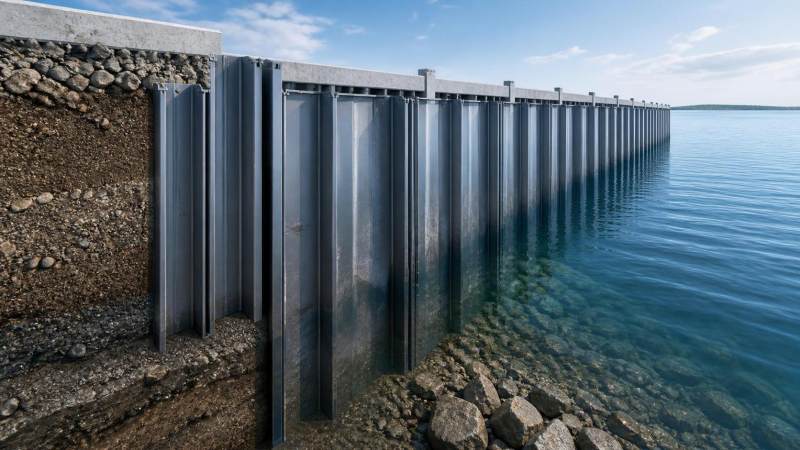
In a retaining wall, the sheet pile does not work as an isolated plate. It works as part of a system that transfers pressure into the ground through embedment, anchorage, or both. The wall face resists active earth pressure, while the toe and embedded section help stabilize the structure against overturning and sliding. Depending on soil conditions, a design may use a cantilever arrangement for moderate heights, or add tie rods and anchor walls when the retained height becomes larger. That is why the question of what steel sheet piles are used for is closely tied to soil profile, groundwater level, excavation depth, and the available construction space.
Marine construction adds another layer of demand. Saltwater exposure, wave action, splash zone corrosion, and repeated wet-dry cycles all place stress on the wall. Steel sheet piles are used because they can be driven into dense or saturated soils and provide a continuous line of interlocks. That continuity matters in harbors and waterfront structures, where leakage, scour, and settlement can affect the surrounding ground. In some projects, the wall also serves as a working platform edge, giving crews a stable boundary for dredging, filling, or temporary excavation near water.
The profile shape is central to performance. A sheet pile section is typically rolled or formed with a locking edge so adjacent pieces connect along the length of the wall. This interlock helps create a near-continuous barrier, though it is never wise to assume the wall is fully watertight without considering installation quality and soil conditions. Driving alignment, interlock fit, and local defects all influence seepage. In projects where water cutoff is sensitive, designers may specify sealants, tighter installation tolerances, or additional cutoff measures rather than relying on the steel alone.
Material choice also matters. Carbon steel sheet piles are common in many civil works because they offer strength and ease of fabrication, while corrosion protection may be added through coating, painting, cathodic protection, or sacrificial thickness allowances. Stainless products are selected in more specific environments where corrosion resistance is a higher priority and the geometry or function fits the application. For example, a product such as 201 Stainless Steel Coil is austenitic stainless material with strong formability and good resistance in many general environments, but it is not a direct substitute for structural sheet pile sections; it is more relevant when stainless strip or coil is being processed into components that need shaping, surface finish, or corrosion resistance under different service conditions.
Engineering decisions around steel sheet piles usually start with load and exposure, not with the section alone. A retaining wall beside a road cut may need stiffness against soil pressure and vibration from nearby traffic. A marine wall may need impact resistance, corrosion allowance, and compatibility with fender systems or cap beams. When groundwater is high, seepage can govern the design just as much as soil pressure. When the retained material is granular, drainage behind the wall becomes important to reduce hydrostatic buildup. When the wall must be temporary, removability and reuse can become part of the material selection.
Installation is another reason steel sheet piles are widely used. Compared with cast-in-place walls, they can often be installed faster, especially in linear projects or emergency works. Vibratory hammers are frequently used where soil permits, while impact hammers may be needed for harder strata. Press-in methods can be appropriate where vibration control is critical near existing buildings. Each method has tradeoffs. Vibratory installation is efficient but may be limited by dense layers. Impact driving can reach tougher ground but can produce more noise and stress. Press-in equipment reduces disturbance but may need a reaction system and more setup.
Connection details affect performance in a way that is easy to underestimate. The top of the wall may need a cap beam to distribute loads and connect the system. Tie rods, wales, and anchors can be added when lateral demand exceeds cantilever capacity. In marine work, a cap beam may also support bollards, fenders, or deck structures. Poor detailing at the top or at penetration points can weaken the system even if the sheet piles themselves are adequate. In practice, the wall performs as a total assembly rather than as one isolated section.
Soil conditions determine how the wall behaves after installation. In cohesive soils, long-term deformation and creep may matter. In granular soils, drainage and seepage control become more important. In soft ground, driveability and settlement control may be difficult. Rock layers or obstructions can interrupt penetration and force changes in pile length or section type. That is one reason project teams often want to know not only what steel sheet piles are used for, but also where they can be driven reliably and how much embedment is needed to meet design intent.
The common applications are easy to describe but not always simple to execute. In retaining walls, they are used for basement excavation support, road widening, riverbank stabilization, slope retention, and temporary shoring. In marine construction, they appear in berth walls, quay structures, flood barriers, cofferdams, jetties, and bank protection. The same product family can serve both temporary and permanent works, but the service life expectation changes the specification. Temporary shoring may focus on speed and removability. Permanent marine walls need better corrosion planning and more attention to interlock condition over time.
Surface condition and section tolerances also influence project outcomes. Coils, plates, and shaped sections used in related steel fabrication work are often defined by thickness, width, length, finish, and forming behavior. In the broader steel industry, grades such as 201 stainless steel are selected for properties like higher formability than some 300 series grades, cold working response, and low nickel content. Those characteristics are useful when a product must be bent, rolled, punched, or welded into assemblies, though the final choice for sheet piles depends on the structural and environmental demands of the wall, not on material description alone.
For sheet pile procurement, one practical mistake is to focus only on nominal section size. A wall may need a certain thickness, but the real question is whether the section modulus, interlock profile, and corrosion allowance match the load case and exposure. Another mistake is to ignore installation constraints. A section that looks efficient on paper may be difficult to drive through mixed fill, cobbles, or dense layers. Transport length matters as well. Long sections can increase handling complexity, while shorter sections may require more field splicing and careful alignment.
Maintenance requirements are often modest at first, then become more specific with age. Periodic inspection should look for coating damage, section loss near the splash zone, interlock separation, displaced caps, and distortion from impact or settlement. In flooded or tidal settings, repeated attention to the toe and waterline is sensible because those areas see the most aggressive exposure. If a wall is part of a critical asset, monitoring deformation and leakage over time is usually more useful than waiting for visible corrosion to become severe.
From a fabrication standpoint, steel sheet piles may be cut, welded, coated, or modified to accept anchors, caps, or fittings. That flexibility is useful in retrofit work and in sites with irregular geometry. However, field modifications should be controlled carefully because heat input, drilling, and poor weld sequencing can affect corrosion behavior and local strength. For marine and retaining wall work, the best result usually comes from combining a section that is straightforward to install with a detail package that accounts for drainage, anchorage, protection, and long-term inspection access.
In short, steel sheet piles are used to retain soil, contain water, and create durable boundaries where excavation or waterfront construction would otherwise be unstable. Their value comes from geometry, embedment, and installation method working together. When the wall must resist earth pressure, limit seepage, and fit into a constrained site, the system is often chosen because it solves several problems at once without requiring a large footprint. For that reason, the material is still common in both retaining walls and marine construction, especially where project conditions reward strength, adaptability, and practical installation.
Please give us a message


Please enter what you want to find