AZ150 Galvalume Steel Coil is more than a coating label—it signals corrosion performance, lifespan, and cost efficiency in real-world projects. For buyers asking is cheap steel from China reliable, understanding how AZ150 compares with DX53D Galvalume Steel Coil and other steel products helps you make smarter sourcing, quality, and application decisions.
In steel procurement, coating designation often looks simple on paper, but it directly affects maintenance frequency, replacement cycle, and total project cost. For procurement teams, project managers, quality inspectors, and technical evaluators, AZ150 is not only a material specification. It is also a practical indicator of whether the supplied steel can survive 10, 15, or even 20 years under outdoor exposure, industrial humidity, or coastal conditions.
For global buyers sourcing from China, the real question is rarely just price per ton. The more important questions are whether the coating weight is real, whether the substrate grade matches the application, whether dimensional tolerances stay stable batch after batch, and whether the supplier can support international standards such as ASTM, EN, JIS, and GB. These are the issues that separate low headline price from true purchasing value.
As a structural steel manufacturer and exporter from China, Hongteng Fengda works with construction, industrial, and manufacturing buyers who need dependable steel products, consistent lead times, and customized solutions. In this article, we break down what AZ150 Galvalume steel coil really tells you, how it compares with related specifications, and how to evaluate reliability before you place an order.
What AZ150 Means in Practical Steel Selection
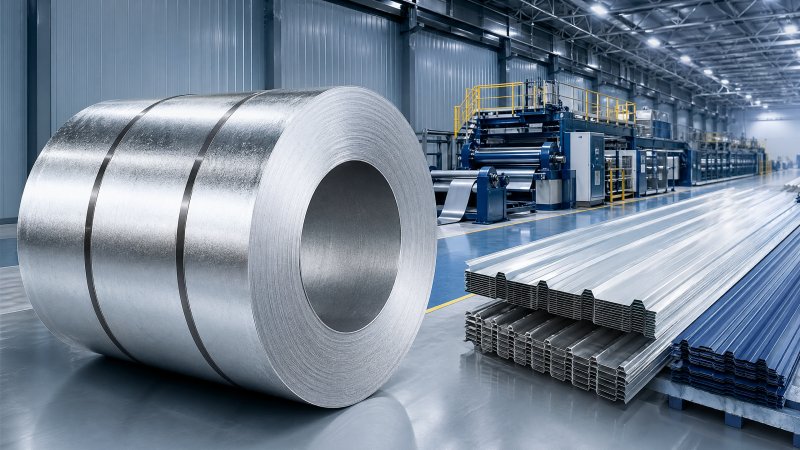
AZ150 refers to the mass of the aluminum-zinc alloy coating applied to both sides of the steel sheet, typically expressed as 150 g/m² total. In practical terms, this coating usually contains about 55% aluminum, 43.4% zinc, and 1.6% silicon, though exact production control can vary by mill and standard route. That composition is what gives Galvalume steel coil its recognized balance of heat reflectivity and corrosion resistance.
For engineers and buyers, AZ150 is important because it is tied to expected service performance, not just appearance. A coil with the correct metallic coating weight generally delivers better edge protection, slower red rust development, and longer useful life than lighter-coated alternatives such as AZ70 or AZ100 in the same exposure category. In roofing, wall cladding, ducting, and industrial enclosures, that difference can translate into years of extra service life.
However, AZ150 alone does not tell the full story. You still need to review the base steel grade, yield strength, thickness tolerance, spangle condition if relevant, passivation or anti-fingerprint treatment, and intended forming process. A well-coated sheet with poor substrate consistency can still cause cracking, oil canning, or fabrication loss. That is why technical evaluation should always combine coating data with mechanical and dimensional checks.
For distributors and project decision-makers, AZ150 also has a financial meaning. If a project life target is 12–20 years in a moderate outdoor environment, choosing a verified AZ150 product may reduce repainting, shutdown time, and replacement cost. In many B2B applications, the initial price gap between lower coating weights and AZ150 is smaller than the long-term maintenance gap over 3, 5, or 10 years.
Why coating weight matters more than a generic “Galvalume” label
Some buyers receive quotations that simply say “Galvalume steel coil” without specifying AZ class. That creates risk because the coating mass can differ significantly. Two coils may look similar when delivered, but their corrosion performance may be very different once exposed to rainwater, condensation, chemical fumes, or UV cycling.
- AZ70 is generally chosen for lighter indoor or lower-demand uses where budget is the main driver.
- AZ100 is a mid-level option used in many standard fabricated products.
- AZ150 is widely preferred when buyers need a stronger corrosion-resistance margin and longer replacement interval.
This is why serious procurement documents should list at least 4 key items: coating mass, steel grade, thickness, and surface treatment. Without those details, price comparison is incomplete and often misleading.
AZ150 vs DX53D Galvalume Steel Coil: What Buyers Should Compare
A common source of confusion is the difference between coating designation and substrate grade. AZ150 describes coating mass, while DX53D usually refers to a formable steel substrate grade under EN-related classification systems. In other words, these terms are not direct substitutes. One speaks to coating quantity, and the other speaks mainly to forming characteristics and base material performance.
That distinction matters in purchasing. A buyer selecting material for roll forming, bending, roofing panels, or light industrial profiles should ask both questions at the same time: what is the coating level, and what is the substrate grade? A coil sold as DX53D without a clearly defined AZ coating may not deliver the same corrosion performance target. A coil sold as AZ150 without confirming formability may not run efficiently through production equipment.
The table below helps separate these two dimensions so technical, commercial, and quality teams can align on specification review before ordering. This is especially useful when comparing offers from multiple mills or trading sources.
The key conclusion is simple: AZ150 and DX53D answer different technical questions. The best sourcing practice is to specify both. For example, a request may require a formable substrate comparable to DX53D and an AZ150 coating for stronger outdoor corrosion protection. That level of clarity reduces claim risk, fabrication waste, and post-delivery dispute.
Typical checks before approving a supplier
- Confirm coating designation on MTC or inspection document, not only on the quotation sheet.
- Verify thickness tolerance and width tolerance, especially for automated production lines.
- Request substrate grade confirmation and intended forming application.
- Check packaging and moisture control if sea shipment is longer than 20–35 days.
- Ask whether third-party inspection is available before loading.
These 5 checkpoints are basic but highly effective for reducing sourcing risk from overseas suppliers.
How to Judge Whether Cheap Steel from China Is Reliable
Low price alone does not mean poor quality, and high price alone does not guarantee performance. In the Chinese steel export market, reliability depends more on production control, specification transparency, inspection discipline, and supply-chain stability than on the quoted number itself. Buyers should focus on whether the supplier can deliver the exact steel grade, tolerance, coating, and documentation required for the job.
A reliable manufacturer will usually communicate measurable points: thickness range, coating weight, tolerance limits, supported standards, production lead time, and inspection options. For structural and industrial projects, this is critical because even small deviation such as thickness under-delivery by 0.03–0.05 mm or width variation beyond ±2 mm can affect fitting, welding, or downstream forming accuracy.
Hongteng Fengda serves global buyers across North America, Europe, the Middle East, and Southeast Asia with structural steel products, cold formed profiles, beams, channels, angles, and customized components. For many international customers, the value of sourcing from China comes from combining competitive manufacturing cost with strict quality control, standard compliance, and stable production capacity rather than simply choosing the cheapest possible offer.
The most practical way to evaluate reliability is to compare suppliers on a structured basis. That includes technical match, documentation quality, packaging, responsiveness, and repeatability across batches. A supplier who answers clearly in 24–48 hours, provides realistic lead times of 2–5 weeks, and supports pre-shipment checks is usually easier to work with than one offering a lower number but vague specifications.
Supplier evaluation factors for steel procurement
The following table is useful for purchasers, business evaluators, and finance approvers who need a balanced view of commercial and technical risk before releasing a purchase order.
For many buyers, reliability becomes visible in small details. If the supplier can explain coating control, packing against transit moisture, standard compatibility, and application advice, that is often a stronger sign than a low unit rate alone.
A useful mid-project comparison point
In many industrial and construction projects, buyers do not purchase coated coil only. They also need slip-resistant flooring, machine-area plates, or deck-related steel products. In that context, it is helpful to compare coating-driven materials with structural plate solutions such as SM400A Patterned steel plate, which is used in transportation, construction, decoration, floor around equipment, machinery, and shipbuilding.
This patterned plate is available in grades including SM400A and SM400B, with thickness from 2–8 mm, width from 600–1800 mm, and length from 2 m to 12 m or customized requirements. Typical tolerance control includes thickness at ±0.02 mm and width at ±2 mm, while patterned height is not less than 0.2 times the substrate thickness. For buyers choosing between coated sheet applications and heavy-duty floor plate applications, that specification difference is crucial.
It also shows an important sourcing principle: “reliable steel” does not mean one material fits every use. AZ150 Galvalume is excellent for corrosion-focused sheet applications, while patterned structural plate is often selected for anti-skid and equipment-floor performance. Good suppliers help customers match the right steel to the right function rather than forcing a single material into every scenario.
Where AZ150 Performs Best and Where Buyers Need Extra Caution
AZ150 Galvalume steel coil is widely chosen for roofing, wall systems, agricultural buildings, ventilation ducts, garage doors, light industrial cladding, and equipment housings. In these uses, the metallic coating improves corrosion resistance while also offering good heat reflectivity. In climates with regular sun exposure and moderate rain, this can support longer service intervals and lower repaint frequency than some lower-spec alternatives.
Still, buyers should be careful in highly aggressive environments. Coastal projects with salt spray, livestock buildings with ammonia exposure, and industrial plants with acidic or alkaline contaminants can shorten service life if the wrong surface treatment or design detail is used. Fastener compatibility, cut-edge exposure, drainage design, and contact with wet insulation all influence performance. Material selection should therefore consider the full use environment, not coating class alone.
For application engineers and operators, fabrication method also matters. Tight bending radii, repeated profiling, or improper storage before installation can damage the protective surface. Moisture trapped inside packed coils for even 7–10 days under poor storage conditions may create white rust or stain risk, especially after marine transport. That is why packaging, ventilation, and warehouse discipline are part of quality control, not just logistics details.
A realistic selection process should connect environment, service-life expectation, and budget. If the project is temporary, a lower coating level may be acceptable. If the project is expected to run 15 years or more with limited maintenance access, AZ150 is often a more defensible choice. This is especially true when downtime is expensive or when replacement work affects occupied facilities.
Typical application fit by environment
- Moderate outdoor use: roofing panels, wall sheets, warehouses, light commercial buildings.
- Indoor industrial use: ductwork, machine covers, fabricated housings, non-immersed equipment panels.
- Higher-caution use: coastal areas, chemical exposure zones, animal housing, poorly ventilated condensate-prone spaces.
Common mistakes that reduce service life
- Selecting by price only and ignoring the difference between AZ70, AZ100, and AZ150.
- Using a suitable coating with an unsuitable substrate for forming operations.
- Leaving coils exposed to rain or condensation before processing.
- Assuming all outdoor environments have the same corrosion severity.
- Failing to define inspection and acceptance criteria before shipment.
Avoiding these 5 mistakes often brings more value than negotiating one more small discount on the order price.
A Practical Buying Checklist for Procurement, QA, and Project Teams
When buying AZ150 Galvalume steel coil from China or any export market, teams should work from a shared checklist. Procurement may focus on cost, but quality control looks at conformity, project managers look at delivery timing, and finance looks at total risk. A unified review process helps avoid the common problem where one department approves a low-cost option that later creates fabrication delays or replacement cost.
The first step is to define the technical baseline. That usually includes substrate grade, coating designation, nominal thickness, width, coil weight range, surface condition, and target standard. The second step is document control, including quotation clarity, inspection records, MTC availability, and packaging description. The third step is execution planning, such as lead time, shipping route, loading protection, and claim-handling procedure.
For many buyers, the difference between a smooth purchase and a costly one lies in whether these steps are written down before order confirmation. Even a 1-container order can benefit from a formal pre-shipment checklist, while repeat monthly shipments should have batch-to-batch review points for coating, weight, and surface consistency.
Below is a concise checklist that can be used by sourcing managers, distributors, and engineering buyers when screening offers and preparing final approval.
Procurement checklist for AZ150 Galvalume steel coil
This checklist is simple, but it addresses the most frequent failure points in international steel sourcing. When buyer and supplier align on these 4 areas early, commercial negotiation becomes faster and post-delivery issues become easier to prevent.
FAQ for technical and commercial decision-makers
Is AZ150 always the best choice?
Not always. It is often a strong option when outdoor durability and maintenance reduction matter, but the right choice depends on environment, design life, and budget. For temporary or low-exposure indoor applications, a lighter coating may be enough.
How long is typical lead time from China?
For common steel products, production lead time often falls within 2–5 weeks depending on specification, quantity, and production schedule. Transit time varies by destination and shipping method, so planning should include both manufacturing and logistics windows.
What should QC teams inspect first after arrival?
Start with packaging condition, coil tag traceability, dimensional sampling, visible surface condition, and document matching. If the material is for continuous forming, a small trial run is also useful before full production release.
Can one supplier handle both coated coil and structural steel products?
Yes, many industrial buyers prefer that approach because it simplifies communication and project coordination. Suppliers with broader structural steel capability can also support beams, channels, angles, cold formed profiles, and custom steel components for one-stop sourcing.
What AZ150 Galvalume steel coil really tells you is whether the product is positioned for stronger corrosion resistance, longer service expectations, and better total cost control than lighter-coated alternatives. But the best buying decision still depends on full specification review: coating, substrate, tolerances, inspection, packaging, and application fit.
For buyers evaluating steel from China, the most reliable path is to work with a manufacturer that combines stable production capacity, clear documentation, international standard familiarity, and practical support for project-specific requirements. Hongteng Fengda supplies structural steel products and customized solutions for global construction, industrial, and manufacturing needs with a focus on consistency, quality control, and dependable delivery.
If you are comparing AZ150, DX53D Galvalume steel coil, or related structural steel products for your next project, contact us to discuss specifications, application conditions, and sourcing options. Get a tailored solution, request product details, and reduce procurement risk before your next order moves forward.
Please give us a message


Please enter what you want to find