When buyers compare steel pipe options, ASTM standard steel pipe grades reveal far more than simple labels. They indicate mechanical properties, chemical composition, testing requirements, and intended applications—key factors for selecting the right material for structural, industrial, and project-specific needs. Understanding these grades helps global buyers reduce sourcing risks, improve compliance, and make more confident purchasing decisions.
What buyers are really looking for when they search ASTM standard steel pipe
Most readers searching this topic do not want a textbook definition. They want to know what an ASTM grade actually tells them before they request quotations or approve a material list.
The short answer is this: an ASTM grade helps you judge suitability, performance, compliance, and risk. It tells you whether a pipe matches the pressure level, fabrication method, environment, and code expectations of a project.
For information-focused buyers, the most useful approach is not memorizing every specification number. It is learning how to read a grade as a practical purchasing signal.
Why ASTM grades matter more than many buyers first assume
An ASTM designation is not only a naming system. It is a technical framework that defines minimum requirements for chemistry, strength, dimensional control, manufacturing route, and testing procedures.
That matters because two steel pipes may look similar in size and surface finish but perform very differently once welded, bent, pressurized, or exposed to corrosion and temperature changes.
If a buyer ignores grade details and buys only on price, the result may be over-specification, underperformance, delayed approvals, or even rejection during inspection. In international sourcing, these risks quickly become expensive.
This is why ASTM standard steel pipe remains a core reference in North America and also a common benchmark for global trade. It gives engineers and procurement teams a shared technical language.
What an ASTM steel pipe grade really tells you
At a practical level, a grade usually communicates four things: what the material is made of, how strong it is, how it was produced, and where it is intended to be used.
First, it points to chemical composition. Carbon, manganese, and alloying elements affect weldability, toughness, hardness, and corrosion behavior. Buyers do not always need full metallurgical detail, but they should know composition affects fabrication and service life.
Second, it indicates mechanical properties. Yield strength, tensile strength, and elongation help determine whether the pipe can withstand structural loads, internal pressure, or forming operations without failing prematurely.
Third, it reflects manufacturing method. Some ASTM pipe specifications cover seamless pipe, others welded pipe, and some allow both. That difference influences consistency, cost, availability, and suitability for certain services.
Fourth, it signals intended application. Some grades are made for structural use, some for pressure service, some for high-temperature operation, and others for general mechanical or low-pressure applications.
Common ASTM pipe standards and how to read them in context
One of the biggest sources of confusion is assuming all ASTM pipe grades are interchangeable. They are not. The standard number usually matters as much as the grade itself.
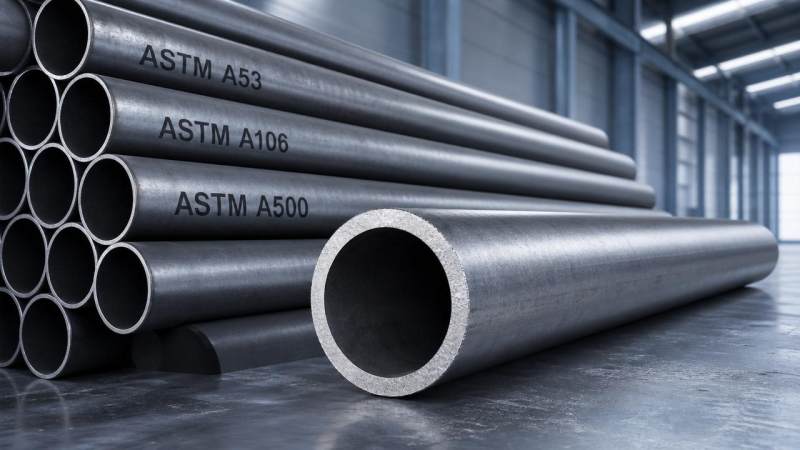
For example, ASTM A53 is widely used for mechanical and pressure applications as well as general-purpose structural use. Buyers often see it in construction, industrial piping, and utility projects.
ASTM A106, by contrast, is better known for seamless carbon steel pipe for high-temperature service. If your application involves elevated temperatures, A106 may be more appropriate than a lower-demand option.
ASTM A500 is commonly specified for structural tubing, especially in hollow structural sections. It is highly relevant when strength, dimensional consistency, and structural performance are the main concerns.
ASTM A252 is often used for piling. ASTM A333 is associated with low-temperature service. ASTM A335 covers alloy steel pipe for high-temperature service. Each standard answers a different engineering need.
So when evaluating ASTM standard steel pipe, do not ask only, “What is the grade?” Also ask, “What service was this standard designed for?” That is where many buying mistakes begin or end.
How grades help you judge strength, weldability, and fabrication risk
For many buyers, the most immediate concern is whether a pipe can be fabricated smoothly and still meet project performance requirements. ASTM grades offer important clues here.
Higher strength is not automatically better. A stronger grade may support lighter design or higher loads, but it can also introduce stricter forming conditions, different welding procedures, or higher cost.
If your project involves extensive cutting, welding, threading, or on-site modification, weldability and workability may matter more than pursuing the highest mechanical values on paper.
This principle also applies beyond pipe procurement. In structural steel systems, buyers often balance strength, formability, coating options, and fabrication convenience across multiple components.
For example, projects that combine pipe with cold-formed structural members may also use Z-beam sections for purlins, wall beams, lightweight roofs, brackets, or mechanical framing.
These profiles are available in materials such as Q235B, Q345B, S235, S275, S355, A36, and A572, with galvanized or perforated options, thicknesses from 6 to 25 mm, and customized lengths from 2 to 12 meters.
The broader lesson is simple: selecting steel by grade should always consider the full fabrication system, not only an isolated material property shown on a mill test report.
What ASTM grades tell you about compliance and inspection
Another major buyer concern is whether the material will pass engineering review, third-party inspection, or end-customer approval. ASTM grades are central to that process.
A proper ASTM specification defines more than minimum strength. It may also include hydrostatic testing, flattening tests, nondestructive examination, dimensional tolerances, marking requirements, and documentation rules.
This means the grade affects not just what the pipe is, but how its quality must be verified. For procurement teams, that is critical because compliance failures often come from missing testing or incomplete traceability, not only bad material.
Before ordering, buyers should confirm whether the project requires mill test certificates, third-party inspection, supplementary tests, coating standards, or source-country certifications. The ASTM reference alone may not cover every approval point.
In export business, reliable manufacturers reduce risk by aligning production, testing, and documentation with the buyer’s regional standards. That is especially important when ASTM requirements must also coordinate with EN, JIS, or GB expectations.
Questions smart buyers should ask suppliers before choosing a grade
If you want to make ASTM standard steel pipe selection easier, ask structured questions early. This prevents confusion between technical compliance and commercial convenience.
Start with application. Is the pipe for structure, pressure, fluid transport, fire protection, mechanical fabrication, piling, or high-temperature service? A supplier cannot recommend the right standard without this context.
Next, ask about manufacturing route. Is the pipe seamless, ERW, LSAW, or SSAW? The acceptable answer depends on project requirements, size range, budget, and inspection criteria.
Then verify mechanical and chemical requirements. Do you need a minimum yield strength, specific impact performance, or restrictions on certain alloying elements for welding or forming?
After that, discuss dimensions and tolerances. Outside diameter, wall thickness, length, straightness, and end finish can affect installation efficiency as much as the grade itself.
Finally, confirm documentation. Request sample MTCs, testing scope, marking method, coating details if applicable, and packaging approach for export shipment. These details often separate dependable suppliers from risky ones.
Common misunderstandings that lead to wrong pipe selection
One common mistake is treating ASTM and grade as identical terms. In reality, the ASTM standard defines the specification, while the grade identifies a level or classification within that specification.
Another mistake is assuming a familiar grade can replace another without engineering review. Even if dimensions match, service conditions, testing requirements, and approval standards may differ significantly.
Some buyers also focus too heavily on tensile strength while ignoring toughness, weldability, or heat-service suitability. That can create hidden downstream costs during fabrication or operation.
A further problem is buying based on the supplier’s “equivalent material” claim without checking code acceptance. Commercial equivalence does not always mean project compliance, especially in regulated sectors.
Lastly, many teams underestimate lead time and supply stability. A technically correct grade is still a sourcing risk if the producer cannot maintain consistency across batches or provide dependable export documentation.
How to make a better purchasing decision with ASTM grade information
The best buying decisions combine technical fit, compliance confidence, and supply reliability. ASTM grades give you a foundation, but they work best when connected to actual project demands.
Begin by defining service conditions clearly. Pressure, temperature, corrosion exposure, structural load, and fabrication method should guide the first screening of possible standards.
Then compare candidate grades based on required strength, manufacturing type, testing scope, and code acceptance. This narrows the field before price discussions distort the decision.
After that, evaluate supplier capability. Strong producers should be able to explain standard differences clearly, offer stable quality control, and support international buyers with accurate documentation and realistic delivery commitments.
For global procurement teams, this approach reduces sourcing risk far better than searching for the cheapest nominally similar pipe. In steel purchasing, clarity upfront usually costs less than correction later.
Conclusion: ASTM grades are a buying tool, not just a label
What ASTM standard steel pipe grades really tell you is not limited to chemistry or strength. They reveal intended service, production expectations, testing discipline, and likely compliance performance.
For information-seeking buyers, that makes ASTM grades a practical decision tool. They help you compare options intelligently, ask suppliers better questions, and avoid costly mismatches between specification and application.
In short, the smartest way to read an ASTM pipe grade is to see it as a risk filter. The more accurately you interpret it, the more confident your sourcing and project decisions become.
Please give us a message


Please enter what you want to find