As high-pressure industrial piping demands escalate in 2026, selecting the correct ASTM standard steel pipe is critical for safety, compliance, and system longevity. Whether you’re a procurement professional sourcing from a trusted stainless steel tube manufacturer, a project manager specifying Z-beam for warehouse support, or a technical evaluator verifying H-beam manufacturer China credentials, understanding ASTM A106, A333, A312, and A790 is essential. Hongteng Fengda — a certified structural steel manufacturer & exporter — supplies ASTM-compliant steel pipe, angle stainless steel Europe-grade profiles, galvanized cold drawn steel wire rod, and stainless steel welded mesh, backed by EN/GB/JIS cross-standard validation. Partner with us for traceable quality, on-time delivery, and end-to-end engineering support.
Which ASTM Standards Govern High-Pressure Steel Pipe in 2026?
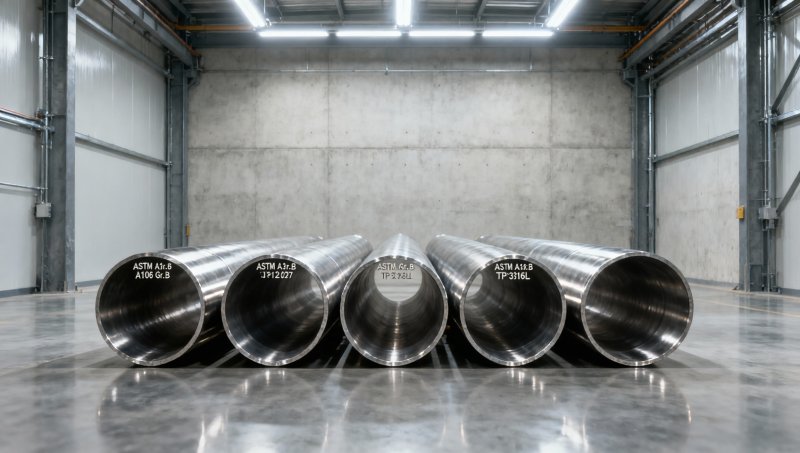
ASTM standards remain the global benchmark for pressure-rated carbon and stainless steel pipe in industrial applications. In 2026, four key specifications dominate high-pressure service: ASTM A106 (seamless carbon), A333 (low-temperature carbon), A312 (stainless seamless/welded), and A790 (duplex stainless). Each addresses distinct operational envelopes—temperature range, corrosion resistance, yield strength, and hydrostatic test requirements.
A106 Grade B remains the most widely specified for steam, oil, and gas transmission at pressures up to 2,500 psi and temperatures between −29°C and 427°C. A333 Grade 6 is mandatory for cryogenic service down to −46°C, especially in LNG facilities across the Middle East and Southeast Asia. For aggressive chemical environments, A312 TP316L offers superior pitting resistance, while A790 S32205 delivers 2–3× the yield strength of standard austenitic grades—critical for offshore platform risers and high-integrity refinery manifolds.
All four standards require full heat treatment documentation, mill test reports (MTRs) per ASTM A600, and third-party verification (e.g., SGS or BV) for export to North America and EU markets. Noncompliance triggers automatic rejection during customs clearance or site inspection—adding 7–15 days delay and potential rework costs.
How Do Application Conditions Dictate ASTM Selection?
Choosing the right ASTM grade isn’t about preference—it’s about matching material behavior to real-world stress cycles. Key decision drivers include operating temperature, pressure fluctuation frequency, fluid chemistry, and ambient exposure. For example, cyclic thermal loading above 370°C accelerates creep in A106 but remains stable in A312 TP347H due to niobium stabilization.
Corrosion risk further narrows options. In sour gas service (H₂S > 10 ppm), A106 fails rapid sulfide stress cracking (SSC) tests per NACE MR0175/ISO 15156 unless post-weld heat treated—a costly add-on. Meanwhile, A790 duplex grades pass SSC testing at hardness ≤ 32 HRC without PWHT, reducing fabrication lead time by 2–4 weeks.
Below is a comparative summary of mechanical and environmental suitability:
This table highlights why blanket substitution is unsafe—and why technical evaluators must verify actual field conditions before approving any ASTM pipe order. Hongteng Fengda provides pre-shipment MTR review and application-specific weld procedure qualification (WPQ) support to prevent specification mismatches.
What Structural Components Complement High-Pressure Piping Systems?
Piping integrity extends beyond the pipe itself. Support structures—including purlins, bracing, and load-bearing columns—must match the same reliability standards. That’s where Z-beam plays a vital role: engineered for lightweight roof systems, wall beams, and mechanical brackets in industrial facilities housing high-pressure lines.
Our Z-beam profiles comply with GB50018-2002 cold-formed steel design code and are available in Q235B through Q460C grades—covering yield strengths from 235 MPa to 460 MPa. With thicknesses from 6–25 mm and customizable lengths (2–12 m), they integrate seamlessly with ASTM-compliant piping supports and anchor systems. Perforated and galvanized options ensure compatibility with corrosive plant atmospheres.
We also supply complementary building components: color-coated steel tiles, rock wool sandwich panels, and floor decks—all tested for fire resistance (EN 13501-2) and wind uplift (ASTM E1592). This integrated approach reduces coordination risk across MEP, civil, and piping contractors—cutting overall project timeline by 10–15%.
Why Global Buyers Choose Hongteng Fengda for ASTM-Compliant Steel
Sourcing ASTM-certified steel from China involves balancing cost, compliance, and continuity. Hongteng Fengda mitigates these risks through three pillars: standardized production control, multi-standard validation, and responsive engineering collaboration.
Our ISO 9001-certified facility conducts 100% dimensional inspection on all pipe and structural products, with automated ultrasonic testing (UT) for seamless pipe and radiographic testing (RT) for welded joints. Every shipment includes EN/GB/JIS cross-referenced MTRs, CE marking (where applicable), and BV/SGS certificates—ready for submission to U.S. ASME Code Case reviews or EU Notified Body audits.
For procurement teams, we offer fixed-lead-time contracts (standard delivery: 25–35 days after PO confirmation), sample support within 7 working days, and OEM labeling services. Financial approvers benefit from transparent FOB/CIF pricing models with no hidden port surcharges or certification fees.
Ready to validate your next ASTM pipe specification or discuss Z-beam integration for piping support? Contact our technical sales team for free MTR review, custom cut-length quoting, or EN/ASTM dual-certification feasibility analysis.
Please give us a message


Please enter what you want to find