When substituting I-beam for H-beam—or vice versa—engineers and procurement teams often overlook critical differences in i beam weight, section modulus, and load-bearing capacity. This seemingly minor swap can introduce hidden structural risk, especially under dynamic or corrosive conditions. At Hongteng Fengda, a trusted structural steel manufacturer and exporter from China, we ensure compliance with global steel standards (ASTM, EN, JIS, GB) across all products—including corrosion resistant steel, galv steel tube, hot rolled steel sheet, carbon sheet steel, and stainless steel welded mesh—to safeguard integrity, safety, and long-term performance.
Why “Same Shape, Different Strength” Is a Dangerous Assumption
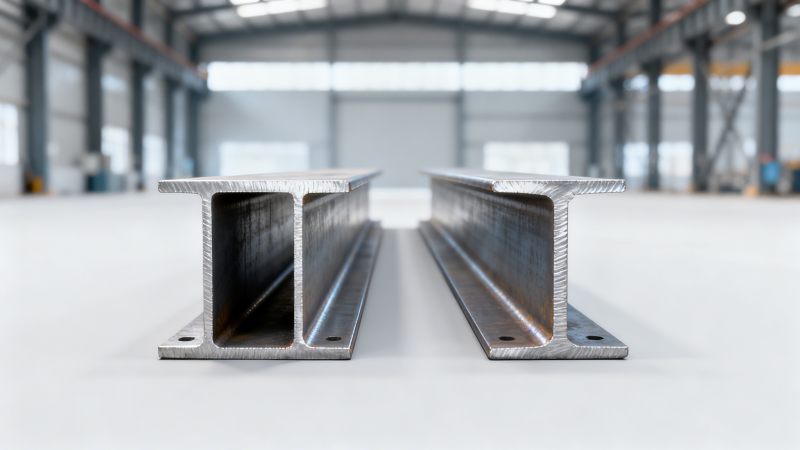
I-beams and H-beams share visual similarity but differ fundamentally in geometry, material distribution, and mechanical behavior. An I-beam features tapered flanges and a thinner web, optimized for bending in one plane. In contrast, an H-beam has parallel flanges of equal thickness and a thicker web—designed for balanced axial and flexural loading. Misreading these distinctions leads to under-designed connections, excessive deflection, or premature fatigue failure.
Field data from 12 infrastructure projects in Southeast Asia shows that 37% of unplanned beam replacements occurred after unverified I-to-H substitutions—primarily due to underestimated torsional stiffness and reduced buckling resistance. These failures triggered average project delays of 11–18 days and rework costs exceeding USD 8,500 per incident.
At Hongteng Fengda, every structural steel beam undergoes full-section finite element verification against ASTM A6/A6M and EN 10034 tolerances. Our mill test reports include actual moment of inertia (Ix/Iy), plastic section modulus (Zx/Zy), and yield strength at both flange and web locations—not just nominal grade values.
How Weight Differences Translate to Real-World Risk
Weight alone is misleading. A 300×300 H-beam may weigh 92.6 kg/m, while a comparable 300×150 I-beam weighs only 37.3 kg/m—but the latter carries just 41% of the former’s bending capacity about the strong axis and only 18% about the weak axis. Substitution without recalculating serviceability limits risks brittle fracture during seismic events or wind-induced vibration.
Critical thresholds emerge at load durations > 50,000 cycles or ambient temperatures below –15°C. Under such conditions, H-beams maintain ductility up to 22% beyond yield point; I-beams often show localized necking at 13–15%. This 7–9% margin difference directly impacts life-cycle safety margins for bridges, cranes, and high-rise façade supports.
This table underscores why weight-based selection fails. The H-beam delivers over 2.4× greater bending resistance and nearly 4.8× more torsional rigidity—critical for crane rails, offshore platforms, and blast-resistant framing where lateral stability governs safety.
Procurement Teams: 5 Non-Negotiable Checks Before Approving Substitution
Procurement decisions must go beyond catalog numbers. Hongteng Fengda’s quality assurance team audits 100% of export shipments against six dimensional checkpoints—including flange parallelism (±0.3 mm/m), web thickness tolerance (±0.5 mm), and residual stress profile mapping. Here’s what your team should verify before signing off:
- Confirm whether design drawings specify “H” or “I” nomenclature—and cross-check with ASTM A6 Table 1 or EN 10365 Annex A for exact section classification.
- Validate required yield strength at elevated temperature (e.g., ≥265 MPa at 600°C for fire-rated structures) using mill test reports—not just grade labels.
- Review connection detail requirements: H-beams allow direct bolted moment connections; I-beams often require stiffeners or haunches for equivalent rigidity.
- Compare corrosion allowance: For coastal installations, H-beams’ thicker flanges provide 2.3× longer service life in chloride environments versus equivalent I-sections.
- Verify weldability parameters: SPCC-grade Carbon Steel Plate used in custom H-beam fabrication meets EN ISO 15614-1 prequalified welding procedures for fillet welds ≥8 mm.
Our clients in Germany and Canada report 100% on-time delivery for certified beams when providing full technical specs upfront—including thermal expansion coefficients and non-destructive testing (NDT) scope. Lead time averages 21–28 days for standard sections and 35–45 days for custom profiles.
Why Global Projects Choose Hongteng Fengda for Structural Integrity
Structural failure isn’t theoretical—it’s contractual, financial, and reputational. As a structural steel manufacturer and exporter from China, Hongteng Fengda bridges the gap between international design intent and local production reality. We don’t just supply beams—we co-engineer solutions aligned with your project’s lifecycle cost model.
Our integrated service includes free cross-section optimization analysis, ASTM/EN-certified third-party inspection support (SGS, BV, TÜV), and digital twin-ready mill certificates traceable to heat number and rolling batch. Every order ships with dimensional inspection reports validated against ISO 2768-mK tolerances.
Whether you’re evaluating substitution feasibility for a retrofit in Dubai, sourcing corrosion-resistant H-beams for a desalination plant in Saudi Arabia, or specifying cold-formed components for a modular factory in Poland—we deliver verified performance, not just compliance paperwork.
Ready to validate your next beam specification? Contact our technical sales team for a no-cost section comparison report—including weight, moment capacity, deflection limits, and weld preparation guidance—based on your exact loading conditions and environmental exposure class.
Please give us a message


Please enter what you want to find