Metallurgical Dynamics of Coating Thickness
The assumption that a thicker zinc coating universally equates to superior corrosion protection is a frequent misjudgment in structural steel assessment. The hot-dip galvanized process relies on a metallurgical reaction between molten zinc and the iron substrate. This reaction is heavily dictated by the steel's chemical composition, specifically the silicon and phosphorus content. When evaluating coating thickness, understanding the Sandelin effect is mandatory for accurate technical judgment.
Steels with a silicon content between 0.05% and 0.25%, or above 0.4%, are classified as reactive. In these grades, the silicon accelerates the formation of the zinc-iron alloy layers. Instead of forming a controlled, dense barrier, the reaction proceeds rapidly, often consuming the pure zinc outer layer and producing an excessively thick, brittle alloy coating. While the total coating thickness might exceed standard minimums, the structural integrity of the coating is compromised. Under mechanical stress or impact, these thick, brittle layers are prone to micro-cracking and spalling, exposing the bare steel to the environment.
International standards such as ASTM A123 and ISO 1461 specify minimum coating thicknesses based on the thickness of the steel article. However, these standards measure the total coating thickness without distinguishing between the ductile pure zinc layer and the brittle alloy layers. A technical assessment must therefore look beyond the compliance certificate. If the steel chemistry is highly reactive, a thick coating reading on a magnetic gauge might indicate a brittle structure rather than a robust, long-lasting barrier. Specifying steels with silicon levels in the optimal range ensures the formation of a thinner, more ductile coating with a substantial pure zinc outer layer, optimizing both corrosion resistance and mechanical durability.
Measurement Nuances and Localized Variations
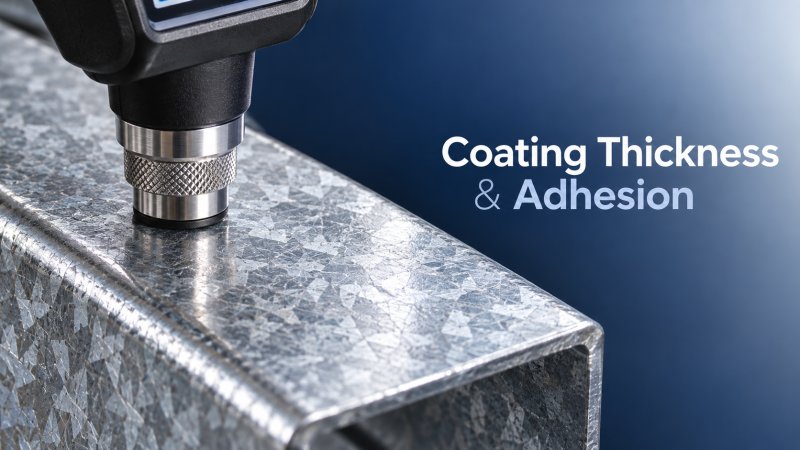
Evaluating coating thickness requires an understanding of the measurement methodologies and their inherent limitations. Magnetic induction gauges are the industry standard for non-destructive testing. These devices measure the distance between the probe and the steel substrate. However, the presence of the zinc-iron alloy layers, which have a different magnetic permeability than pure zinc, can introduce slight variations in the readings. Accurate measurement requires calibrating the gauge on an uncoated sample of the exact same steel grade, thickness, and surface profile.
More critically, magnetic gauges provide a localized reading. Standards typically require the average of multiple readings taken over a defined test area. In complex structural profiles, such as angles, channels, or beams, zinc drainage and pooling create significant thickness variations. The bottom edges and internal corners often accumulate thick pools of zinc, while the top surfaces and sharp edges experience drainage, resulting in thinner coatings. A localized thin spot, even if the average thickness complies with the standard, can become the initiation point for premature corrosion.
Furthermore, surface profile and roughness influence the readings. A heavily blasted or rough surface increases the actual surface area, leading to a thicker coating. However, the peaks of the surface profile can cause the magnetic gauge to read lower than the actual minimum thickness in the valleys. When strict adherence to minimum local thickness is required for highly aggressive environments, cross-sectional microscopy remains the only definitive method, though it is destructive and impractical for routine batch inspection.
Adhesion Mechanisms and Failure Boundaries
The defining advantage of the hot-dip galvanized process is the metallurgical bond between the coating and the substrate. Unlike paint or powder coatings that adhere mechanically, the galvanized coating becomes part of the steel surface. This bond is formed through the diffusion of iron and zinc, creating a series of intermetallic layers. The Gamma layer (Fe3Zn22) forms closest to the steel and is the hardest and most brittle. It is followed by the Delta layer (FeZn10), which is harder than the base steel, and the Zeta layer (FeZn7), which is softer and more ductile. Finally, the outer Eta layer consists of pure zinc.
The adhesion of these alloy layers is exceptionally strong, often exceeding the adhesion of the steel itself. However, the pure zinc Eta layer on the surface is relatively soft and can be mechanically removed. Evaluating adhesion involves assessing the integrity of the entire layered structure, not just the surface. Standard adhesion tests, such as the bend test or the quench test, are designed to check for flaking or peeling. If the coating passes these tests without separating from the substrate, the metallurgical bond is considered intact.
Adhesion failures in hot-dip galvanizing are rare but typically stem from process deviations rather than the galvanizing reaction itself. Inadequate surface preparation, such as residual mill scale, rust, or trapped flux salts, prevents the molten zinc from wetting the steel surface, leading to bare spots or blistering. Additionally, if the zinc bath temperature is too low, the alloy layers do not form properly, resulting in a weak bond. It is also worth noting that while structural components rely on this metallurgical bond for durability under load, building envelopes might utilize pre-painted aluminum-zinc products like a Colored Corrugated Roof Sheet, where the coating adhesion relies on different polymer and metallic bonding mechanisms optimized for weathering and aesthetic retention rather than structural load-bearing.
Operational Variables and Process Control
The final coating thickness and adhesion are heavily influenced by the operational parameters of the galvanizing line. Bath temperature is a primary control variable. The standard operating temperature for molten zinc is between 445°C and 460°C. At these temperatures, the iron-zinc reaction proceeds at a predictable rate. If the temperature drops, the zinc viscosity increases, leading to a thicker, uneven pure zinc layer and poor drainage. If the temperature exceeds 465°C, the reaction rate accelerates uncontrollably, the alloy layers become excessively thick, and the formation of zinc dross increases, which can adhere to the coating and compromise its surface integrity.
Immersion time also plays a critical role. The longer the steel remains in the bath, the thicker the alloy layers grow. For reactive steels, even a minor increase in immersion time can result in a disproportionately thick and brittle coating. Therefore, controlling the line speed and immersion time is essential to manage the alloy layer growth. In cases where reactive steel must be galvanized, adding small amounts of nickel to the zinc bath can suppress the Sandelin effect, slowing down the alloy layer growth and producing a more uniform, ductile coating.
The withdrawal speed from the zinc bath dictates the thickness of the outer pure zinc layer. A faster withdrawal speed leaves a thicker layer of pure zinc, which enhances corrosion resistance but can lead to excessive dripping and the formation of zinc spikes at the edges. A slower withdrawal allows more zinc to drain off, resulting in a thinner pure zinc layer but a smoother finish. Balancing these parameters requires a precise understanding of the specific steel grade and the desired coating characteristics.
Evaluating for Specific Application Conditions
The optimal balance of coating thickness and adhesion varies significantly depending on the service environment. In atmospheric conditions where the primary threat is uniform corrosion, a thicker pure zinc layer is highly beneficial. The zinc sacrificially protects the steel, and a greater volume of zinc extends the time before the alloy layers are exposed and consumed.
However, in environments involving high mechanical abrasion, frequent handling, or severe thermal cycling, a thick, brittle coating is a liability. In these scenarios, a thinner, more ductile coating with strong adhesion is preferable. The coating must be able to deform with the steel substrate without cracking. When assessing structural steel for such applications, specifying a steel grade with low silicon content and requesting a fine spangle finish can help ensure a more ductile coating structure.
Edge protection is another critical consideration. The sharp edges of cut steel or fabricated components naturally have a thinner coating due to the surface tension effects during withdrawal. In highly corrosive environments, these edges are the most vulnerable points. Assessing the design to include edge rounding during fabrication or specifying post-galvanizing touch-up with zinc-rich paint is necessary to restore the protective barrier at these critical junctions.
Ultimately, assessing the hot-dip galvanized process requires moving beyond simple thickness measurements. It demands a comprehensive understanding of the metallurgical interactions, the limitations of inspection methods, and the specific mechanical and environmental stresses the component will face. By aligning the steel chemistry, galvanizing parameters, and application requirements, the structural integrity and long-term durability of the galvanized components are secured.
Please give us a message


Please enter what you want to find