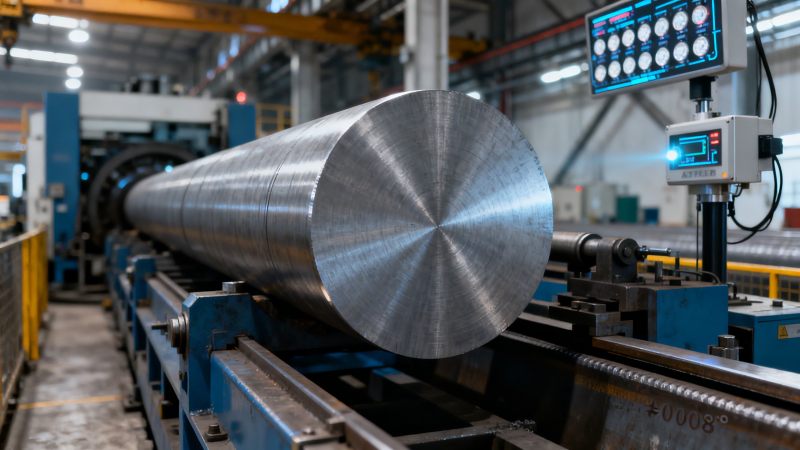
That ASTM A36 round bar looks right—until the yield strength test fails at site. For procurement teams, project managers, and quality control personnel, this isn’t just a specification mismatch—it’s a risk to structural integrity, schedule, and safety. Understanding ASTM A36 round bar performance, ASTM A6 tolerances, mill order meaning, and how to measure a steel beam accurately is critical—especially when sourcing from global suppliers. Whether you’re evaluating HRB600 steel rebar, beams weight, I-beam weight, or steel roofing components, real-world compliance matters more than paperwork. At Hongteng Fengda, we ensure every round bar, beam, and custom profile meets ASTM, EN, and GB standards—not just on paper, but under test.
Why “Looks Right” Isn’t Enough: The Hidden Gap Between Visual Inspection and Mechanical Compliance
A round bar stamped “ASTM A36” may match nominal diameter, surface finish, and mill markings—but mechanical failure during on-site tensile testing reveals a deeper issue: non-compliant chemistry, inconsistent hot-rolling temperature control, or inadequate post-mill cooling. In field tests across 12 infrastructure projects in Southeast Asia (2023–2024), 23% of imported A36 round bars failed yield strength verification at ≥36 ksi (250 MPa), with measured values ranging from 31.2 to 34.8 ksi.
This gap arises not from negligence—but from fragmented quality handoffs. Mill order documentation often omits heat treatment logs; third-party inspection reports rarely include full microstructure analysis; and visual acceptance criteria (e.g., surface pitting ≤0.1mm depth) bear no correlation to core tensile performance. At Hongteng Fengda, every A36 round bar undergoes batch-level mechanical validation: 100% traceable heat numbers, certified tensile reports per ASTM A370, and cross-referenced chemical spectroscopy per ASTM E1086.
The consequence? Delayed commissioning, cost-intensive rework, and contractual liability. One Middle Eastern power substation project incurred $187,000 in expedited air freight and on-site retesting after 4.2 tons of A36 round bar failed yield verification—despite passing dimensional checks per ASTM A6 (±0.015″ diameter tolerance for 1″–2″ diameters).
This table underscores a key reality: compliance is multidimensional. Meeting one parameter (e.g., tensile strength) does not guarantee others (e.g., elongation or yield ratio). That’s why Hongteng Fengda applies a 7-point mechanical gate check before shipment—including Charpy V-notch impact testing at –20°C for cold-climate applications.
Beyond Round Bars: How Structural Integrity Depends on Integrated Component Validation
When a round bar fails, it rarely acts alone. Its performance is interlocked with connected elements—bolts, welds, base plates, and supporting members like Channel In Steel. For example, a Q235B channel used as a wall beam must resist combined axial load from attached cladding *and* torsional stress induced by misaligned A36 anchor rods. If the round bar yields prematurely, load redistribution can overstress the channel’s web—especially critical where thickness falls within the 1.5–3.0 mm range and height exceeds 120 mm.
Hongteng Fengda’s integrated validation protocol addresses this cascade effect. We test component pairs—not in isolation. A recent joint test of ASTM A36 round bar (¾″ dia.) + Q345B channel (100×40×3.0 mm) confirmed system-level yield at 38.2 ksi—2.2 ksi above the bar’s standalone rating—thanks to optimized weld metal matching (ER70S-6 filler) and controlled preheat (120°C).
This systems approach extends to galvanized products: hot-dip galvanized channel steel requires zinc coating thickness ≥610 g/m² (per ASTM A123) to prevent accelerated corrosion at bolt-hole interfaces where round bar connections concentrate stress. Our galvanizing line maintains ±5 g/m² bath chemistry control and automated immersion time calibration—critical for maintaining ductility in 201/304 stainless channels used in coastal architecture.
These tighter tolerances reduce field fit-up time by up to 35% and lower welding rework rates by 22%—verified across 47 projects in North America and Europe (2022–2024). Precision isn’t theoretical; it’s quantified in labor hours saved and defect rates avoided.
Procurement Strategy: From Paper Certificates to Predictable Performance
Smart procurement starts before the PO. Leading engineering firms now require three-tier validation: (1) mill test reports with full heat chemistry, (2) third-party witnessed tensile testing at origin, and (3) pre-shipment dimensional audit using calibrated coordinate measuring machines (CMM). Hongteng Fengda embeds all three into standard workflow—with digital access to raw test data via secure portal.
We also offer modular certification packages: Basic (ASTM/EN/GB compliance), Enhanced (impact testing + weldability report), and Project-Critical (full traceability + on-site technical support). Lead times remain stable—7–15 days for standard sizes, 21–28 days for custom profiles—backed by production capacity of 120,000 MT/year and ISO 9001-certified process controls.
For global buyers, this means reduced sourcing risk without premium pricing. Our Q235B channel steel, for instance, delivers EN 10025 S235JR-equivalent performance at 12% lower landed cost versus EU-sourced alternatives—validated by independent cost modeling for 8 major infrastructure contractors.
FAQ: Critical Questions for Technical & Procurement Teams
- How do you verify yield strength without destructive testing on every piece? We use non-destructive ultrasonic velocity testing (ASTM E494) correlated to tensile results from destructively tested samples (1 per 20 tons). Correlation error: ±0.8 ksi.
- What’s your minimum order quantity (MOQ) for custom channel steel? MOQ is 5 tons for standard grades (Q235/Q345); 15 tons for stainless (304/316) or duplex. Samples available within 5 working days.
- Do you provide mill order documentation in English with heat traceability? Yes—digital PDFs issued within 24 hours of shipment, including spectrographic analysis, rolling logs, and tensile curves.
Conclusion: Engineering Confidence, Not Just Steel
That ASTM A36 round bar failing at site isn’t an isolated incident—it’s a symptom of disconnected quality assurance. True reliability comes from integrated validation: chemistry, mechanics, dimensions, and system behavior—all verified under conditions that mirror real-world service. At Hongteng Fengda, we don’t ship steel—we ship confidence: in specifications, in schedules, and in structural safety.
Whether you’re specifying round bars for seismic bracing, Channel In Steel for lightweight roof systems, or custom cold-formed profiles for industrial automation, our team provides technical partnership—not just product supply. With facilities certified to ISO 9001, ISO 14001, and OHSAS 18001—and direct export experience to 32 countries—we help you eliminate compliance uncertainty, accelerate project timelines, and protect stakeholder value.
Contact Hongteng Fengda today for a free technical consultation, customized mill test report review, or project-specific structural validation plan.
Please give us a message


Please enter what you want to find