When comparing sus pipe vs stainless pipe, buyers and engineers need to look beyond naming and focus on material grade, corrosion resistance, application standards, and cost. Whether you source stainless steel square pipe, welded stainless tubing, seamless steel tube, or API 5L pipe for fluid pipe and industrial projects, understanding the real differences helps you choose the right solution with confidence.
The short answer is this: SUS pipe is not a different metal from stainless pipe in the broad sense. “SUS” usually refers to stainless steel grades defined under Japanese Industrial Standards, while “stainless pipe” is a general market term that may refer to products made under JIS, ASTM, EN, or other standards. For most buyers, the real decision is not SUS vs stainless as a material category, but which grade, standard, manufacturing method, and finish match the service environment and project budget.
What Does SUS Pipe Actually Mean in Real Purchasing Terms?
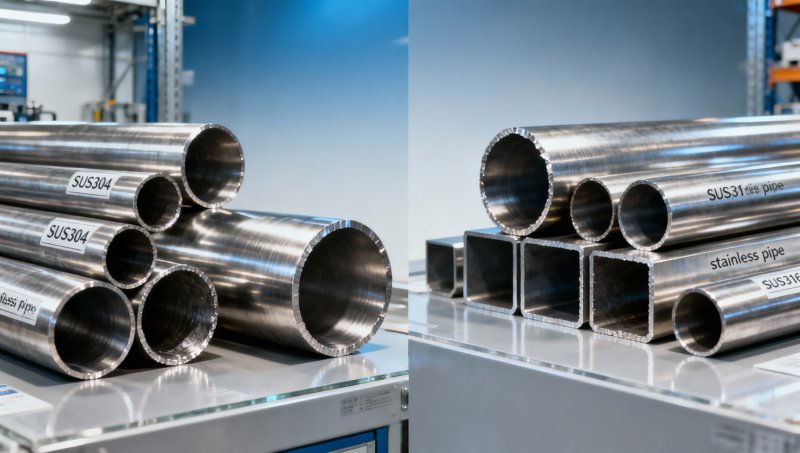
In real-world sourcing, “SUS” is commonly used to identify stainless steel grades under JIS standards, such as SUS304 or SUS316. By contrast, “stainless pipe” is a broader commercial term that can include many equivalent or similar grades from different standards systems.
This matters because many searchers assume there is a technical conflict between sus pipe vs stainless pipe. In practice, SUS pipe is usually one subset of stainless steel pipe naming. A supplier may describe the same product differently depending on export market, drawings, certifications, and buyer habits.
For example:
- SUS304 is commonly compared with ASTM 304 stainless steel pipe
- SUS316 is commonly compared with ASTM 316 stainless steel pipe
- Different standards may have slightly different composition tolerances, testing methods, and marking requirements
So if you are evaluating quotations, the first question should be: What exact grade and standard is being offered? Not simply whether the label says SUS or stainless.
How Should Buyers Compare SUS Pipe vs Stainless Pipe Correctly?
To make a sound decision, technical evaluators and procurement teams should compare the following factors in order of importance.
1. Grade equivalence
Check whether the offered SUS grade truly matches the corrosion resistance, strength, and weldability required by your project. A grade name that looks familiar may still differ in chemical composition range or intended service condition.
2. Applicable standard
A pipe produced to JIS may be suitable for some projects, while others require ASTM, EN, or project-specific compliance. For international construction, industrial, and manufacturing work, certification alignment often matters as much as the metal itself.
3. Pipe type
Confirm whether you need:
- welded stainless tubing for cost-sensitive structural or light industrial use
- seamless steel tube for higher pressure, temperature, or critical service
- stainless steel square pipe for frames, supports, and fabricated assemblies
- fluid pipe or process pipe for transport media and sanitary systems
4. Surface finish and fabrication requirements
For visible architectural use, food-related systems, or clean environments, finish quality may be a major decision factor. For hidden industrial supports, dimensional consistency and weld performance may matter more than appearance.
5. Total cost, not just unit price
A lower pipe price may lead to higher fabrication cost, premature corrosion, inspection failure, or replacement risk. Smart buyers compare lifecycle value, not only the initial quotation.
What Are the Practical Differences in Performance and Application?
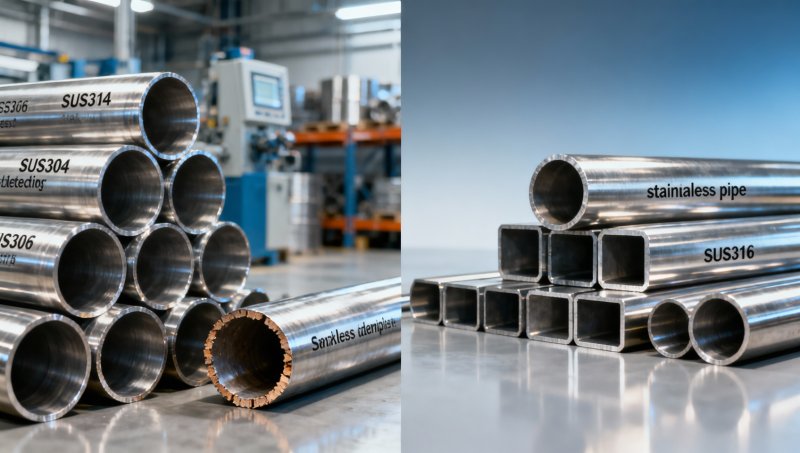
From a practical standpoint, the main differences are usually driven by grade selection and manufacturing specification rather than the words “SUS” or “stainless.”
Corrosion resistance
If the environment involves humidity, chemicals, salt exposure, or outdoor installation, grade selection becomes critical. For example, 316-type materials generally perform better than 304-type materials in more corrosive environments. This is much more important than whether the pipe is described as SUS pipe or stainless pipe in a listing title.
Mechanical performance
For load-bearing, support, or fabrication use, buyers should evaluate wall thickness, dimensional tolerance, forming performance, and weld integrity. Structural applications often require more than just corrosion resistance; they need predictable strength and reliable installation performance.
Pressure and service condition
For high-pressure transport or process systems, the discussion may shift away from decorative or light structural stainless products and toward engineered piping standards. In some projects, API 5L pipe may also enter the comparison, but it serves a different role. API 5L is generally associated with carbon steel line pipe for oil, gas, and fluid transmission, not a direct stainless substitute in all cases.
Fabrication suitability
If the material will be cut, bent, welded, or integrated into larger systems, consistent dimensional control is essential. This is especially relevant in industrial manufacturing and prefabricated assemblies, where fit-up problems create delays and hidden cost.
In many steel projects, stainless pipe is only one part of the overall structure. Buyers also often need compatible support members and framing sections. For example, in machinery frameworks, warehouse systems, renewable energy installations, and prefabricated structures, C-Shaped Steel is widely used because it offers high load-bearing capacity, accurate dimensional control, corrosion-resistant surface options, and compatibility with standards such as ASTM, EN, JIS, and GB. When pipe systems connect to broader support structures, material coordination across all steel components can improve installation efficiency and long-term reliability.
Which Option Makes More Sense for Engineers, Purchasers, and Project Managers?
For most professional buyers, the best choice depends on application logic rather than terminology.
Choose by standard if:
- your project drawings specify JIS grades such as SUS304 or SUS316
- the end customer requires Japanese standard documentation
- your supply chain or local market commonly works with SUS marking
Choose by performance requirement if:
- you need a defined corrosion resistance level
- the project must meet ASTM, EN, or multi-market compliance
- you are comparing welded stainless tubing versus seamless steel tube
- you need a fit-for-purpose solution for fluid pipe, fabrication, or structural support
Choose by commercial risk if:
- you want consistent lead times and stable export documentation
- you need mill test certificates and traceability
- you are managing approval risk across technical, commercial, and quality teams
For procurement managers and business decision-makers, the most effective sourcing method is to request a clear technical-commercial comparison sheet from suppliers. That sheet should include grade, standard, dimensions, wall thickness, finish, production method, testing scope, origin, and delivery schedule.
Common Buying Mistakes to Avoid Before Placing an Order
Many sourcing problems come from incomplete comparison, not bad intent. These are the most common mistakes in sus pipe vs stainless pipe evaluation:
- Assuming SUS means higher quality by default: SUS is a standards naming convention, not automatic proof of better performance.
- Ignoring equivalence details: similar grade names across standards do not always mean perfect interchangeability.
- Comparing price without checking test requirements: inspection scope, tolerance, and finish can significantly affect value.
- Choosing the wrong pipe form: stainless steel square pipe, round tubing, and seamless pipe are not interchangeable in all applications.
- Overlooking downstream fabrication cost: poor dimensional consistency or weld quality may erase any purchase savings.
Final Decision Guide: Is SUS Pipe Better Than Stainless Pipe?
No—SUS pipe is not automatically better than stainless pipe, because SUS pipe is generally part of the stainless steel category rather than an opposing option. The better question is: Which stainless grade, standard, and pipe type best fit your operating environment and project requirements?
If your project is driven by JIS specifications, SUS-marked material may be the right and most efficient choice. If your project is governed by ASTM, EN, or broader international standards, a general stainless pipe specification may be more appropriate. Either way, grade verification, corrosion resistance, production quality, and compliance documentation should guide the decision.
For buyers, engineers, and project teams, the safest path is to compare materials by application, certification, and lifecycle cost. That approach reduces sourcing risk, avoids specification mismatch, and helps ensure the pipe you buy performs as expected in service.
Please give us a message


Please enter what you want to find