Thermal cycling-induced structural steel welding cracks can compromise integrity in critical applications—from steel beam manufacturer projects to stainless seamless pipe installations. Was base metal selection the root cause? As a trusted structural steel welding partner and stainless steel sheet supplier, Hongteng Fengda investigates how material choices—like ASTM-compliant steel plate galvanized grades or seamless stainless steel tube specifications—affect weld performance under thermal stress. For procurement teams, engineers, and project managers evaluating angle steel price vs. long-term reliability, this analysis bridges metallurgical science with real-world fabrication challenges.
Why Base Metal Selection Matters in Thermal Cycling Environments
Repeated heating and cooling cycles—common in bridge expansion joints, industrial furnace supports, or offshore platform structural frames—induce cyclic thermal stresses. These stresses interact with residual weld stresses and microstructural heterogeneity, increasing susceptibility to cracking. Base metal composition, grain structure, and hardenability directly influence crack initiation thresholds. For example, low-carbon steels like ASTM A572 Grade 50 show superior thermal fatigue resistance compared to higher-carbon alternatives when welded with matching filler metals and post-weld heat treatment (PWHT) is omitted.
Cracking often initiates at the heat-affected zone (HAZ), where rapid cooling during welding creates martensitic or bainitic microstructures. Steels with high hardenability—such as certain S355JR variants with elevated Mn/Si ratios—may develop brittle zones even without preheat, especially under thermal cycling. This is why selecting a base metal with balanced carbon equivalent (CEV ≤ 0.42%) and controlled alloying elements is non-negotiable for cyclic-load applications.
Hongteng Fengda’s Mild Steel Plate Supplier offerings include ASTM A572 and EN S355JR plates engineered for consistent CEV control, uniform thickness tolerance (±0.15 mm for plates ≤20 mm thick), and guaranteed Charpy V-notch impact values ≥27 J at –20°C—critical for preventing brittle fracture under thermal shock.
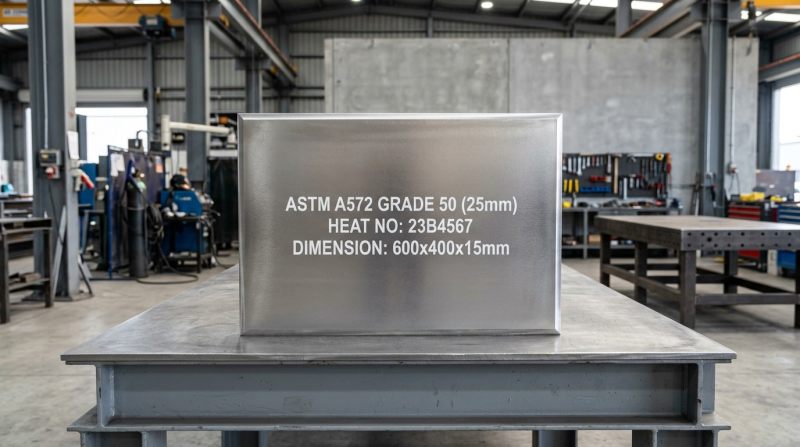
How ASTM A572 & S355JR Compare Under Thermal Stress
Not all structural steel plates perform equally under repeated thermal excursions. While both ASTM A572 and EN S355JR are widely used in construction and heavy machinery, their response to thermal cycling differs significantly due to compositional and processing variances. A572 emphasizes yield strength consistency across grades (42–65 ksi), while S355JR prioritizes weldability and low-temperature toughness per EN 10025-2.
The table highlights that while tensile properties align closely, S355JR offers stricter low-temperature toughness assurance—making it preferable for projects exposed to diurnal temperature swings in Northern Europe or high-altitude sites. Conversely, A572’s tighter yield-strength banding (±5 ksi) supports predictable load distribution in transmission towers subjected to 3–5 thermal cycles per day over 25+ years of service life.
Procurement Checklist: 5 Critical Parameters for Thermal-Cycle-Resistant Plates
When sourcing structural steel plates for thermally cycled applications, procurement and technical evaluation teams must go beyond nominal grade compliance. The following five parameters—verified via mill test reports (MTRs)—directly correlate with field performance:
- Carbon Equivalent (CEV): Must be ≤ 0.42% for arc welding without preheat; verified per AWS D1.1 Annex K.
- Grain Size Number: ASTM E112 ≥ 7.0 ensures fine-grained HAZ stability after multiple thermal cycles.
- Charpy V-Notch Impact @ Operating Temp: Not just room temperature—requires testing at minimum service temperature (e.g., –30°C for Middle East winter nights).
- Thickness Tolerance: ±0.15 mm for plates ≤20 mm; critical for uniform heat dissipation during welding and thermal cycling.
- Surface Cleanliness: Mill scale removal prior to welding reduces hydrogen pickup risk—especially vital for multi-pass welds in support plates.
Hongteng Fengda provides full MTR traceability for every coil and plate lot, including third-party verification from SGS or Bureau Veritas. Lead time for certified A572/S355JR plates ranges from 7–15 days for standard sizes (up to 2000 mm width × 12 m length), with expedited options available for urgent bridge panel or mechanical mounting plate orders.
Why Partner with Hongteng Fengda for Structural Steel Solutions
Structural integrity under thermal cycling isn’t determined solely by material specs—it’s validated through process discipline, quality transparency, and application-specific engineering support. As a China-based structural steel manufacturer and exporter, Hongteng Fengda delivers more than steel: we deliver risk-mitigated sourcing.
Our ISO 9001-certified production lines apply strict controls on rolling temperature, cooling rates, and final straightening—ensuring dimensional stability across 100–400 mm thicknesses. Every batch undergoes ultrasonic testing (UT) per EN 10160 Class C, and optional magnetic particle inspection (MPI) is available for critical transmission tower components.
For your next project involving steel beams, cold-formed profiles, or custom support plates, contact us to discuss: plate grade selection for thermal cycling conditions, weld procedure qualification (WPQ) support, sample availability (including pre-galvanized A572), delivery scheduling for North America/EU shipments, and OEM documentation packages compliant with ASTM, EN, and ASME standards.
Please give us a message


Please enter what you want to find