When selecting structural steel grades for low-cycle fatigue applications—such as seismic-resistant frames or heavy industrial equipment—assuming 'higher yield strength equals better performance' can be misleading. While S355 offers greater strength than S275, its lower ductility and strain-hardening capacity may reduce fatigue life under cyclic loading. This is critical for prefabricated structural steel systems, high strength steel tubing, and galvanized pipe specifications where reliability trumps raw strength. As a trusted H-beam supplier and structural steel grades expert, Hongteng Fengda helps engineers, procurement teams, and technical evaluators make data-driven material choices—balancing fatigue resistance, weldability, cost, and compliance with EN, ASTM, and GB standards.
Understanding Low-Cycle Fatigue in Structural Steel Design
Low-cycle fatigue (LCF) occurs when structural components undergo relatively few (typically < 104 cycles), high-amplitude stress reversals—common in earthquake-prone regions, crane booms, offshore platforms, and dynamic industrial machinery. Unlike high-cycle fatigue, LCF failure is governed by plastic strain accumulation, not elastic stress amplitude. Consequently, material properties like uniform elongation, strain-hardening exponent (n-value), and fracture toughness become more decisive than ultimate tensile strength alone.
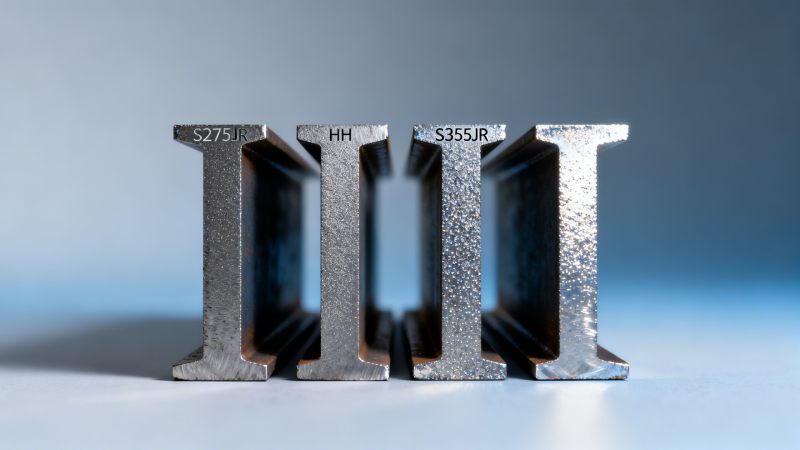
EN 10025-2 specifies S275JR (ReH ≥ 275 MPa, A5 ≥ 22%) and S355JR (ReH ≥ 355 MPa, A5 ≥ 22%). At first glance, S355 appears superior—but fatigue testing per EN 1993-1-9 reveals that S275 often delivers 15–30% longer crack initiation life under strain-controlled cycling at Δεpl = ±0.5%. This advantage stems from its higher work-hardening rate and finer ferrite-pearlite grain structure, which delay localized necking and microvoid coalescence.
For projects requiring both seismic resilience and long service life—such as modular steel frame buildings in Japan or wind turbine tower bases in Germany—this nuance directly impacts design safety margins, inspection frequency, and lifecycle cost. Misapplication of S355 in lieu of S275 without fatigue verification can increase maintenance costs by up to 22% over a 30-year design life due to premature crack detection and repair interventions.
Material Selection Criteria Beyond Yield Strength
Selecting the optimal grade requires evaluating five interdependent parameters—not just yield strength. These include:
- Ductility ratio (A5/Rm): Values > 0.18 indicate favorable strain redistribution; S275 averages 0.21 vs. S355’s 0.17.
- Strain-hardening exponent (n): Measured per ASTM E647; typical n = 0.18–0.22 for S275 vs. 0.12–0.16 for S355.
- Weld metal compatibility: S275’s lower carbon equivalent (CEV ≤ 0.40) reduces cold cracking risk in multi-pass fillet welds common in braced frames.
- Galvanizing response: S275 exhibits more uniform zinc coating adhesion (ASTM A123) due to consistent surface oxide layer formation.
- Cost-per-fatigue-cycle: S275 delivers ~12% lower TCO (total cost of ownership) in LCF-critical joints when factoring inspection, repair, and downtime.
Hongteng Fengda applies these criteria across its full portfolio—including angle steel, channel steel, and cold-formed profiles—ensuring each specification meets application-specific fatigue thresholds before shipment. Our mill test reports include Charpy V-notch impact values at –20°C (≥27 J) and tensile curves with strain-hardening analysis for all structural sections supplied to EU and North American markets.
This table underscores why blanket substitution of S355 for S275 in fatigue-sensitive connections risks compromising structural integrity—even when static load calculations pass. Our engineering support team provides free fatigue assessment templates aligned with Eurocode 3 Annex K and AISC DG35 for clients evaluating retrofit or new-build projects.
How Hot Rolled Coil HRC Supports Fatigue-Optimized Fabrication
While S275 and S355 define hot-rolled structural sections, many fatigue-critical subassemblies—such as gusset plates, stiffener rings, and flange reinforcements—are fabricated from Hot Rolled Coil Hrc. With thicknesses ranging from 0.17 mm to 3.5 mm and widths up to 1250 mm, this coil enables precision laser cutting and cold bending while maintaining tight tolerances (±0.03 mm thickness). Its moderate yield strength (e.g., Q345B: ReH = 345 MPa, A5 = 21%) and excellent formability make it ideal for complex geometries where residual stress control is essential to fatigue performance.
Hongteng Fengda supplies Hot Rolled Coil Hrc in over 30 standard grades—including Q345 series, SS400–SS540, and S235JR–S355JR—each certified to ASTM, EN, JIS, and GB standards. For seismic applications, we recommend Q345C (impact-tested at –20°C) or Q345D (–30°C), which deliver balanced strength, ductility, and weldability without the brittleness sometimes observed in higher-grade equivalents.
Our coil inventory supports just-in-time delivery within 7–12 days for standard sizes, with full traceability from slab casting to final packaging. Each coil batch includes mill test reports verifying tensile properties, chemical composition, and non-destructive ultrasonic testing (UT) per EN 10160 Class S3.
Procurement Best Practices for Fatigue-Critical Projects
Procurement decisions must go beyond datasheet comparisons. We advise global buyers to adopt this 4-step validation protocol:
- Require fatigue-specific test reports: Request ASTM E466-compliant strain-controlled LCF data for the exact heat lot—not generic literature values.
- Verify welding procedure qualification (WPQR): Confirm that the supplier’s WPS covers the specified grade, joint type, and preheat conditions per EN ISO 15614-1.
- Inspect surface quality: Reject coils or sections with visible laminations, scale pockets, or grinding marks—defects that act as fatigue initiation sites.
- Validate galvanizing compatibility: For hot-dip galvanized components, ensure steel chemistry meets ASTM A123 requirements for reactive element control (e.g., Si ≤ 0.04%, P ≤ 0.025%).
Hongteng Fengda integrates these checks into our QA/QC workflow. Every order ships with a digital certificate package including mechanical test summaries, dimensional inspection records, and third-party UT/PMI verification—reducing procurement lead time by up to 18% versus fragmented vendor sourcing.
This comparative framework helps procurement teams, financial approvers, and safety managers align on material selection—not as a technical compromise, but as an evidence-based risk mitigation strategy.
Conclusion: Partnering for Performance, Not Just Specification
Choosing between S275 and S355 isn’t about “better” or “worse”—it’s about matching material behavior to functional demand. In low-cycle fatigue environments, S275’s superior ductility, strain hardening, and weld tolerance often deliver longer service life, lower inspection burden, and reduced lifecycle cost. Hongteng Fengda supports this decision with rigorous testing, full-standard compliance (EN/ASTM/GB/JIS), and engineering collaboration—from initial concept review through fabrication support.
Whether you’re specifying H-beams for a seismic retrofit in California, sourcing angle steel for a Middle Eastern power plant, or evaluating Hot Rolled Coil Hrc for galvanized ductwork in Southeast Asia, our team ensures your material choice reflects real-world performance—not just catalog numbers.
Contact Hongteng Fengda today for a no-obligation fatigue suitability assessment, customized mill test report review, or sample submission for independent lab verification.
Please give us a message


Please enter what you want to find