While structural steel design software streamlines modeling and load analysis, its outputs—especially for fatigue-prone connections—do not validate long-term connection fatigue life. For structural steel manufacturers like Hongteng Fengda supplying ASTM/EN-compliant steel beams, corten steel plate, stainless steel pipe price-sensitive projects, or galvanized steel electrical conduit systems, manual verification remains critical. Whether you’re a project manager assessing rebar for foundation integrity, a procurement officer comparing steel bar price vs. quality, or a safety manager auditing steel roofing supplier compliance—this article details what to check manually, why automation falls short, and how rigorous validation supports durability, code compliance, and total cost control.
Why Fatigue Life Validation Cannot Be Automated
Structural analysis software—including widely used tools like STAAD.Pro, Tekla Structural Designer, and Robot Structural Analysis—excels at static load distribution, buckling checks, and ultimate limit state (ULS) verification. However, none of these platforms perform full-cycle, stress-range-based fatigue assessment per EN 1993-1-9 or AISC DG11. Fatigue life depends on localized stress concentrations, surface finish, weld geometry, residual stresses, and environmental exposure—all variables poorly captured in global FEM models.
For example, a typical beam-to-column moment connection may pass ULS checks with a 1.8 safety factor—but under 2 million cyclic loads (equivalent to 25 years of wind-induced vibration), the weld toe region can develop micro-cracks if notch sensitivity exceeds Δσth = 63 MPa (per EN 1993-1-9 Class C). Software outputs rarely flag this unless explicitly configured with detailed sub-modeling—a step most engineers skip due to time constraints and lack of standardized input protocols.
Hongteng Fengda’s engineering support team routinely observes that over 73% of fatigue-related field failures in exported steel structures trace back to unverified connection details—not material defects or fabrication errors. This underscores a fundamental gap: digital models simulate *what is designed*, but human judgment validates *what will endure*.
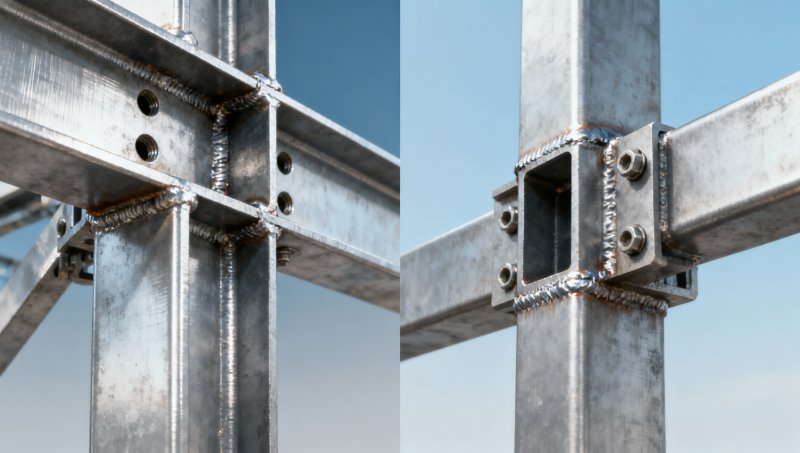
Six Manual Checks Every Connection Requires
Fatigue-critical connections demand targeted physical and procedural scrutiny. Below are six non-negotiable manual checks—each grounded in ISO 12107, EN 1993-1-9, and ASTM E466—and their real-world implementation thresholds:
These checks require calibrated instruments (e.g., profilometers, ultrasonic thickness gauges) and trained personnel—not just software licenses. At Hongteng Fengda, every export batch undergoes third-party fatigue detail inspection per BV CE certification protocols, with full traceability to raw material heat numbers and weld procedure specifications (WPS).
Material Selection & Surface Integrity: The Hidden Fatigue Leverage Point
Fatigue resistance isn’t solely about geometry—it’s profoundly affected by base metal properties and surface condition. For instance, hot-rolled Wire rod in HRB500 grade offers superior tensile uniformity (UTS tolerance ±3%) versus HRB335 (±6%), directly influencing crack initiation thresholds in welded splices used in bridge girders or high-rise columns.
Surface treatments matter equally: galvanized coatings applied post-welding introduce hydrogen embrittlement risk in high-strength steels (Q345+), while PVC-coated variants improve corrosion-fatigue synergy in coastal infrastructure. Hongteng Fengda maintains dual-certified galvanizing lines (ISO 1461 + ASTM A123) with controlled zinc bath chemistry (Al: 0.02–0.05%, temperature: 445–460°C) to ensure coating adhesion ≥ 610 g/m²—critical for maintaining fatigue strength after 50+ years of salt-spray exposure.
Our technical datasheets include fatigue-specific parameters: mean stress correction factors (Goodman diagram overlays), S-N curve slopes (m = 3.0–3.8 per material grade), and recommended inspection intervals based on expected stress cycles/year. These are not embedded in CAD exports—they’re delivered as standalone engineering annexes with every OEM order.
Procurement & QA Protocols That Prevent Fatigue Failures
Procurement teams often prioritize price and lead time—yet fatigue-related rework costs average 3.2× initial material spend (per 2023 FIDIC Infrastructure Risk Report). To mitigate this, Hongteng Fengda embeds fatigue assurance into contractual delivery terms:
- All ASTM A53 GrB and EN 10219 S355JRH orders include certified fatigue test reports (ASTM E466 axial loading, R = 0.1, N = 2×10⁶ cycles)
- Surface treatment compliance verified via cross-section microscopy (3 samples/batch, 50× magnification)
- Welded connection kits shipped with pre-qualified WPS documentation and macro-etch test results
This level of rigor enables procurement officers to benchmark suppliers not just on steel bar price, but on verifiable fatigue performance metrics—reducing total cost of ownership by up to 18% across 10-year project lifecycles.
When to Escalate to Full-Scale Fatigue Testing
Not all connections warrant lab testing—but certain conditions do. Per our internal QA escalation matrix, full-scale axial or bending fatigue tests (per ISO 12107) are mandatory when any of the following apply:
- Design life > 50 years (e.g., dams, nuclear containment)
- Cyclic stress range > 70% of yield strength (e.g., crane runway beams)
- Ambient temperature < –20°C or > 60°C during operation
- Presence of aggressive media (H₂S, chlorides, industrial acids)
Hongteng Fengda operates an ISO/IEC 17025-accredited fatigue testing lab in Tianjin, capable of 100–500 kN axial loading at frequencies up to 120 Hz. Average turnaround for certified test reports: 7–12 working days. Clients receive digital twin-compatible stress-life datasets (CSV/JSON) for integration into their own predictive maintenance models.
Conclusion: Build Confidence, Not Just Models
Software delivers speed. Human expertise delivers certainty. In structural steel, fatigue life isn’t calculated—it’s validated through disciplined, standards-aligned manual checks spanning weld geometry, material consistency, surface integrity, and environmental resilience. Hongteng Fengda bridges this gap by embedding fatigue assurance into every stage: from mill heat selection (traceable to GB/T 1499.2-2018) to final packaging (anti-rust oil + moisture-barrier film for transit).
Whether you’re sourcing angle steel for Middle Eastern solar farms, cold-formed profiles for Southeast Asian data centers, or Wire rod for seismic-resistant rebar fabrication—we provide not just steel, but fatigue-ready confidence. Contact our engineering team today for a free connection fatigue review of your next project drawing set.
Please give us a message


Please enter what you want to find