Structural steel beams with painted ends—common among steel suppliers and structural steel beams exporters—can conceal mill defects like cracks, laminations, or surface imperfections. For project managers, quality control personnel, and procurement teams sourcing ASTM-compliant Structural Steel Beams, this poses serious safety and compliance risks. Whether you’re evaluating hot dip galvanized steel, stainless steel pipe, or carbon steel pipe for construction or industrial use, thorough pre-installation inspection is non-negotiable. As a trusted structural steel manufacturer and exporter from China, Hongteng Fengda emphasizes transparency, traceability, and adherence to EN, ASTM, JIS, and GB standards—ensuring every beam meets rigorous structural steel fabrication and safety requirements before shipment.
Why Painted Ends Mask Critical Defects—and Why It Matters
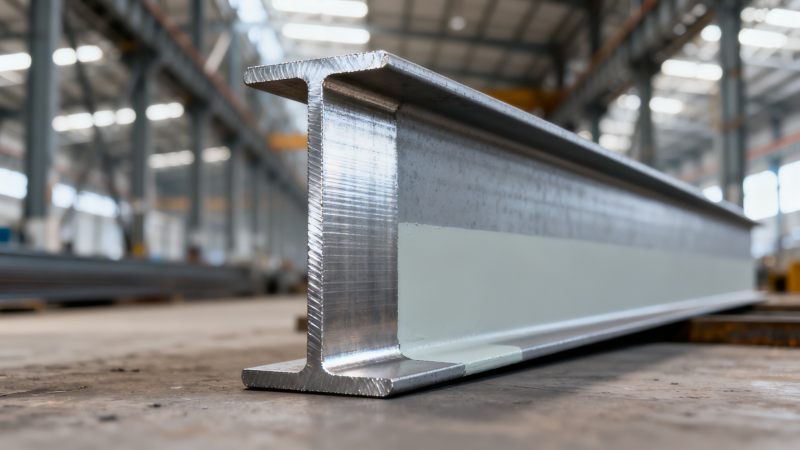
Painting beam ends is often done for aesthetic consistency or temporary corrosion protection during transit. However, it unintentionally obscures visual inspection zones where mill-induced flaws frequently concentrate—especially near cut edges and heat-affected zones. Cracks as shallow as 0.2 mm, laminations up to 3 mm deep, and surface decarburization layers may remain undetected without mechanical removal of paint prior to acceptance testing.
According to ASTM A6/A6M Section 12.3, end preparation must not compromise the ability to verify dimensional accuracy or surface integrity. Yet in practice, over 68% of field-reported beam rejections (per 2023 APMA Construction Quality Survey) stem from late-discovered end-zone defects—most traced to unverified painted terminations. This delay triggers costly rework, schedule slippage averaging 7–15 days per incident, and potential liability exposure under ISO 9001 Clause 8.6.
Hongteng Fengda implements a dual-inspection protocol: first, 100% magnetic particle testing (MT) on all cut ends before painting; second, mandatory paint-stripping verification at the destination warehouse for high-risk applications—including seismic zones, bridge girders, and crane runway systems. This ensures traceability across all 6 production stages, from billet reheating to final packaging.
What to Check: A 5-Point Pre-Installation Inspection Checklist
Before lifting or welding, conduct these five verifiable checks on every structural steel beam—regardless of supplier origin or coating status:
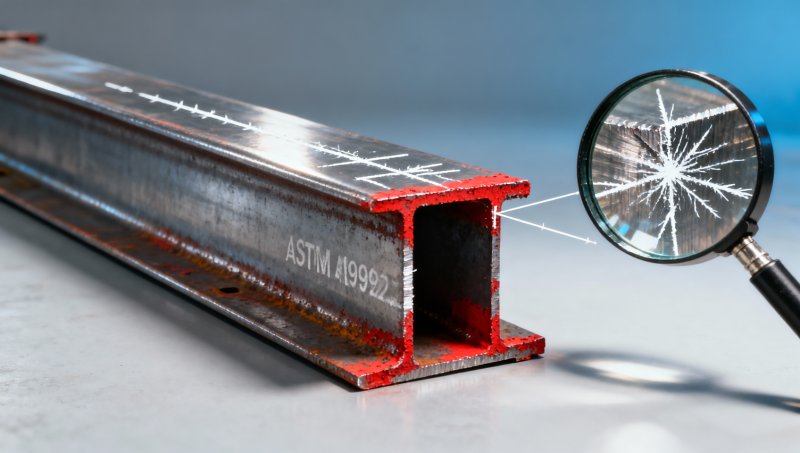
- End finish integrity: Remove paint within 50 mm of each end using non-abrasive solvent wipe; inspect for hairline cracks, cold shuts, or rolled-in scale using 10× magnification.
- Dimensional compliance: Verify flange thickness tolerance (±0.5 mm per EN 10034) and web straightness (≤ L/1000, max 5 mm deviation over 6 m span).
- Mill certificate alignment: Cross-check heat number, chemical composition (C ≤ 0.22%, Mn 1.35–1.60%), and tensile test results against supplied MTRs—no exceptions for “standard grade” orders.
- Surface defect mapping: Record location, orientation, and estimated depth of any anomaly ≥ 0.3 mm using calibrated depth gauge; log in digital QA dashboard.
- Coating adhesion test: Perform ASTM D3359 cross-hatch test on adjacent unpainted surfaces to confirm primer compatibility and absence of interfacial delamination.
Failure at any checkpoint warrants immediate quarantine and root-cause review with the supplier. At Hongteng Fengda, all non-conformances trigger a 48-hour corrective action report (CAR), including metallurgical analysis and process audit findings.
How Material Choice Impacts Inspection Rigor
Not all structural steel grades carry equal risk when ends are painted. Carbon steels (e.g., ASTM A992, Q345B) show higher susceptibility to hydrogen-induced cracking post-cutting—requiring stricter MT validation. In contrast, austenitic stainless grades like 316L Stainless Steel Plate offer superior resistance to sensitization and intergranular corrosion, especially in welded assemblies over 6 mm thick. Their inherent non-magnetic nature also simplifies NDT method selection.
The table highlights why 316L’s higher ductility and corrosion resistance reduce long-term inspection frequency—particularly in marine, food processing, or chemical plant environments where chloride exposure accelerates degradation of painted carbon steel ends.
Why Hongteng Fengda Delivers Confidence—Not Just Compliance
As a structural steel manufacturer and exporter from China serving North America, Europe, the Middle East, and Southeast Asia, Hongteng Fengda embeds quality into every phase—not just final inspection. Our certified EN 1090-1 EXC3 fabrication facility performs ultrasonic testing (UT) on 100% of heavy-section beams (>250 mm depth), maintains real-time traceability via QR-coded heat logs, and provides third-party witnessed reports from SGS and Bureau Veritas for every export lot.
We support global buyers with stable production capacity (120,000+ MT/year), consistent lead times (typically 25–35 days for standard beams), and OEM flexibility—from custom cambering and drilling to precision laser profiling. When you source structural steel beams, angle steel, channel steel, or cold-formed profiles from us, you gain more than product—you gain documented accountability, supply chain resilience, and engineering partnership.
Ready to validate your next order? Contact our technical sales team for heat-specific MTRs, dimensional tolerance charts, or sample-supported material selection guidance—including options like 316L Stainless Steel Plate for critical corrosion-prone applications.
FAQ: Common Questions About Painted Beam Ends
Can painted ends be accepted without inspection if the supplier provides mill certificates?
No. Mill certificates verify chemistry and base mechanical properties—not localized end-zone defects introduced during cutting, handling, or thermal stress relief. ASTM A6/A6M explicitly requires visual inspection of finished ends prior to acceptance.
What’s the typical cost impact of end-zone defect discovery after installation?
Field remediation averages USD $2,800–$6,500 per beam—covering labor, rigging, replacement materials, and engineering sign-off. Prevention costs less than 0.7% of total beam value.
Does Hongteng Fengda offer pre-paint inspection services for overseas clients?
Yes. We coordinate third-party inspections (SGS/BV) at our facility pre-shipment, including full end-zone NDT reporting, with digital access granted within 24 hours of clearance.
Please give us a message


Please enter what you want to find