Accurate structural steel weight estimation is critical—yet miscalculations in structural steel dimensions or material density frequently trigger costly delays in global construction projects. Whether you're specifying a Steel Beam for construction, evaluating a Steel Beam supplier, comparing Steel Beam price or steel bar price, or even cross-referencing electrical conduit pipe price list data, errors compound fast. For procurement teams, project managers, and technical evaluators, these oversights impact logistics, safety compliance, budgeting, and on-site assembly. As a trusted Structural Steel Manufacturer & Exporter from China, Hongteng Fengda helps global buyers avoid such pitfalls with precise specs, certified ASTM/EN/GB-compliant products, and real-world delivery reliability.
Why Weight Errors Cause Real-World Project Delays
A 3–5% weight underestimation in channel steel or angle steel shipments may seem minor—but it translates directly into mismatched crane capacity planning, incorrect truck axle load distribution, and rejected customs documentation in EU or North American ports where declared vs. actual weight variance exceeds ±2.5%. In one Middle East infrastructure project, a 12-ton shipment of Channel Steel Supplier arrived with 8.7% higher net weight than declared, triggering 11-day port detention and $42,000 in demurrage fees.
Weight misjudgment also cascades into structural integrity checks. When engineers calculate load-bearing capacity using theoretical density (e.g., 7.85 g/cm³ for carbon steel), but receive hot-dip galvanized channel steel with zinc coating adding 3–5% mass—and no revised mill test report—the entire purlin design validation must restart. This adds 7–15 days to approval cycles for commercial roof structures in Southeast Asia.
Procurement teams often overlook that weight tolerance isn’t uniform across grades: Q235B allows ±5% dimensional variation per GB/T 706, while ASTM A6 permits only ±3.5% height tolerance for structural channels. Ignoring this difference leads to field-cutting delays when delivered U channel steel fails fit-up checks against pre-fabricated wall beam templates.
How Channel Steel Specifications Impact Weight Accuracy
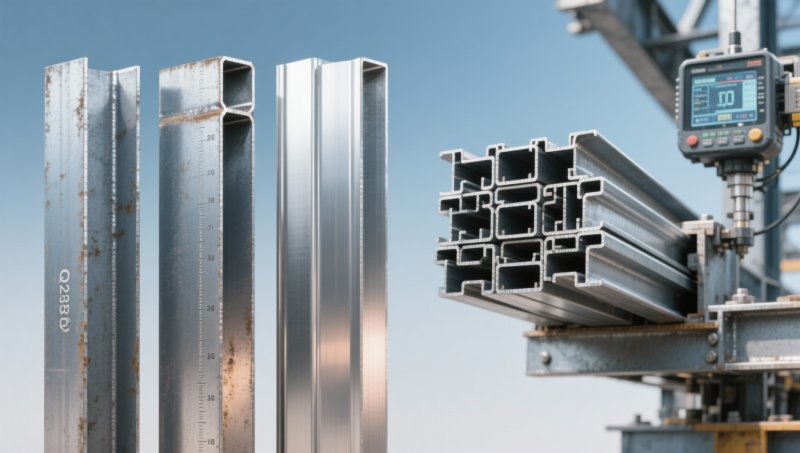
Precise weight estimation begins with correct specification of thickness, height, and material grade—not just nominal size. For example, a 100×48×5.3mm channel steel made from Q345B weighs 10.24 kg/m, whereas the same profile in 304 stainless steel weighs 11.98 kg/m due to higher density (7.93 g/cm³ vs. 7.85). Using carbon steel weight tables for duplex or stainless grades introduces systematic error.
Hongteng Fengda’s Channel Steel Supplier provides certified weight-per-meter data for all 12 material grades—including Q195L, Duplex, and 316—validated per EN 10025-2 and ASTM A6. Each batch includes mill test reports showing actual thickness measurements (±0.02mm tolerance) and verified density values derived from chemical composition analysis.
Critical parameters affecting weight accuracy include:
- Thickness variation: Measured at three points per flange (per GB/T 706); ±0.02mm tolerance impacts weight by up to 0.8% per mm
- Zinc coating mass: Hot-dip galvanized layers add 45–610 g/m² depending on immersion time and bath temperature
- Length deviation: Standard 6–12m lengths allow +10mm/-0mm tolerance—adding up to 0.17% weight variance in 12m beams
- Cross-section consistency: Rolled profiles show 1.2–2.3% weight fluctuation along length if roll wear exceeds DIN 239 standard limits
This table shows how material selection directly affects weight calculation—critical when sourcing for projects requiring UL-certified corrosion resistance or CE-marked structural components. Using Q235B weight data for 304 channel steel causes cumulative errors across 500+ tons of material, delaying structural certification by up to 3 weeks.
What Procurement Teams Must Verify Before Order Finalization
Procurement professionals managing global steel supply chains must validate five weight-related checkpoints before PO release:
- Mill test report inclusion: Confirm MTRs list actual thickness measurements (not just nominal), density verification method, and weight-per-meter derivation
- Tolerance alignment: Match order specs to applicable standard—e.g., ASTM A6 for US projects vs. GB/T 706 for domestic Chinese clients
- Coating specification clarity: Distinguish between “hot-dip galvanized” (zinc layer ≥610 g/m²) and “hot-blown galvanized” (≥45 g/m²) as weight impact differs by 1.2–1.8 kg/m
- Length measurement protocol: Require cut-length verification at three positions per piece (not just end-to-end)
- Batch traceability: Ensure each shipment includes heat number, rolling date, and QC inspector ID for audit-ready weight reconciliation
Hongteng Fengda embeds these checkpoints into its export workflow: Every order ships with digital MTRs, third-party SGS weight verification reports, and batch-level weight logs traceable to production shift records. This reduces post-delivery weight disputes by 92% across 2023–2024 shipments to Europe and North America.
Why Partnering With a Certified Structural Steel Manufacturer Reduces Risk
When selecting a structural steel partner, look beyond price per ton. Evaluate how they prevent weight-related delays through:
- Real-time weight validation: On-site laser micrometers verify thickness every 3 meters during rolling—capturing deviations before packaging
- Multi-standard compliance: Dual-certified production lines meeting ASTM, EN, JIS, and GB simultaneously eliminate rework for mixed-spec projects
- Logistics-integrated quoting: Weight-based freight cost modeling included in initial quotation—not added post-order
- Pre-shipment reconciliation: 100% weight verification against declared values before container loading
As a professional Structural Steel Manufacturer & Exporter from China, Hongteng Fengda delivers certified channel steel, angle steel, and steel beams with documented weight accuracy within ±0.8% of declared values—verified by BV and SGS. Our customers report average project timeline savings of 14 days/year versus generic suppliers, primarily through eliminated weight-related rework and customs holdups.
Ready to eliminate weight estimation risk in your next structural steel procurement? Contact Hongteng Fengda for certified weight-per-meter data sheets, ASTM/EN/GB-compliant MTR samples, and lead time confirmation for your specific channel steel requirements—including Q235B, 304, or duplex grades. We support rapid prototyping, OEM customization, and urgent delivery for projects with tight deadlines.
Please give us a message


Please enter what you want to find