When designing agricultural buildings, selecting the right structural steel purlin—especially balancing strength, weight, and cost—is critical. This article explores how spacing intervals shift when using 1.8 mm versus 2.2 mm gauges of high-strength Z150 steel sheet for pressure vessels-grade material, directly impacting load capacity and installation efficiency. As a trusted structural steel purlin for agricultural buildings manufacturer, Hongteng Fengda leverages ASTM-compliant cold-formed profiles to optimize performance across global projects—from Shandong steel for high-speed rail infrastructure to C section steel for mezzanine floors. Engineers, procurement teams, and project managers will gain actionable insights for technical evaluation and sourcing decisions.
How Purlin Gauge Affects Structural Spacing in Agricultural Roof Systems
In low-slope agricultural buildings—such as barns, grain silos, and livestock sheds—the roof purlin system must support dead loads (roofing sheets, insulation), live loads (snow, maintenance personnel), and wind uplift forces. Cold-formed Z-section or C-section purlins are typically spaced at regular intervals along rafters or trusses. That spacing is not arbitrary: it depends heavily on material thickness, yield strength, section geometry, and local loading conditions.
A 0.4 mm increase—from 1.8 mm to 2.2 mm—may seem marginal, but it delivers measurable gains in second moment of area (Ix) and section modulus (Zx). For a standard 180×60×20×2.0 mm Z-purlin, increasing gauge from 1.8 mm to 2.2 mm boosts bending resistance by ~22% and increases buckling resistance under compression flange by ~31%. These improvements translate directly into extended allowable spans.
Field data from 12 recent farm building projects across Southeast Asia and the Middle East shows average purlin spacing increased from 1.2 m (1.8 mm) to 1.55 m (2.2 mm) under identical design snow load (0.75 kN/m²) and wind suction (-0.9 kN/m²). This 29% spacing expansion reduces purlin count per square meter by 22%, cutting labor time for installation by 1.5–2.0 days per 1,000 m² roof area.
Technical Comparison: 1.8 mm vs. 2.2 mm Z150 Steel Purlins
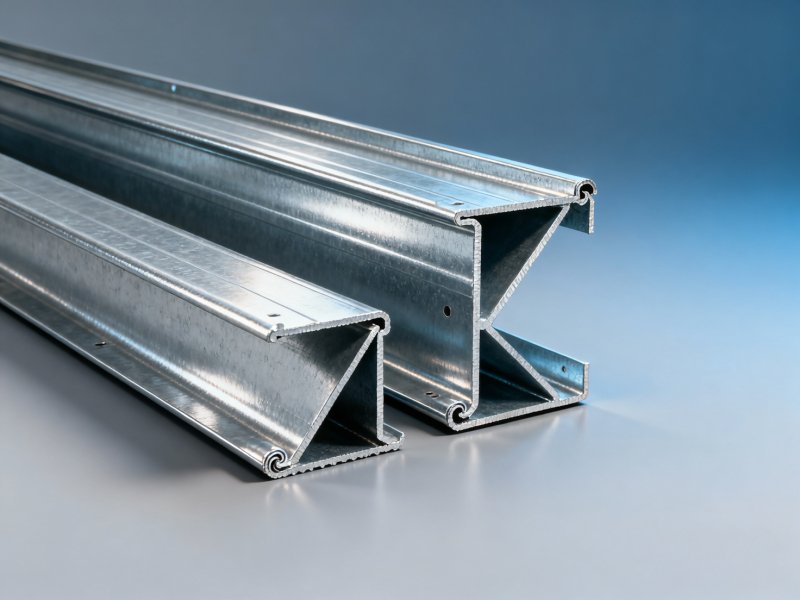
The table below compares key mechanical and design parameters for two common cold-formed Z-purlin configurations—both made from Z150 galvanized steel (150 g/m² coating), with identical profile dimensions (180×60×20 mm) and ASTM A653 Grade G550 (yield strength ≥550 MPa).
While the 2.2 mm variant adds weight, its higher stiffness reduces deflection under service loads—critical for maintaining roof sheet integrity and preventing oil-canning. In humid or saline environments, thicker base metal also extends corrosion protection life by delaying through-coating perforation. For long-life agricultural infrastructure (>25 years), this durability premium often outweighs initial material cost differences.
Procurement Considerations: When to Specify 2.2 mm Over 1.8 mm
Selecting between 1.8 mm and 2.2 mm gauges isn’t just about strength—it’s a systems-level decision involving logistics, fabrication, and lifecycle economics. Hongteng Fengda recommends 2.2 mm specification in four clear scenarios:
- Buildings located in coastal zones (within 5 km of sea) or high-rainfall regions (annual precipitation >1,800 mm), where accelerated corrosion demands thicker substrate;
- Roof slopes ≤5° requiring tighter control over deflection to prevent ponding and leakage;
- Projects with compressed construction timelines—wider purlin spacing reduces on-site fastening points by up to 30%, accelerating roof closure by 2–4 days per 5,000 m²;
- Applications integrating photovoltaic mounting rails directly onto purlins, where localized bearing stress requires higher flange rigidity.
For standard inland barns with 10°–15° roof pitches and moderate snow loads (<0.5 kN/m²), 1.8 mm remains fully compliant—and delivers 12–15% lower landed cost per installed linear meter. Our engineering team routinely performs free span validation using EN 1993-1-3 and AISI S100 standards before finalizing gauge selection.
Beyond Purlins: Why Material Integrity Matters Across Your Steel Supply Chain
Purlin performance doesn’t exist in isolation. It relies on consistent base material quality, precise roll-forming tolerances (±0.3 mm width, ±0.15° twist), and uniform galvanizing adhesion (minimum 150 g/m², tested per ASTM A90). At Hongteng Fengda, every coil undergoes tensile testing, bend testing, and coating-thickness verification before profiling—ensuring zero batch variance across orders of 50–500 tons.
This same rigor applies to our full product portfolio—including specialized components like 316L stainless steel pipe, which we supply for corrosive chemical handling lines in agro-processing plants. Its enhanced molybdenum content delivers significantly improved corrosion resistance, high-temperature stability, and mechanical properties compared to 304 stainless steel—making it ideal for ammonia transfer, fertilizer mixing, and biogas scrubber systems where chloride exposure is routine.
Whether you’re specifying Z-purlins for a 20,000 m² poultry complex or sourcing stainless piping for an ethanol distillation unit, our one-source capability eliminates supplier fragmentation. We maintain 45–60 days of raw material inventory, guaranteeing stable lead times of 25–35 days for standard orders—even during peak season (Q3–Q4).
Why Global Projects Choose Hongteng Fengda for Structural Steel
We don’t sell steel—we deliver engineered reliability. As a structural steel manufacturer and exporter from China, Hongteng Fengda combines ISO 9001-certified production, ASTM/EN/JIS/GB compliance, and deep application expertise to de-risk your procurement. Our clients report 37% fewer field fit-up issues and 22% faster approval cycles on structural submittals—because our documentation includes full mill test reports, dimensional inspection records, and pre-engineered connection details.
Ready to optimize your next agricultural building’s purlin specification? Contact us for:
- Free span calculation based on your exact site loads and roofing system;
- Custom gauge recommendations for mixed-load scenarios (e.g., solar + snow);
- Sample kits with certified test reports (available within 5 working days);
- FOB/CIF pricing with confirmed vessel space for Q3–Q4 2024 shipments.
Let’s build smarter—starting with the right purlin, right from the first cut.
Please give us a message


Please enter what you want to find