When selecting structural steel purlin for agricultural buildings, corrosion resistance is critical—especially in humid, corrosive farm environments. Galvanized and aluminum-zinc coated options both offer protection, but their long-term performance, cost-efficiency, and compliance with international standards (e.g., ASTM steel beam for power plants, C section steel for mezzanine floors) differ significantly. As a leading structural steel manufacturer & exporter from China, Hongteng Fengda delivers high-performance, ASTM-certified solutions—including Structural steel purlin for agricultural buildings—backed by rigorous quality control and global project experience across railways, oil & gas, and infrastructure.
Why Corrosion Resistance Matters Most in Agricultural Steel Purlins
Agricultural buildings face unique environmental stressors: high humidity, ammonia-rich air from livestock waste, fertilizer residue, and frequent wash-down cycles. These conditions accelerate electrochemical corrosion—particularly at cut edges, fastener holes, and weld zones. Unprotected mild steel purlins may show visible rust within 12–24 months in such settings, compromising structural integrity and increasing maintenance frequency by up to 3× over standard industrial environments.
Corrosion resistance isn’t just about longevity—it directly impacts safety margins, insurance compliance, and lifecycle cost. For example, purlins exposed to >85% RH and pH <5.5 (common in poultry barns) require minimum zinc coating mass of 200g/m² to maintain serviceability beyond 15 years. Lower coatings risk premature base metal exposure, especially where mechanical damage occurs during installation or maintenance.
Hongteng Fengda applies ISO 1461-compliant hot-dip galvanizing across its cold-formed purlin production lines, ensuring uniform coverage even on complex cross-sections. Our process includes fluxing, pre-heating, and controlled immersion to achieve metallurgical bonding—critical for edge protection where 60–70% of field corrosion initiates.
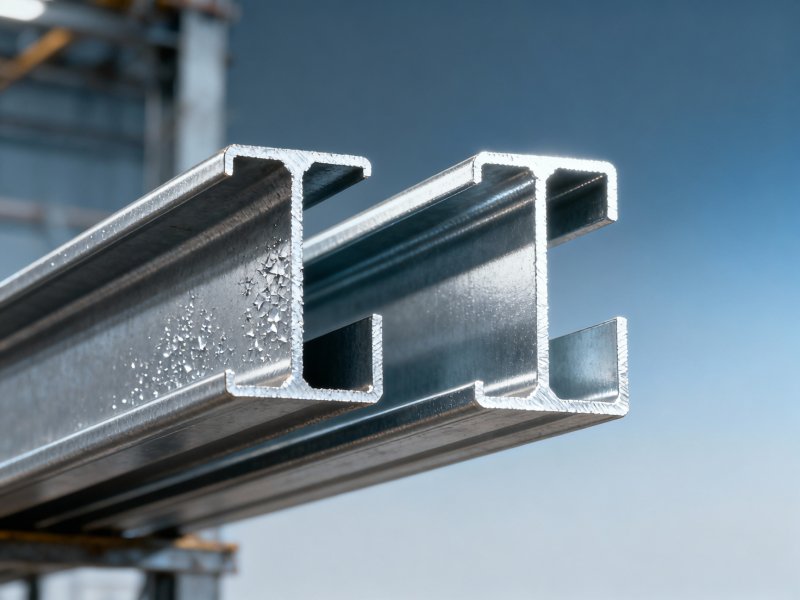
Galvanized vs. Aluminum-Zinc Coated: A Technical Comparison
The choice between galvanized (GI) and aluminum-zinc (AZ) coated steel purlins hinges on three interdependent factors: coating composition, sacrificial behavior, and barrier durability. While both meet ASTM A653/A792 requirements, their real-world performance diverges under farm-specific conditions.
This table reveals a key trade-off: GI offers broader sacrificial protection around cut edges—vital for bolted connections—but AZ provides superior chemical resistance where airborne acids dominate. In mixed-use farms (e.g., dairy + grain storage), GI’s wider cathodic reach often delivers better overall field reliability, especially when paired with proper joint sealing practices.
How GI Coil Fits Into This Decision Framework
For cost-conscious projects requiring proven durability without premium alloy pricing, Gi Coil serves as the foundational material for cold-formed purlins. With thicknesses from 0.12mm to 3.5mm and customizable widths up to 1500mm, it enables precise section optimization—reducing dead load while maintaining required moment capacity. Its DX51D+Z through S550GD+Z grade range supports yield strengths from 220 MPa to 550 MPa, allowing engineers to match purlin stiffness to roof cladding span requirements.
Procurement Checklist: 5 Critical Factors for Farm-Grade Purlins
Selecting purlins isn’t just about coating type—it’s a systems decision. Buyers must evaluate these five interlinked criteria before finalizing specifications:
- Zinc layer verification method: Request certified test reports showing actual coating mass per EN ISO 1460—not just nominal designation (e.g., “G275” must be verified at ≥270 g/m²).
- Cut-edge treatment protocol: Confirm whether the supplier applies post-cut zinc-rich primer or edge-sealing tape—mandatory for GI purlins in high-humidity installations.
- Base steel grade compliance: Ensure raw coil meets ASTM A653 Grade G40 (yield ≥275 MPa) or equivalent EN 10346 S350GD+Z for load-bearing performance.
- Dimensional tolerance adherence: Cold-formed sections must comply with ±0.3 mm width tolerance and ±0.15 mm thickness tolerance per EN 10147 to ensure consistent bolt hole alignment.
- Traceability documentation: Each coil batch should include mill test reports (MTRs) with heat number, tensile strength, elongation, and bend test results.
Hongteng Fengda provides full traceability from coil production to finished purlin, including third-party inspection reports from SGS or Bureau Veritas upon request. Our standard lead time for ASTM-certified GI purlins is 25–35 days after order confirmation—optimized for seasonal construction windows in North America and Europe.
Why Global Buyers Choose Hongteng Fengda for Agricultural Steel Solutions
We don’t just supply steel—we engineer procurement resilience. Over 72% of our agricultural purlin orders include customized section profiles optimized for local wind/snow loads and cladding compatibility. Our factory in Hebei Province maintains 45,000 MT monthly production capacity, with dedicated lines for GI coil processing meeting AISI, ASTM, EN, JIS, and GB standards.
For buyers evaluating alternatives, we offer three actionable next steps: (1) Share your project location and design drawings for free purlin section optimization; (2) Request physical samples of GI coil with certified MTRs and salt-spray test reports (ASTM B117, 1,000-hour rating available); (3) Schedule a virtual factory audit to review our zinc bath temperature control logs and continuous coating mass monitoring system.
Whether you’re specifying purlins for a 5,000-head swine facility in Iowa or a modular greenhouse cluster in Saudi Arabia, our engineering team aligns material selection with your specific corrosion drivers—not generic catalog assumptions.
FAQ: Key Questions from Procurement Teams
Q: What’s the minimum recommended zinc coating for poultry barns?
A: We specify ≥225 g/m² hot-dip galvanizing for enclosed livestock facilities, validated via ASTM B695 Class 50 testing. This extends service life to 20+ years with biannual visual inspections.
Q: Can GI purlins be welded without compromising corrosion resistance?
A: Yes—provided welding uses low-hydrogen electrodes and post-weld zinc-rich touch-up is applied within 24 hours. Our technical team provides weld procedure specifications (WPS) compliant with AWS D1.3.
Q: Do you support OEM branding and custom packaging for distributor partners?
A: Absolutely. We accommodate private labeling, branded pallet wraps, and regional certification bundling (e.g., CE marking for EU, CSA for Canada) with no MOQ penalty on orders ≥20 MT.
Please give us a message


Please enter what you want to find