Structural steel design affects safety, procurement risk, and long-term project cost far more than many buyers realize. For technical evaluators, the key question is not only whether a section looks adequate on paper, but whether loads, connections, and code checks have been translated into manufacturable, verifiable steel components.
When structural steel design is reviewed correctly, it becomes easier to compare suppliers, confirm compliance, and avoid hidden issues such as underdesigned joints, inconsistent material grades, or incomplete documentation. This article explains the design checks that matter most and how to assess whether a steel manufacturer can reliably support project requirements.
Why Technical Evaluators Focus on Loads, Connections, and Code Checks
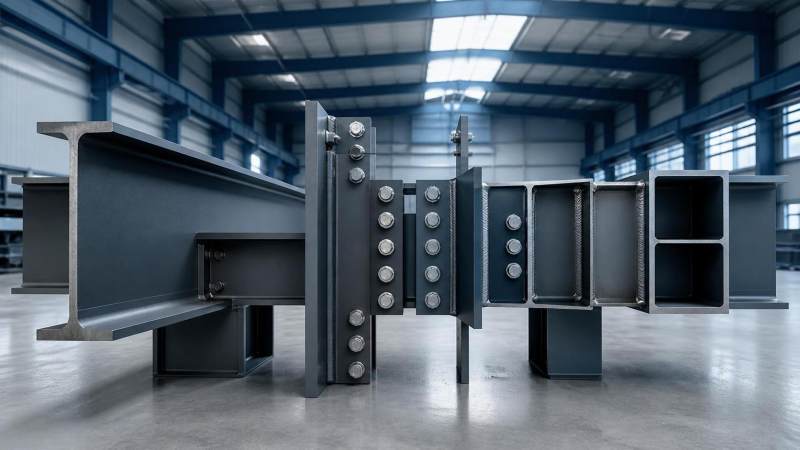
Technical evaluators are usually asked to do more than verify section sizes. They must judge whether a supplier understands the real performance demands of the structure and can deliver components that meet design assumptions in practice.
That is why structural steel design reviews usually concentrate on three areas first: design loads, connection behavior, and code compliance. If any one of these is weak, the entire system can become inefficient, costly to revise, or unsafe.
Loads determine what forces members and joints must resist. Connections determine how those forces transfer through the structure. Code checks confirm whether the design has sufficient capacity, serviceability, and safety margins under recognized standards.
For procurement teams and engineering reviewers, these checks also reveal supplier capability. A manufacturer that understands them well is more likely to produce steel components with consistent quality, accurate dimensions, and documentation suitable for approval workflows.
What Loads Must Be Considered in Structural Steel Design?
The first step in structural steel design is identifying all relevant actions the structure may experience during construction and service life. These are not limited to the self-weight of steel members.
Dead loads include permanent items such as the weight of beams, columns, floor systems, cladding supports, and fixed equipment. Because these remain throughout the structure’s life, they form the baseline for many calculations.
Live loads represent variable occupancy and usage conditions. These may include people, movable equipment, storage, vehicles, or maintenance activity, depending on whether the project is commercial, industrial, or infrastructure related.
Environmental loads often govern the design more strongly than gravity loads. Wind, snow, seismic effects, temperature change, and in some cases blast or vibration can control member sizing, bracing, and connection detailing.
Construction-stage loads should not be ignored. Lifting, temporary instability, erection sequence, and localized handling forces can create demands that differ significantly from the completed structural model.
For technical evaluators, the practical issue is whether the supplier is working from clearly defined load cases and combinations. If loading assumptions are vague, later code checks may look complete while still being based on the wrong design basis.
How Are Steel Members Checked for Strength and Serviceability?
Once loads are defined, engineers verify whether beams, columns, braces, and secondary members have enough capacity. This is where structural steel design moves from general concept to measurable engineering performance.
Typical strength checks include tension, compression, bending, shear, and combined force conditions. A member may pass a simple bending check yet fail because of local buckling, lateral-torsional buckling, or interaction between axial and flexural forces.
Columns are particularly sensitive to slenderness and stability. Their load capacity is not based only on material strength, but also on effective length, end restraint conditions, and the risk of global buckling under compression.
Beams often require checks for bending strength, shear resistance, and deflection. In long-span or lightly braced situations, lateral stability can become a governing factor and may require section changes or added restraints.
Serviceability checks matter because code compliance is not only about collapse prevention. Excessive deflection, vibration, or movement can affect cladding, equipment alignment, finishes, and end-user confidence even when ultimate strength is technically adequate.
Evaluators should therefore ask whether the proposed sections were checked for both ultimate and serviceability conditions. A supplier focused only on tonnage reduction may overlook long-term performance issues that become expensive after installation.
Why Connection Design Often Determines Project Risk
Connections are where many practical problems appear. Even when primary members are correctly sized, poorly designed or poorly fabricated joints can compromise structural performance, slow installation, and trigger costly site modifications.
In structural steel design, connections must transfer axial force, shear, bending moment, or a combination of these effects. Their actual behavior depends on bolts, welds, plate thickness, edge distances, hole tolerances, and fit-up accuracy.
Common connection types include simple shear connections, moment connections, bracing gusset connections, end-plate details, base plates, and splices. Each has different assumptions for stiffness, ductility, erection efficiency, and inspection requirements.
Bolted joints are often preferred for site assembly efficiency, but they still require checks for bolt shear, tension, bearing, slip resistance, and block shear failure. Hole quality and installation control are also important to final reliability.
Welded connections can provide clean force transfer and fabrication flexibility, but they require stronger control of welding procedure, heat input, distortion, and inspection. The design calculation is only one part of the quality equation.
For technical evaluators, connection review should include one simple question: can this detail be fabricated, inspected, transported, and assembled exactly as designed? A connection that works only in theory is a procurement warning sign.
Which Code Checks Matter Most When Comparing Suppliers?
Technical teams often receive material lists and drawings that appear complete, yet the supporting code logic may be unclear. This is why code-based verification is one of the best ways to compare supplier maturity.
Depending on project location and specification, structural steel design may follow ASTM-related material requirements, AISC design methods, Eurocode provisions, JIS rules, or GB standards. International projects often require cross-reference between multiple systems.
The important issue is not just whether a supplier names a standard, but whether the design, material certificates, tolerances, and manufacturing controls align with that standard consistently from quotation to shipment.
Code checks typically cover member resistance, connection strength, local stability, overall frame behavior, serviceability, and sometimes fire or corrosion-related requirements. The required documentation should match the project approval pathway.
Evaluators should look for traceable mill certificates, section tolerances, welding records, coating specifications, and calculation support where needed. Missing or inconsistent records may indicate a gap between nominal compliance and actual execution.
At Hongteng Fengda, structural steel production is aligned with major international standards including ASTM, EN, JIS, and GB. For buyers handling multi-region projects, this helps reduce interpretation gaps between engineering review and manufacturing delivery.
How Material Selection Affects Design Reliability and Procurement Decisions
Material selection is often treated as a purchasing issue, but it also affects structural steel design performance. Strength, ductility, corrosion behavior, weldability, and dimensional consistency all influence whether the final system performs as intended.
For example, some projects require structural sections for primary load-bearing frames, while others also need stainless or specialty components for exposed, corrosive, decorative, or hygienic environments. These selections should still be judged through a design-performance lens.
In mixed-material procurement, buyers may encounter products such as 316 Stainless Square steel rod for industrial or construction-related applications. Product data should be checked carefully against actual grade, strength, finish, and standard requirements before inclusion in any evaluated package.
Reviewers should confirm whether mechanical properties, dimensional ranges, and certification documents support the intended use case. This is particularly important when products may be offered in customized forms or when project specifications require equivalency review.
A capable manufacturer helps by clarifying where standard catalog items are suitable, where custom fabrication is needed, and where substitutions could affect structural behavior, inspection scope, or downstream compliance.
What Technical Evaluators Should Ask a Structural Steel Supplier
Good evaluation is not about requesting more paperwork than necessary. It is about asking targeted questions that reveal whether the supplier can support engineering intent, stable production, and dependable project execution.
First, ask which design standards and material standards are being followed for the quoted scope. These should be stated clearly, especially when exported steel products must satisfy regional project codes or consultant review requirements.
Second, ask how connection details are developed and verified. If a project includes customized components, the supplier should be able to explain fabrication feasibility, tolerance control, and how joint assumptions align with the engineer’s design basis.
Third, review manufacturing capability in relation to the required sections. A supplier of angle steel, channel steel, steel beams, cold formed profiles, and custom components should demonstrate how production capacity supports lead time and consistency.
Fourth, confirm quality control procedures. Material traceability, dimensional inspection, welding quality, surface treatment control, and final documentation are all relevant to technical approval and on-site performance.
Finally, ask how nonstandard requests are handled. OEM solutions can create value, but only if design coordination, shop drawing control, and compliance review are managed carefully and not treated as informal changes.
How a Qualified Manufacturer Supports Better Structural Outcomes
From a technical evaluator’s perspective, the best supplier is not simply the one offering the lowest unit price. It is the one that lowers total project risk through reliable interpretation of requirements and consistent product execution.
Hongteng Fengda manufactures and exports structural steel products for construction, industrial, and manufacturing projects across North America, Europe, the Middle East, and Southeast Asia. This experience is especially relevant where specifications, logistics, and approval requirements must all stay aligned.
Its product range includes angle steel, channel steel, steel beams, cold formed steel profiles, and customized structural steel components. That breadth helps project teams consolidate sourcing while keeping technical requirements under tighter control.
Modern production facilities and strict quality control are valuable because they support what design calculations assume: repeatable dimensions, correct grades, dependable fabrication, and stable delivery schedules. For evaluators, this connection between engineering and manufacturing is critical.
When a manufacturer can support standard specifications as well as customized solutions, buyers gain flexibility without losing visibility. That makes it easier to reduce sourcing risk, control cost, and keep projects moving without repeated technical clarifications.
Conclusion: What Good Structural Steel Design Review Really Means
For technical evaluators, structural steel design should never be reduced to section size alone. The real value lies in understanding whether loads are defined correctly, connections are realistic, and code checks are supported by sound materials and manufacturing control.
When these areas are reviewed together, procurement decisions become more accurate and defensible. It becomes easier to compare suppliers, identify hidden weaknesses, and select steel products that will perform reliably throughout fabrication, shipment, and installation.
In practical terms, strong structural steel design review protects safety, cost control, and schedule certainty at the same time. That is why experienced buyers look beyond quotations and focus on technical completeness, compliance evidence, and execution capability.
A manufacturer that understands these priorities can contribute more than supply volume. It can become a dependable project partner, helping teams convert design intent into steel solutions that meet international standards and perform consistently in real applications.
Please give us a message


Please enter what you want to find