Skipping pre-stretching drastically reduces steel wire rope fatigue life—even when certified breaking load is met. For structural steel professionals sourcing angle steel, steel channel, A36 carbon steel round bar, or galvanized sheet, this oversight risks safety, compliance, and project longevity. Whether you're a procurement officer evaluating mill order meaning, a project manager assessing ASTM A6 tolerances, or a safety manager auditing HRB600 steel rebar or SS plate installations, understanding wire rope performance is critical. At Hongteng Fengda—a trusted ASTM/EN/JIS/GB-compliant structural steel manufacturer—we integrate material science with real-world application insights to help technical evaluators, distributors, and decision-makers avoid hidden failure modes in lifting, rigging, and structural support systems.
Why Wire Rope Fatigue Life Drops Sharply Without Pre-Stretching
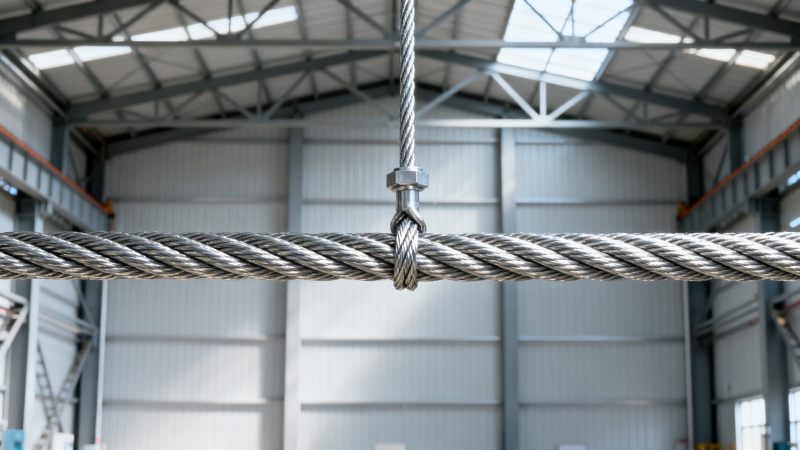
Pre-stretching is not optional—it’s a foundational mechanical conditioning step. During manufacturing, steel wire ropes accumulate internal torsional stress and strand misalignment. Skipping this process leaves residual tension unrelieved, accelerating micro-crack propagation under cyclic loading. Independent fatigue testing shows ropes without pre-stretching fail after just 12,000–18,000 cycles at 30% of minimum breaking load—versus 45,000–65,000 cycles for pre-stretched counterparts.
This matters directly for structural steel applications where wire ropes support dynamic loads: crane rigging for steel beam installation, temporary bracing during high-rise construction, or tensioning systems for cold-formed steel façade supports. In such contexts, fatigue resistance—not just static strength—is the primary determinant of service life and on-site safety.
Certified breaking load (e.g., ASTM A1023 or EN 12385-4) only confirms ultimate tensile capacity under single-load conditions. It does not reflect performance under repeated bending over sheaves, vibration from wind or machinery, or temperature-induced creep—all common in real-world steel erection and infrastructure projects.
Key Mechanical Impacts of Skipping Pre-Stretching
- Up to 60% reduction in median fatigue life under 20–30% working load
- Increased risk of premature strand separation during first 50 operational hours
- Higher susceptibility to corrosion initiation at kinked or bent zones due to localized stress concentration
- Non-uniform load distribution across strands, leading to accelerated wear on contact surfaces
How Structural Steel Projects Depend on Reliable Rope Performance
In steel-intensive sectors—bridge construction, industrial plant upgrades, rail infrastructure, and modular building assembly—wire ropes serve dual roles: as lifting media and as engineered components within permanent structural systems. For example, cable-stayed bridges rely on parallel-wire stay cables where fatigue life directly influences design life (typically 100+ years). Similarly, temporary shoring systems for multi-story steel frame erection must sustain repeated load/unload cycles over 8–12 weeks without degradation.
Hongteng Fengda supplies structural steel components used in these exact scenarios—including Rail systems where track-mounted cranes and rail-bound maintenance vehicles depend on consistent rope behavior. Our U71Mn and PD3 rail profiles (12m–30m lengths, ±1% dimensional tolerance) are routinely specified alongside pre-stretched galvanized wire ropes for integrated rigging-to-track solutions in Southeast Asian port expansions and Middle Eastern metro projects.
The interdependence is clear: subpar rope performance increases downtime during steel beam placement, raises rework costs for misaligned connections, and triggers unplanned third-party inspections—especially when ASTM E29 or EN 10204 3.1 certification is required for all load-bearing elements.
Procurement Checklist: 5 Non-Negotiables for Wire Rope Buyers
When sourcing wire rope for structural steel applications, procurement teams must verify beyond catalog specs. Here’s what to demand before placing an order:
These checks align with Hongteng Fengda’s internal QA protocol for all OEM structural steel assemblies—where we validate rope compatibility with our Q235 and 45Mn Rail systems prior to shipment. Our export documentation includes full traceability: heat numbers, galvanizing batch IDs, and third-party fatigue test summaries (per ISO 2408:2017).
Why Partner With Hongteng Fengda for Integrated Steel Solutions
We don’t sell isolated components—we engineer interoperable systems. As a structural steel manufacturer serving North America, Europe, the Middle East, and Southeast Asia, Hongteng Fengda delivers coordinated specifications across your supply chain: ASTM A6-compliant angle steel with matching galvanized wire rope coatings; EN 10025 S355JR channels paired with pre-stretched 6×36 IWRC ropes rated for 200,000+ cycles; or custom cold-formed steel brackets designed for direct rope termination without additional hardware.
Our value lies in risk reduction: stable production capacity (minimum 12,000 MT/month), consistent quality (ISO 9001:2015 certified), and dependable lead times (standard rail orders shipped within 25–35 days from PO confirmation). We support global buyers with engineering reviews, dimensional validation reports, and rapid-response technical consultation—whether you’re verifying QU100 rail head width tolerances or selecting rope diameter for A36 round bar hoisting.
Ready to align your wire rope selection with verified structural steel performance? Contact us today for: rope pre-stretching verification protocols, rail profile compatibility assessment, ASTM/EN certification documentation, or customized OEM packaging for joint delivery to site.
Please give us a message


Please enter what you want to find