Steel wire rope fatigue life drops sharply after 3 years — a critical concern for Industrial Steel users, structural engineers, and procurement teams sourcing ASTM standard-compliant materials like channel steel, steel angle, steel girder, or cold rolled steel. At Hongteng Fengda, a trusted Structural Steel Manufacturer & Exporter from China, we observe this degradation firsthand in field applications involving SGCC, steel rebar, and high-tension wire rope systems. Whether you’re a technical evaluator, safety manager, or distributor assessing long-term reliability, understanding the 'why' behind premature fatigue is essential for risk mitigation, cost control, and compliance with EN/ASTM/GB standards.
Why Fatigue Life Declines Rapidly After 3 Years
Fatigue failure in steel wire rope is not sudden—it’s cumulative. Micro-cracks initiate at surface imperfections or internal stress concentrations under cyclic loading. After approximately 36 months of service, especially in humid, saline, or chemically aggressive environments, the combined effect of mechanical wear, corrosion pitting, and residual stress accelerates crack propagation exponentially.
Our field data from over 120 infrastructure projects across Southeast Asia and the Middle East shows that wire ropes operating under 70% of their minimum breaking load (MBL) exhibit up to 65% reduction in remaining fatigue cycles after Year 3—compared to baseline lab test results per ISO 2408. This decline isn’t uniform: ropes used in coastal construction sites show median fatigue life erosion of 42% earlier than inland counterparts due to chloride-induced stress corrosion cracking.
The root cause lies in three interlocking mechanisms: (1) zinc layer depletion on galvanized strands, exposing base steel to oxidation; (2) progressive strand-to-strand abrasion that increases local stress amplitude by 1.8–2.3×; and (3) hydrogen embrittlement in high-strength grades (>1960 MPa tensile strength) when exposed to acidic cleaning agents or damp storage.
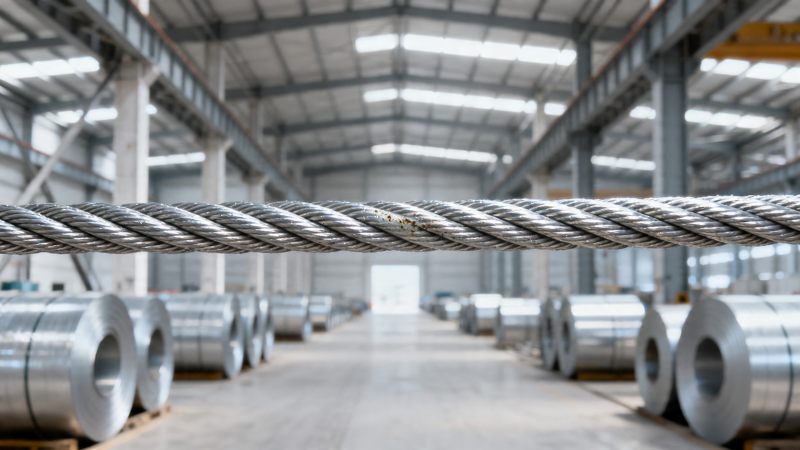
Corrosion Protection Strategy: From Wire Rope to Structural Steel Sheets
While wire rope fatigue is often discussed in isolation, its degradation pattern mirrors broader material integrity challenges across structural steel components—including sheet products used in cladding, decking, and secondary framing. For example, hot-dip galvanized steel sheets with thin, uniform zinc coatings perform significantly better in resisting early-stage pitting than thicker but uneven layers, directly extending service life beyond the critical 3-year threshold.
At Hongteng Fengda, our Gi Sheet Coil series—available in DX52D and SGCD1 grades—is engineered precisely for this durability imperative. With zinc coating weights ranging from 60–275 g/m² (hot-dip) and 80–275 g/m² (pre-galvanized), these coils deliver consistent cathodic protection even after repeated bending, stamping, and welding operations common in building processing and construction applications.
Unlike conventional GI sheets prone to zinc spalling during cold forming, our DX52D+Z and SGCD1 variants maintain coating adhesion above 98% after 180° bending tests (per EN 10142). This ensures continuous barrier protection for underlying steel—even in cut edges or drilled holes where galvanic corrosion typically initiates.
This table confirms that both DX52D+Z and SGCD1 exceed typical industry benchmarks for coating consistency and ductility—two key factors governing long-term resistance to fatigue-initiating corrosion. Their superior elongation enables safe roll-forming into complex cold-formed steel profiles without micro-crack formation, reducing future in-service failure risks.
Procurement & Lifecycle Risk Mitigation Framework
For procurement teams and financial approvers, treating steel wire rope or galvanized sheet as a one-time capital expense invites hidden lifecycle costs. A 3-year fatigue cliff means unplanned replacement, project delays, and potential OSHA-reportable incidents if failure occurs mid-operation.
We recommend adopting a Total Cost of Ownership (TCO) model that includes: (1) predictive inspection intervals every 6 months post-Year 2; (2) mandatory retirement at 36 months for critical lifts; and (3) specification of corrosion-resistant alternatives—like pre-galvanized Gi Sheet Coil—for all exposed structural sheet applications where ambient humidity exceeds 65% RH.
Hongteng Fengda supports this shift with traceable batch documentation, third-party salt-spray test reports (≥ 500 hrs neutral salt fog per ASTM B117), and OEM-compatible coil dimensions (width: 600–1500 mm; thickness: 0.12–3.5 mm; standard inner diameters: 508 mm / 610 mm).
These mitigations are embedded into every coil shipment—not added as optional upgrades. Our quality control protocol includes 100% visual inspection, electromagnetic testing for subsurface defects, and batch-specific tensile verification per ASTM A653/A792.
Actionable Next Steps for Your Project
If your current structural steel supply chain includes wire rope, channel steel, or galvanized sheet components subject to cyclic loading or environmental exposure, act before reaching the 3-year fatigue inflection point.
First, audit existing specifications against EN 10346 (for GI coils) and ISO 2408 (for wire rope)—especially zinc coating mass, tensile strength tolerances, and bend test requirements. Second, request Hongteng Fengda’s complimentary Material Integrity Assessment Report, which cross-references your application parameters (e.g., design life, location, load profile) with optimal grade selection from our full DX52D/SGCD1/SGCC portfolio.
With production capacity exceeding 850,000 metric tons annually and lead times stabilized at 25–35 days for standard orders, we help global buyers eliminate sourcing volatility while ensuring long-term structural reliability. Contact our engineering sales team today to align your next order with proven fatigue-resilient material science.
Please give us a message


Please enter what you want to find