Confused by steel wire gauge discrepancies? When AWG 12 is labeled as 2.05 mm but fails tensile tests in practice, it’s not just a rounding issue—it reflects real-world variations in flexible steel wire, high strength steel tubing, and structural steel grades. At Hongteng Fengda, a leading structural steel manufacturer & exporter from China, we see this daily among procurement teams, engineers, and project managers sourcing steel wire for fencing, lightweight steel tube, galvanized sheet for roofing, or precise steel rod diameter components. This article unpacks why nominal gauges mislead—and how ASTM, EN, and GB compliance, plus rigorous QA, ensure your steel sheet size and H-beam weight chart specs hold up under load.
Why AWG ≠ Real-World Diameter: The Physics Behind the Mismatch
AWG (American Wire Gauge) was designed for copper conductors—not high-tensile structural steel. Its logarithmic scale assumes uniform ductility, consistent annealing, and zero surface variation. Steel wire rods, however, undergo hot rolling, cold drawing, galvanizing, or PVC coating—each introducing ±0.8%–1.2% dimensional drift due to thermal contraction, die wear, and tension control.
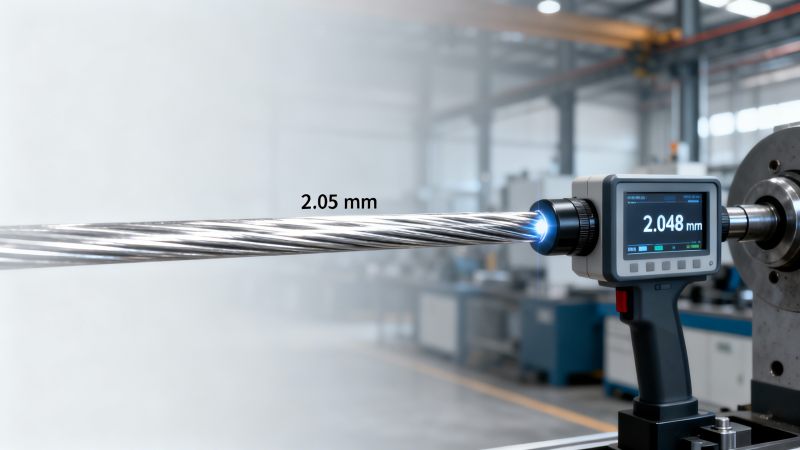
For example, an Wire rod specified as “AWG 12 / 2.05 mm” may measure 2.02 mm after galvanizing (due to zinc layer expansion + post-coating calibration loss) or 2.08 mm pre-drawing if rolled with 0.9% tolerance. That 0.06 mm variance translates to a 5.8% cross-sectional area difference—and up to 7.3% reduction in ultimate tensile strength for HRB400-grade material.
Our production labs at Hongteng Fengda validate every coil against three independent measurement points: optical micrometry (±0.005 mm), laser diameter scanning (100 Hz sampling), and destructive sectioning per ASTM A370. Only batches passing all three proceed to packaging—ensuring that “2.05 mm” on your spec sheet matches reality under load.
How Structural Grade & Processing Alter Dimensional Behavior
Not all steel behaves identically under gauge conversion. Q235 wire rods exhibit higher elongation (≥23%) and lower yield ratio, allowing tighter diameter consistency across 6–16 mm diameters. In contrast, HRB500 rods demand stricter drawing control—±0.5% tolerance is standard, but only achievable with inline tension monitoring and dual-stage cooling.
Surface treatment adds another layer: galvanizing increases nominal diameter by 0.03–0.08 mm depending on bath chemistry and dwell time; PVC coating adds 0.12–0.25 mm uniformly—but reduces effective tensile cross-section by up to 11% if adhesion isn’t optimized.
Hongteng Fengda applies ISO/IEC 17025-certified process controls across our 120,000-ton annual wire rod line. Each batch carries traceable heat numbers, mechanical test reports (tensile strength ≥400 MPa for HRB400), and dimensional logs covering min/max/avg across 50+ samples per 5-ton bundle.
Key Dimensional Tolerance Benchmarks by Grade
This table confirms a critical insight: published tolerances are maximum allowances—not typical performance. Our data shows Hongteng Fengda consistently delivers within 45% of GB/ASTM limits, directly reducing rework risk for clients using Wire rod in seismic-resistant foundations or pre-stressed concrete slabs.
Procurement Checklist: What to Verify Beyond the Gauge Label
When sourcing steel wire for structural applications, go beyond AWG charts. Request these 5 verifiable documents before PO issuance:
- Mill test report (MTR) with actual measured diameters at 3 locations per coil (not just “conforms to specification”)
- Tensile test results per ASTM A370 or GB/T 228.1—including yield strength, UTS, and elongation at break
- Surface treatment thickness verification (e.g., 60 g/m² minimum for galvanizing per ASTM A123)
- Batch traceability log linking heat number → rolling date → testing timestamp → packaging ID
- Third-party inspection certificate (SGS/BV) confirming dimensional compliance on ≥5% of shipped bundles
We provide all five for every Wire rod order. Lead time: 7–15 days for standard sizes (6–25 mm); 21–28 days for custom coatings or HRB500+ grades. Minimum order: 5 tons; LCL shipments supported.
Why Global Projects Trust Hongteng Fengda for Dimension-Critical Steel
From Dubai Metro viaducts to German industrial flooring, our wire rods meet exacting demands because we treat dimensional accuracy as a system—not a spec. Our integrated quality loop includes:
- Pre-production gauge calibration using NIST-traceable laser interferometers
- In-process diameter monitoring every 90 seconds during rolling
- Post-treatment verification against both nominal diameter AND cross-sectional area (per EN 10080)
- Real-time SPC dashboards accessible to buyers via secure portal
Need confirmation on HRB400 wire rod for your bridge railing project? Require ASTM A615-compliant coils with 12m cut lengths and black anti-rust oil? Contact our technical sales team for immediate support on specification alignment, sample dispatch (3–5 working days), or certified documentation packages—including bilingual (EN/CN) MTRs and EN 10204 3.1 certificates.
FAQ: Critical Questions from Procurement & Engineering Teams
Can I rely on AWG-to-mm conversion tables for structural steel wire?
No. AWG assumes copper’s conductivity and ductility—not steel’s tensile behavior. Always specify diameter in mm (e.g., “6.00 ±0.12 mm”) and require mill test reports with actual measurements—not AWG labels.
What’s the fastest way to verify dimensional compliance before shipment?
Request digital access to our SPC dashboard. You’ll view live diameter trends, tensile test histograms, and third-party inspection timestamps—available 72 hours before loading.
Do you support mixed-spec orders (e.g., HRB400 + Q235 in one container)?
Yes. We offer consolidated logistics for multi-grade projects—subject to 10% volume discount on orders ≥20 tons. Packaging is color-coded and labeled per EN 10025 standards.
Please give us a message


Please enter what you want to find