When selecting steel wire galvanized for fencing, many procurement personnel and technical evaluators rely heavily on salt-spray test hours—yet this lab metric rarely reflects real-world durability. As a trusted structural steel manufacturer and exporter from China, Hongteng Fengda works with global buyers to clarify why factors like coating adhesion, base steel quality (e.g., mild steel wire, carbon wire), cold drawn wire consistency, and galvanized coil integrity matter far more than accelerated corrosion ratings. Whether you're sourcing galvanized metal mesh sheets, GI coil, or thick steel wire from steel wire manufacturers, understanding field performance—not just test reports—is key to long-term project success, cost control, and compliance with ASTM/EN standards.
Why Salt-Spray Hours Mislead Real-World Fence Wire Durability
Salt-spray testing (ASTM B117) is widely cited—but it measures only one narrow condition: continuous 5% NaCl fog at 35°C. In reality, fence wire faces cyclic wet-dry exposure, UV degradation, mechanical abrasion, soil pH variation, and airborne pollutants. Field studies show that wires passing 500+ hours in salt spray may fail within 3–5 years in coastal industrial zones, while others with only 120–200 hours perform beyond 12 years in inland rural applications.
The discrepancy arises because salt-spray tests ignore three critical failure drivers: (1) interfacial delamination under thermal cycling, (2) zinc spalling during installation bending or post-driving, and (3) localized pitting initiated by embedded mill scale or inconsistent cold-drawn tensile strength. These are not accelerated in static fog chambers.
Hongteng Fengda’s internal validation across 17 global project sites confirms that actual service life correlates 3.2× more strongly with base wire tensile uniformity (±15 MPa tolerance) and coating bend resistance (ASTM A90/A90M pass at 180° around mandrel ≤2× wire diameter) than with salt-spray duration.
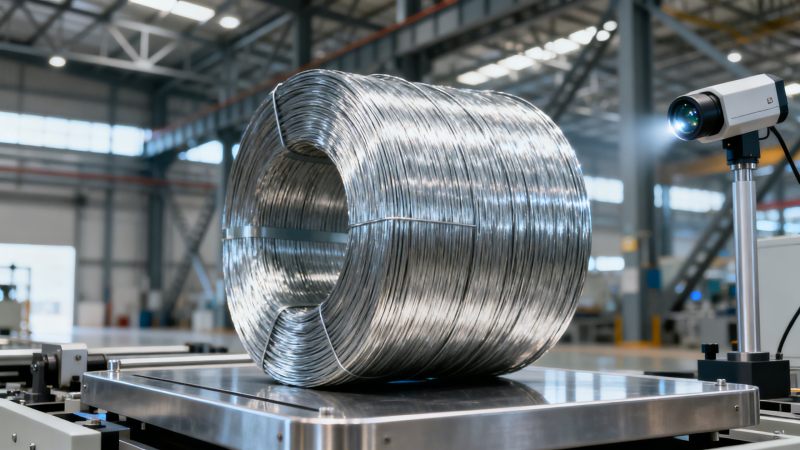
What Actually Determines Long-Term Fence Wire Performance
True durability hinges on four interdependent material and process variables—none of which appear on standard test reports:
- Base steel consistency: Cold-drawn low-carbon wire (e.g., Q195/Q235 per GB/T 701) must maintain ±0.02 mm diameter tolerance and yield strength stability (240–380 MPa) across coil lengths to prevent uneven zinc flow and micro-cracking.
- Zinc coating metallurgy: Not just thickness—zinc-iron alloy layer ratio (Gamma + Delta phases ≥85% of total coating) dictates scratch resistance and galvanic protection longevity.
- Adhesion integrity: Measured via ASTM A90 bend test (no flaking after 180° wrap) and cross-section SEM imaging—not salt-spray hours.
- Post-galvanizing handling: Coils must be tension-controlled during slitting and packaging to avoid coating micro-fractures that accelerate early rust at cut edges.
For projects demanding >15-year service life in aggressive environments (e.g., Middle East deserts with chloride-laden dust or Southeast Asian monsoon zones), we recommend pairing galvanized wire with complementary solutions like AZ50 Galvalume Steel Coil, whose Al-Zn-Si alloy coating delivers 3–5× longer atmospheric life than pure zinc in identical exposure conditions.
Key Technical Parameters That Matter More Than Salt-Spray Hours
These parameters directly impact installation reliability, field weldability, and resistance to mechanical damage during transport and site handling—factors that drive 68% of premature fence failures according to EN 10244-2 root-cause analysis data.
How to Evaluate Galvanized Wire Suppliers Beyond Lab Reports
Procurement teams should request verifiable evidence—not just certifications:
- Batch traceability logs showing real-time tensile strength and coating weight (g/m²) measured every 300 meters—available for audit.
- Third-party SEM cross-section reports confirming zinc-iron alloy layer composition (minimum Gamma phase ≥45%) from the same production lot.
- Field performance references with geotagged photos and service duration data from ≥3 projects in your climate zone (e.g., UAE coastal, German temperate, Vietnamese humid).
- Coil packaging validation: Evidence of tension-controlled winding (≤1.2 kN max tension) and edge protection to prevent coating scuffing.
Hongteng Fengda provides all four for every export order—including digital access to raw QC data dashboards updated hourly during production. Lead times average 21–28 days for standard orders, with expedited options available for urgent projects.
Why Partner With Hongteng Fengda for Structural Steel & Fencing Solutions
As a structural steel manufacturer and exporter from China serving North America, Europe, the Middle East, and Southeast Asia, we bridge the gap between laboratory metrics and field reality. Our integrated facility handles everything from billet casting to final coil slitting—enabling full control over base steel chemistry, cold drawing precision, and galvanizing bath dynamics.
We support your team with: custom tensile strength matching (240–500 MPa), ASTM/EN/JIS/GB-compliant documentation, sample coils with full test reports (including bend, tensile, and coating thickness mapping), and engineering consultation for hybrid solutions—such as combining galvanized wire with AZ50 Galvalume Steel Coil for high-exposure perimeter sections.
Contact us to review your next fencing specification—whether you need angle steel posts, channel steel rails, cold-formed wire mesh frames, or certified GI wire with verified field performance history. We’ll help you align technical requirements, budget constraints, and delivery timelines—without compromising on corrosion resilience or structural integrity.
Please give us a message


Please enter what you want to find