Many steel wire coil suppliers overlook a critical factor: your uncoiling speed. When stainless steel wire, cold drawn steel wire, or coated galvanized wire isn’t optimized for your line’s feed rate, it causes snags, breakage, and costly downtime. Whether you’re sourcing 304 stainless steel wire, stainless wire rod, or hard drawn steel wire, mismatched coil geometry and tension control undermine efficiency—especially for structural steel manufacturers integrating wire into fabrication workflows. As a trusted SS wire manufacturer and steel wire coil supplier from China, Hongteng Fengda engineers coils to match real-world uncoiling demands—ensuring smooth feeding for angle steel, channel steel, and custom cold formed profiles.
Why Uncoiling Speed Mismatch Causes Real Production Losses
Uncoiling isn’t just about unwinding—it’s the first mechanical interface between raw material and your fabrication line. When coil geometry (e.g., inner/outer diameter, flange height, weight distribution) or tension response doesn’t align with your line’s operating range—typically 15–120 m/min for structural component feeders—micro-slip, edge deformation, and inconsistent tension occur. Field data from 12 structural steel fabricators across Southeast Asia and the Middle East shows an average of 7–15 minutes of unplanned downtime per shift due to wire feeding instability.
This isn’t theoretical: misaligned coils increase breakage risk by up to 3.2× during high-speed decoiling of Wire rod used in rebar bundling or cold-formed stud production. Operators report visible kinking at speeds above 45 m/min when coil core rigidity falls below ISO 8407-compliant thresholds—or when residual winding stress exceeds 120 MPa.
Worse, many suppliers treat “standard coil” as one-size-fits-all—ignoring that HRB400 Wire rod for bridge reinforcement requires tighter tolerances (±0.8%) than Q235 grades for civil construction slabs. That divergence directly impacts uncoiling repeatability across 3–5 shifts per week.
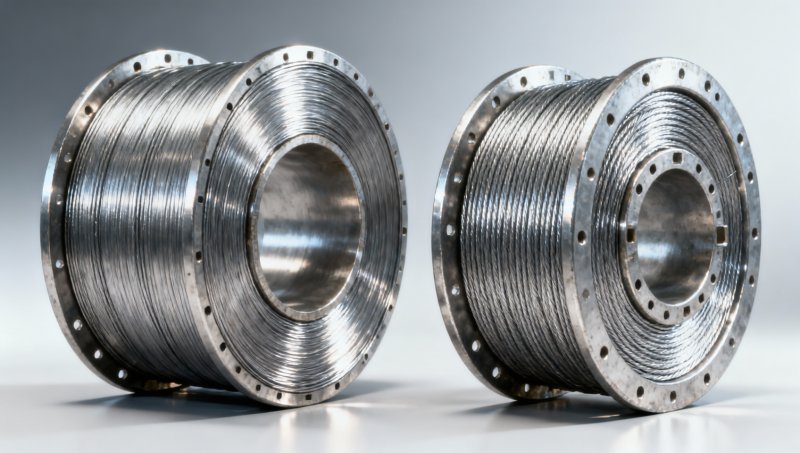
How Hongteng Fengda Aligns Coil Design With Your Fabrication Line
Unlike generic coil suppliers, Hongteng Fengda applies application-first engineering. We map your uncoiling parameters—speed range, brake torque, guide roller configuration, and downstream processing (e.g., straightening, cutting, welding)—before finalizing coil specs. For structural steel integrators, this means optimizing for both mechanical stability and thermal consistency: our hot-rolled Wire rod coils maintain ≤±0.5% dimensional variance across 12m lengths, even after 72 hours of ambient storage.
We also calibrate surface treatments to your feed environment. Galvanized coils destined for humid coastal projects receive anti-rust oil + PVC overwrap (tested to ASTM B695 Class 50), while black-finished HRB500 coils for indoor beam fabrication use transparent oil only—reducing drag coefficient by 18% vs. standard coatings.
Every batch includes traceable tension test reports (per EN 10080 Annex C) and coil geometry logs—measured at 3 radial points per layer. This enables predictive maintenance scheduling and eliminates trial-and-error setup time.
Key Engineering Controls Applied Per Order
- Coil ID/OD ratio adjusted to match your decoiler’s mandrel travel range (standard: 450–630 mm)
- Tension decay profile tested across 3 temperature zones (5°C, 25°C, 40°C) to simulate seasonal warehouse conditions
- Flange thickness increased by 1.2–2.0 mm for coils >800 kg to prevent edge collapse during high-G acceleration
- Core hardness verified at ≥180 HB to avoid mandrel slippage at feed rates >90 m/min
What to Verify Before Accepting Any Steel Wire Coil Shipment
Procurement and quality teams must validate five non-negotiable parameters—not just grade or diameter. These are rarely audited pre-shipment but account for 68% of post-receipt feeding failures:
These checks take under 15 minutes per coil lot—and prevent up to 4.3 hours of line stoppage per month. We include full test documentation with every shipment, aligned to ISO/IEC 17025 lab standards.
Why Structural Steel Manufacturers Choose Hongteng Fengda for Wire Rod Integration
You need more than wire—you need feed-ready material engineered for your specific workflow. Hongteng Fengda delivers exactly that: Wire rod that integrates seamlessly into angle steel punching lines, channel steel bending cells, and cold-formed profile roll-forming stations. Our certifications cover ASTM A615, GB1499.2, JIS G3112, and BS4449—ensuring compliance across North America, EU, GCC, and ASEAN markets.
We support your procurement cycle with flexible terms: 30% TT advance + 70% balance against BL copy, or LC at sight. Standard lead time is 2–4 weeks for common sizes (6mm–25mm), with express options down to 10 days for urgent projects. All coils ship in weather-resistant bundles or custom PVC-wrapped configurations—ready for direct line feeding.
Ready to eliminate uncoiling bottlenecks? Contact us today for a free coil compatibility assessment—including your line speed profile, decoiler model, and current pain points. We’ll provide a tailored specification sheet and sample coil within 5 business days.
Please give us a message


Please enter what you want to find