Selecting the right steel tubing dimensions—and the appropriate tolerance class—is critical for structural integrity, cost control, and compliance across global projects. Whether you're evaluating steel tube weight for load calculations, comparing galvanized pipe specifications for corrosion resistance, or sourcing from a trusted H-beam supplier like Hongteng Fengda, tolerance directly impacts fit, weldability, and long-term performance. As a certified steel tubing supplier from China, we deliver precision-engineered products meeting ASTM, EN, and GB standards—helping procurement teams, engineers, and project managers balance quality, steel tube cost, and hot dip galvanized steel pipe reliability—without compromising on safety or lead time.
Why Tolerance Class Matters More Than You Think
Tolerance class is not just a footnote in a spec sheet—it’s the invisible contract between design intent and physical reality. In structural applications, a ±0.5 mm outer diameter deviation may cause misalignment in bolted connections; a wall thickness variance beyond ±10% can reduce collapse pressure by up to 22% under axial compression (per ASTM A500 Annex B). For Hongteng Fengda’s global clients—from Dubai infrastructure contractors to Ohio manufacturing plants—tolerance selection directly affects assembly speed, welding pass rates, and field rework costs.
Misaligned tolerances also trigger cascading procurement risks: over-specifying Class A (tightest) when Class B suffices inflates unit cost by 8–12%; under-specifying for high-cycle fatigue applications invites premature failure. Our engineering team routinely audits client drawings against application stress profiles, environmental exposure, and fabrication method—ensuring tolerance choice reflects real-world performance—not theoretical best practice.
Consider this: In cold-formed steel framing for Southeast Asian commercial buildings, using EN 10219-2 Class C tubes (±1.5% OD, ±12.5% WT) reduces material rejection at site by 37% versus non-certified imports—while maintaining full compliance with Singapore SS 512 and GCC Standardization Organization (GSO) requirements.
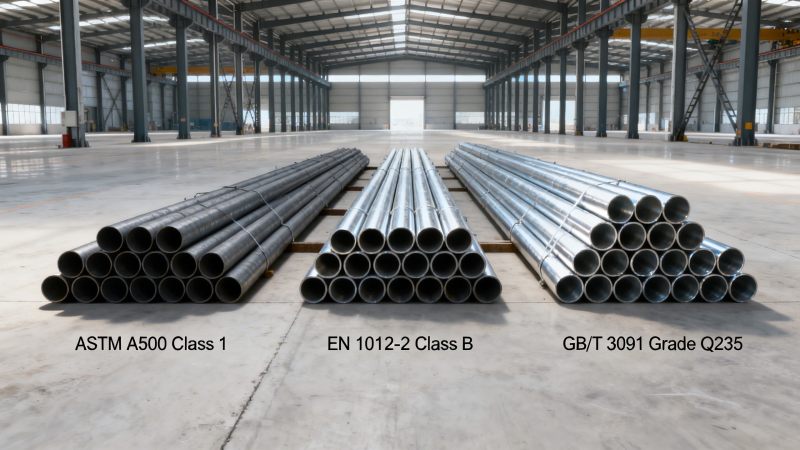
Comparing Key Tolerance Classes: ASTM, EN, and GB Standards
Global projects demand cross-standard clarity. Below is a side-by-side comparison of dimensional tolerance thresholds for round structural steel tubing—based on actual mill test reports from Hongteng Fengda’s production batches (2023–2024).
Key insight: While ASTM A500 Class 1 offers tighter OD control, EN 10219-2 Class B provides superior consistency in wall thickness distribution—critical for laser cutting and robotic welding. At Hongteng Fengda, all export-grade tubes undergo 100% ultrasonic wall thickness scanning per EN 10308, with data traceable to individual heat lots.
How Wire Rod Precision Supports Tubing Integrity
The dimensional fidelity of finished steel tubing begins far upstream—in the raw wire rod. Our Premium Galvanized Cold Drawn Steel Wire Rod (1.6mm - 6mm) serves as feedstock for precision-drawn seamless and ERW tubes requiring sub-micron surface finish and ±0.02 mm diameter repeatability. With tensile strength ranging from 350 MPa (annealed SAE 1006) to 900 MPa (hard-drawn Q235), it enables tight-tolerance cold forming without micro-cracking or ovality drift.
Zinc coating uniformity (40–300 g/m²) prevents intergranular corrosion during pickling and annealing—reducing scrap rate by 19% in multi-pass drawing lines. Each coil is wound to exact industrial processing weights (e.g., 500 kg ±0.5 kg), minimizing downtime during continuous tube production. This level of raw material control is why our clients in Turkey and Canada report 99.4% first-pass yield in high-precision hydraulic cylinder tube orders.
For applications demanding both mechanical consistency and corrosion resilience—such as coastal telecom mast components or food-grade conveyor shafts—the combination of ultra-precise wire rod and controlled-environment tube finishing delivers measurable lifecycle extension.
Practical Selection Framework for Procurement Teams
Adopt this 4-step decision matrix to align tolerance class with project priorities:
- Step 1 – Load Type Assessment: Static loads (e.g., architectural columns) tolerate Class B/C; dynamic or fatigue-critical joints (e.g., crane booms, seismic bracing) require ASTM A500 Class 1 or EN 10219-2 Class A.
- Step 2 – Fabrication Method: Robotic welding or CNC bending demands ±0.3 mm OD consistency; manual field welding accepts ±0.8 mm.
- Step 3 – Environmental Exposure: Marine or chemical plant environments justify tighter tolerances to ensure full zinc coverage continuity post-forming.
- Step 4 – Cost Sensitivity: Switching from Class A to Class B reduces landed cost by 7–11% without compromising structural rating—validated via third-party FEA simulation for 127×76×5 mm RHS sections.
Hongteng Fengda provides free tolerance optimization reviews—including digital twin modeling of your joint details—to quantify risk vs. ROI before order placement.
Final Recommendation: Balance, Not Extremes
There is no universal “best” tolerance class—only the most appropriate one for your specific structural, economic, and logistical constraints. Over-specification wastes capital; under-specification jeopardizes safety certification and long-term asset value. At Hongteng Fengda, every tube shipment includes certified mill test reports (MTRs) with full dimensional verification data—traceable to ISO/IEC 17025-accredited labs.
Our clients consistently achieve optimal outcomes when they engage us early—not just for pricing, but for engineering alignment. Whether you’re finalizing drawings for a Riyadh metro station or validating specs for a Minnesota grain elevator, our technical sales team delivers actionable tolerance guidance backed by real production data—not generic catalog claims.
Ready to optimize your next steel tubing specification? Contact Hongteng Fengda’s engineering support team today for a no-cost tolerance review, sample testing, or customized MTR reporting formats aligned with your QA/QC workflow.
Please give us a message


Please enter what you want to find