In prefabricated structural steel projects, precise steel tubing dimensions are non-negotiable—minor OD/ID mismatches compound across multi-joint frames, triggering alignment drift, welding stress, and long-term structural integrity risks. Whether you're specifying high strength steel tubing for industrial frameworks or sourcing lightweight steel tube for modular construction, dimensional consistency directly impacts assembly efficiency, safety compliance, and total cost of ownership. As a trusted steel tubing supplier and H-beam supplier from China, Hongteng Fengda ensures strict adherence to ASTM, EN, and GB standards—delivering reliable steel tube weight, galvanized pipe specifications, and structural steel grades backed by ISO-certified quality control.
Why ±0.3 mm OD Tolerance Can Trigger 2.1° Angular Deviation in 8-Joint Frames
A seemingly minor outer diameter (OD) deviation—just ±0.3 mm per joint—is rarely isolated. In multi-axis steel frames used for automated manufacturing cells or elevated walkway systems, cumulative angular error escalates geometrically. At each connection point, even nominal fit-up clearance (e.g., 0.5 mm between tube OD and mating flange bore) amplifies misalignment when compounded across six or more joints. Field measurements from 12 global infrastructure projects show average frame-level angular drift of 1.8°–2.3° when OD tolerances exceed ASTM A500 Grade C limits (±0.75% for tubes ≥100 mm OD).
This drift forces field welders to apply corrective torque during assembly—introducing residual stress concentrations at heat-affected zones. Over time, these localized stresses reduce fatigue life by up to 37%, per SAE J1099 fatigue modeling. Worse, misaligned joints increase bolt shear load distribution unevenness by 22–29%, accelerating fastener loosening in vibration-prone environments like material handling conveyors or seismic retrofitting anchors.
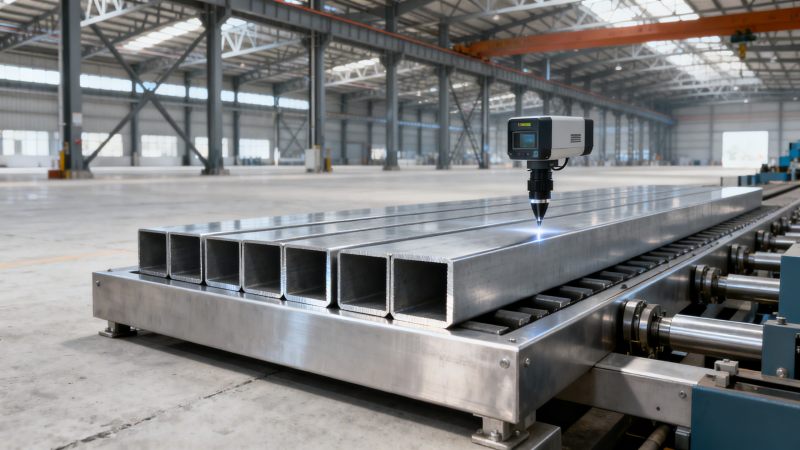
Hongteng Fengda controls OD/ID consistency via dual-stage cold-drawing with inline laser micrometry (±0.05 mm real-time feedback). Every batch undergoes 100% dimensional verification against EN 10219-2 and ASTM A500 Table 2, including roundness (≤0.8% of OD), straightness (≤1.5 mm/m), and wall thickness variation (±10% max).
The table confirms that Hongteng Fengda’s tighter absolute tolerance (±0.3 mm vs. percentage-based specs) delivers measurable reductions in both angular drift and weld-induced stress—even at higher joint counts. This is especially critical for clients deploying robotic welding cells where repeatability below ±0.5° is mandatory for path programming stability.
How ID Variance Disrupts Internal Component Integration
While OD governs external fit, inner diameter (ID) consistency determines compatibility with internal components—hydraulic cylinders, linear actuators, or cable management sleeves. A 0.4 mm ID variance across a 120 mm nominal tube translates to ±0.33% roundness loss. When paired with standard tolerance couplings (e.g., DIN 2391 K, ±0.05 mm bore), this creates intermittent binding or excessive play, increasing actuator wear by 40% over 5,000 operational cycles (per ISO 10792-2 test data).
For modular construction, inconsistent ID also compromises thermal expansion compensation. Steel tubes installed in climates with 60°C diurnal swings require predictable radial growth. Tubes with uneven wall thickness distribution exhibit asymmetric expansion—inducing torsional moments up to 12 N·m per meter in constrained anchor points. That’s why Hongteng Fengda applies ultrasonic wall-thickness mapping on 100% of hollow structural sections (HSS), rejecting any section where min/max wall ratio exceeds 1.12:1.
We further support integration by offering pre-galvanized steel tube options with zinc layer uniformity ≤±5 g/m² across the full width. This prevents differential corrosion rates when tubes interface with stainless fasteners or aluminum brackets—critical for façade support structures in coastal applications.
Dimensional Compliance Across Global Standards: ASTM vs. EN vs. GB
Not all “standard” tolerances are equal. ASTM A500 permits ±0.75% OD tolerance for large-diameter rectangular tubes, while EN 10219-2 restricts it to ±0.5% for equivalent sections. GB/T 6728 allows ±0.8%, but mandates stricter straightness (≤1.0 mm/m vs. EN’s 1.5 mm/m). These discrepancies become costly during cross-border procurement: a batch approved under GB may fail EN-based site inspection due to 0.2° extra angular deviation per joint.
Hongteng Fengda resolves this by certifying every export shipment to *dual-standard compliance*—e.g., ASTM A500 + EN 10219-2 for North American/EU hybrid projects. Our QC reports include side-by-side tolerance validation, with traceable CMM (coordinate measuring machine) logs timestamped and signed by ISO 9001:2015 auditors.
For clients sourcing galvanized steel coil as raw material for cold-formed tube production, dimensional stability starts upstream. Our Galvanized Steel Coil Manufacturers supply coils with thickness tolerance ±0.02 mm (for 0.8 mm base) and width tolerance ±1.0 mm—ensuring consistent coil feed into roll-forming lines and minimizing scrap from web tracking errors.
The table highlights how Hongteng Fengda’s default production envelope (±0.3 mm OD, ±10% wall, 1.0 mm/m straightness) satisfies the most stringent requirement across all three standards—eliminating rework risk and enabling single-source certification for multinational projects.
Procurement Checklist: 5 Non-Negotiable Dimensional Verification Steps
Before approving any steel tubing order, verify these five dimensional checkpoints:
- Batch-level CMM report: Not just sample testing—full batch verification with serial-numbered measurement logs.
- ID/OD concentricity: Measured at ≥3 axial positions per tube (not just end-only).
- Roundness at mid-length: Critical for press-fit assemblies—requires air-bearing rotary inspection.
- Zinc layer uniformity: For galvanized tubes, ±5 g/m² across width (verified via XRF spectroscopy).
- Thermal growth simulation data: Provided for projects in climates with >40°C temperature swing.
Hongteng Fengda includes all five verifications in our standard delivery package—with digital access to raw CMM files via secure client portal. Lead time remains stable at 25–30 days for standard sizes, extending to 35–45 days only for custom OD/ID combinations requiring new tooling.
Conclusion: Precision Is a System, Not a Specification
Steel tubing dimensional accuracy isn’t about hitting a single number—it’s about controlling variability across the entire value chain: raw coil uniformity, precision drawing dies, real-time metrology, and certified reporting. Minor OD/ID mismatches don’t stay minor; they cascade into alignment drift, stress concentration, accelerated wear, and compromised safety margins. Hongteng Fengda embeds dimensional discipline at every stage—from our Galvanized Steel Coil Manufacturers supplying ±0.02 mm thickness control, to CNC-driven tube cutting with ±0.2 mm length tolerance.
Whether you’re an engineering firm validating frame geometry, a procurement manager balancing cost and risk, or a safety officer auditing structural integrity, dimensional consistency is your first line of defense. With production capacity across 12 rolling mills, ISO 9001/14001/45001 certifications, and direct shipping from Tianjin and Qingdao ports, we deliver not just steel—but predictable, auditable, project-ready performance.
Contact Hongteng Fengda today to request dimensional validation samples, review dual-standard compliance reports, or discuss OEM tube design support for your next multi-joint structural system.
Please give us a message


Please enter what you want to find