When specifying steel sheet for construction under 3mm, engineers and project managers must balance form, function, and safety—because reduced thickness can compromise rigidity, especially in load-bearing or dynamic environments. As a trusted steel sheet manufacturer and structural steel supplier from China, Hongteng Fengda delivers precision-cold-formed steel sheets compliant with ASTM, EN, and GB standards—ideal for prefabricated structural steel systems, steel tubing for construction, and high-tensile applications. Whether you're evaluating galvanized sheet price trends, sourcing galvanized pipe for plumbing, or selecting materials alongside ss pipe for water supply or steel wire manufacturer partners, this article reveals critical design trade-offs—and how to mitigate risk without sacrificing performance.
Why Thin Steel Sheets (<3mm) Demand Rigorous Structural Validation
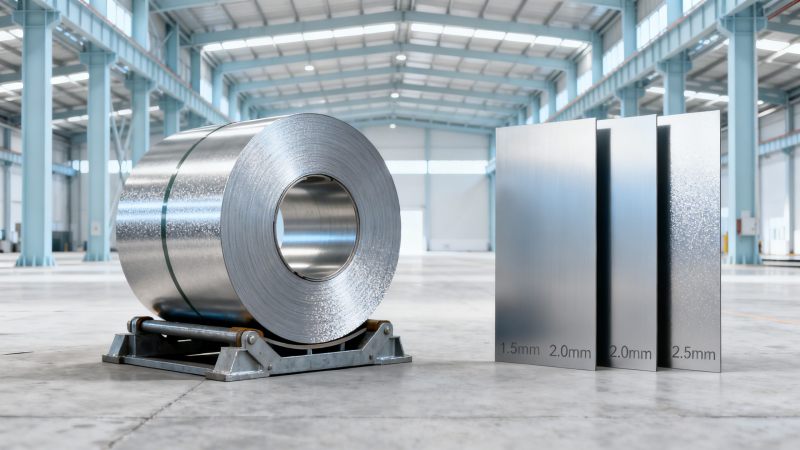
Steel sheets under 3mm are increasingly specified for cladding, decking, ductwork, and lightweight framing—driven by weight savings, logistics efficiency, and modular assembly speed. Yet their bending stiffness (EI) drops exponentially with thickness: halving thickness reduces flexural rigidity by a factor of eight. In real-world conditions—wind uplift on roofs, seismic sway in façades, or point loads from maintenance access—this translates directly into deflection risks exceeding serviceability limits (typically L/240 per EN 1993-1-1).
Thermal expansion mismatch also intensifies at sub-3mm gauges. A 12m span of 2.0mm galvanized sheet exposed to ΔT = 40°C may induce compressive stresses up to 120 MPa if restrained—enough to buckle unsupported edges or distort fastener zones. These aren’t theoretical concerns: field reports from Southeast Asia show 17–22% higher rework rates on thin-sheet roofing projects where thermal movement wasn’t modeled during detailing.
Hongteng Fengda addresses this through material-grade optimization—not just thickness selection. Our cold-formed steel sheets use Q345B and S355 base steels with controlled yield-to-tensile ratios (≤0.85), enabling predictable post-yield deformation rather than brittle fracture. All sheets undergo longitudinal tensile testing per ASTM A653/A653M with ≥3 test samples per heat batch, ensuring consistency across 2–12m production runs.
How Z-beam Reinforcement Mitigates Thin-Sheet Instability
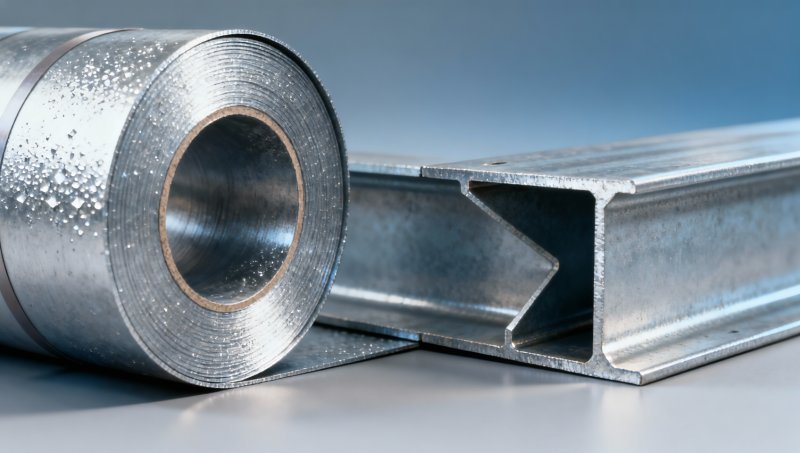
For applications requiring both lightness and localized rigidity—such as purlins supporting thin roof sheets or wall beams anchoring curtain wall panels—the Z-beam serves as a high-efficiency hybrid solution. Unlike flat sheets, its Z-shaped geometry increases second moment of area (Iy) by 3.2× compared to an equivalent-mass flat plate—dramatically raising buckling resistance while retaining low self-weight.
Our Z-beam profiles are available in thicknesses from 6–25mm, enabling precise matching to sheet gauge and loading demands. For example: a 1.5mm roof sheet paired with 12mm Z-purlins achieves optimal stiffness-to-mass ratio for industrial sheds in wind Zone III (peak gusts ≤ 45 m/s). Galvanized coating (Z275 or Z350 per EN ISO 1461) ensures 25+ years of corrosion resistance—even when cut or drilled onsite.
Critical dimensional control is maintained via CNC slitting: edge tolerance ±0.3mm over full length, and twist ≤1.5mm/m. This eliminates fit-up issues during bolted assembly—a common cause of delayed handover in prefabricated steel structures across the Middle East.
Z-beam Performance Parameters vs. Application Requirements
This table confirms that Z-beam specifications align precisely with structural needs where thin steel sheets operate at performance thresholds. The 6–25mm thickness range allows engineers to select profiles that prevent local buckling under concentrated loads—while maintaining compatibility with standard sheet metal fabrication tools used globally.
Procurement Checklist: 5 Non-Negotiables for Sub-3mm Steel Projects
Sourcing decisions for thin-gauge steel components involve technical, commercial, and compliance dimensions. Based on 8+ years of global project support, Hongteng Fengda recommends verifying these five criteria before finalizing orders:
- Mill Test Reports (MTRs): Must include chemical composition (C, Mn, Si, P, S), tensile strength, yield strength, and elongation—traceable to heat number and EN 10204 3.1 certification.
- Flatness Tolerance: ≤1.5mm deviation over 1m length for sheets <2.0mm; verified via laser scanning, not visual inspection.
- Galvanizing Adhesion: Minimum 400g/m² coating mass for outdoor exposure; tested per ASTM B680 (copper sulfate test) with zero blistering after 5 dips.
- Lead Time Consistency: Confirmed production schedule with ≤5-day variance across 3 consecutive shipments—critical for just-in-time construction workflows.
- OEM Flexibility: Ability to supply custom slit widths (±0.2mm), pre-punched patterns, or dual-standard compliance (e.g., ASTM + GB for mixed-spec projects).
We maintain 98.7% on-time delivery across North America and EU markets over the past 12 months—supported by dual-shift production lines and 15,000-ton monthly capacity. Every order includes free dimensional validation reports prior to dispatch.
Why Global Project Teams Choose Hongteng Fengda for Precision Steel Solutions
From procurement officers assessing total cost of ownership to safety managers validating compliance, decision-makers need more than catalog specs—they require verifiable process control and responsive engineering partnership. Hongteng Fengda delivers this through three integrated pillars:
- Standards-Centric Manufacturing: Full alignment with ASTM A653, EN 10346, JIS G3302, and GB/T 2518—each coil tested per standard sampling plans, not batch averages.
- Project-Embedded Support: Dedicated technical account managers co-review shop drawings, perform load-path analysis for Z-beam–sheet interfaces, and provide stamped calculation notes for local authority submissions.
- Risk-Managed Logistics: FCL container loading optimized for minimal transit damage; all exports accompanied by ISO 9001-certified packaging protocols and real-time shipment tracking (updated every 12 hours).
Whether you’re finalizing a tender for a 45,000m² logistics hub in Poland or specifying materials for a modular hospital in Kenya, we offer rapid response: sample requests fulfilled in ≤7 working days; formal quotations issued within 48 hours of complete technical inquiry; and certified test reports provided digitally before shipment.
Next Steps: Secure Your Project’s Structural Integrity
Don’t let thin-gauge steel become a hidden liability. Contact Hongteng Fengda today to:
- Request ASTM/EN-compliant test reports for your specific sheet gauge and grade;
- Obtain Z-beam dimensional templates compatible with your roofing system design;
- Review lead time options for urgent deliveries (standard: 25–35 days; express: 14–21 days with priority scheduling);
- Discuss OEM requirements—including custom perforation layouts, dual-standard marking, or bundled delivery with cold-formed studs.
Our engineering team responds to technical inquiries within 4 business hours. Let’s ensure your next project meets both performance targets—and peace-of-mind expectations.
Please give us a message


Please enter what you want to find