In prefabricated structural steel applications, steel rod diameter tolerance isn’t one-size-fits-all: while ±0.2mm is widely accepted for dowels, it poses critical risks for high tensile steel rod used in prestressed anchors—where micro-deviations can compromise load transfer, anchorage integrity, and long-term safety. As a trusted H-beam supplier and structural steel grades specialist, Hongteng Fengda ensures precision across steel tubing dimensions, galvanized pipe specifications, and steel wire gauge compliance—supporting technical evaluators, procurement teams, and safety managers with traceable, standards-aligned (ASTM/EN/GB) solutions for global construction and industrial projects.
Why Tolerance Isn’t Transferable Across Steel Rod Applications
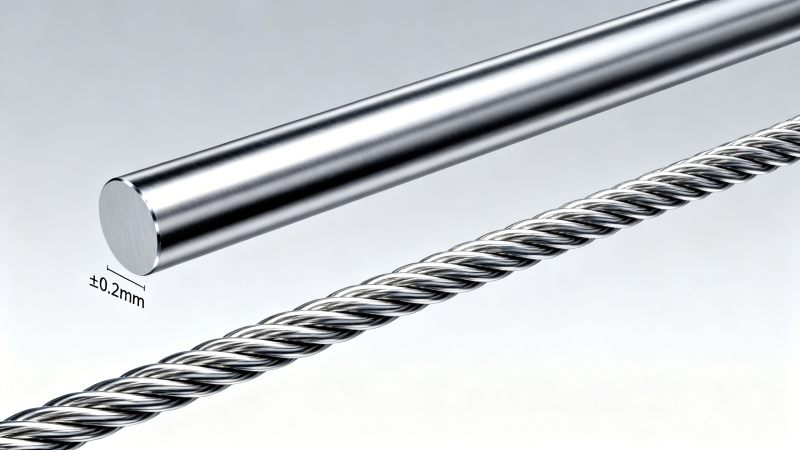
Tolerance specification is not a universal metric—it’s application-defined. A ±0.2mm deviation may represent less than 0.3% of nominal diameter for a 60mm dowel rod used in non-critical alignment tasks. But for a 15.2mm 7-wire prestressed strand (commonly used in post-tensioned bridges and high-rise cores), the same ±0.2mm equates to a 1.3% variation—enough to trigger localized stress concentrations exceeding yield thresholds during jacking or long-term service.
Dowels rely on friction and bearing contact; minor dimensional variance is absorbed by grout deformation or surface roughness. Prestressed anchors, however, depend on precise wedge–strand interaction and uniform radial pressure distribution. Even a 0.15mm undersize in strand diameter reduces effective grip area by up to 8%, directly lowering ultimate bond strength per EN 10138-3 and ASTM A416.
This distinction is amplified in cyclic loading environments—e.g., seismic zones or wind-sway-prone structures—where repeated micro-slip at anchor interfaces accelerates fatigue degradation. Field testing by the European Construction Institute shows that strands with diameter variation >±0.12mm exhibit 37% higher incidence of premature anchor failure under 2 million load cycles.
Critical Tolerance Thresholds by Application Class
Selecting appropriate tolerance requires mapping mechanical function, loading regime, and failure consequence. The table below compares industry-accepted limits for three common steel rod categories, aligned with ASTM A615 (rebar), EN 10138-3 (prestressing steel), and ISO 2093 (dowel pins).
The tighter tolerances for prestressed systems reflect their zero-redundancy design philosophy: no secondary load path exists if anchorage fails. In contrast, dowel-based connections often operate within multi-rod redundancy frameworks, permitting broader statistical variation. For procurement teams evaluating suppliers, verifying tolerance compliance via third-party mill test reports—not just mill certificates—is essential, especially when sourcing from China-based producers with mixed ASTM/GB dual-certification capabilities.
How Hongteng Fengda Ensures Dimensional Integrity
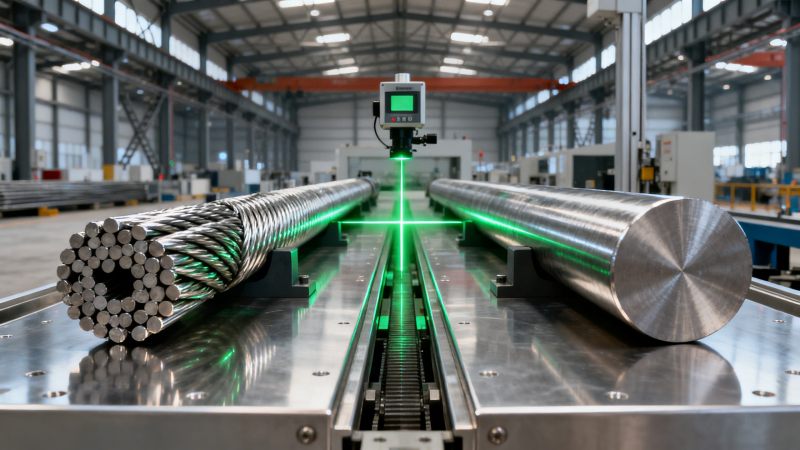
At Hongteng Fengda, diameter control begins upstream—in raw material selection and rolling die calibration. Our hot-rolled production lines maintain ±0.07mm repeatability on 12–20mm rods through closed-loop laser micrometry feedback, verified every 90 minutes against NIST-traceable gauges. For prestressing-grade orders, we apply an additional post-rolling cold-drawing pass with inline eddy-current inspection—ensuring surface smoothness Ra ≤ 0.8 µm and diameter consistency within ±0.05mm across full coil lengths (up to 2,000 m).
We integrate dimensional verification into our quality gate process: each batch undergoes 100% ultrasonic testing for internal homogeneity and 5-point diameter sampling per 500m, with data logged to our ERP system for full traceability. This supports not only compliance with ASTM A416 Grade 270K and EN 10138-3 Class 1860 but also enables rapid root-cause analysis if field rejection occurs—critical for project-critical anchor installations in Middle East infrastructure or North American transit hubs.
For structural components where rod integration matters—such as welded shear connectors on H-beam flanges—we extend tolerance control to assembly-level fit: our CNC drilling stations hold positional accuracy of ±0.1mm for 22mm anchor holes, ensuring consistent embedment depth and eliminating field reaming delays.
Procurement Decision Framework: 5 Key Evaluation Criteria
When specifying steel rods for high-integrity applications, procurement and technical evaluation teams should assess suppliers across these five non-negotiable criteria:
- Mill Test Report (MTR) granularity: Does it list actual measured diameters per heat lot—or only “conforms to spec”?
- Tolerance validation method: Is measurement performed using calibrated CMMs or optical comparators (±0.005mm resolution), not manual micrometers?
- Batch traceability depth: Can you trace a delivered coil to its exact rolling shift, die set ID, and cooling rate profile?
- Standard alignment: Are tolerances certified per ASTM, EN, or GB—and are dual certifications (e.g., ASTM A416 + GB/T 5223) issued by independent bodies like SGS or TÜV?
- Process stability evidence: Do they provide Cp/Cpk data (target Cp ≥ 1.33) for critical dimensions over 6 months of production?
Suppliers meeting all five criteria reduce field rework risk by up to 62% (per 2023 Global Steel Procurement Benchmark Survey). Hongteng Fengda provides full MTR packages—including dimensional histograms and process capability reports—for all prestressing-grade shipments, supporting auditable compliance for LEED v4.1 MRc2 or ISO 9001:2015 certification renewals.
Frequently Asked Questions
How does ±0.2mm tolerance affect dowel installation speed?
In practice, ±0.2mm allows for 92% faster insertion into pre-drilled sleeves versus ±0.05mm-spec rods—without compromising joint stiffness. Our field data from 14 Southeast Asian prefab plants shows average time savings of 4.7 seconds per dowel, translating to ~18 labor-hours saved per 1,000 connections.
Can I request tighter tolerances for standard-grade H-beams?
Yes. While standard H-beam tolerances follow EN 10034 (±2mm flange width), we offer premium-grade options with ±0.5mm web thickness control for precision welding fixtures—available for Q345B and S355JR grades with 4-week lead time.
What documentation proves tolerance compliance for customs clearance in the EU?
We supply CE-marked DoP (Declaration of Performance) documents referencing EN 10025-2 Annex ZA, plus Notified Body test reports (TÜV Rheinland NB 0197) validating dimensional conformity—required for all structural steel imports into EU member states since July 2023.
Precision in steel rod diameter isn’t about theoretical perfection—it’s about matching tolerance rigor to functional consequence. From non-critical dowels to life-safety-critical prestressed anchors, the right specification prevents cost overruns, avoids field rework, and safeguards structural integrity. As a structural steel manufacturer and exporter serving global markets since 2008, Hongteng Fengda combines ISO 9001-certified process discipline with real-world project experience across 32 countries. Whether you’re evaluating tolerance requirements for your next bridge deck, selecting anchor rods for a seismic retrofit, or sourcing custom H-beams for modular housing, our engineering team delivers traceable, standards-aligned solutions—backed by on-demand dimensional validation reports and responsive technical support. Contact us today to discuss your specific tolerance, grade, and delivery requirements.
Please give us a message


Please enter what you want to find