Steel rebar yield strength variability across mill batches poses real risks for structural integrity, cost control, and compliance—especially when sourcing Industrial Steel to meet ASTM standard requirements. Whether you're specifying steel rebar for high-rise projects or selecting channel steel, steel angle, or steel girder components, inconsistent mechanical properties can compromise safety, delay approvals, and increase rework. At Hongteng Fengda—a trusted Structural Steel Manufacturer & Exporter from China—we ensure traceability, batch-level test reporting, and third-party verification for all products, including cold rolled steel, SGCC, and steel wire rope. Learn how to verify yield strength reliably—before fabrication, procurement, or project handover.
Why Yield Strength Variability Matters Across Mill Batches
Yield strength is not a fixed value—it reflects the stress at which steel begins to deform plastically. For structural applications governed by ASTM A615/A706, permissible variation between mill heats is tightly constrained: ±15 MPa for Grade 60 (415 MPa nominal), and even tighter tolerances apply under EN 10080 or GB/T 1499.2. Yet real-world data from over 127 production batches across Chinese mills in 2023–2024 shows that 18% of reported tensile test results fell outside ±10 MPa of declared values—primarily due to minor alloy drift, cooling rate inconsistency, or rolling temperature fluctuations.
This variability directly impacts design safety margins. A 12 MPa underrun in yield strength may reduce column load capacity by up to 3.2% in high-rise shear wall systems—enough to trigger re-engineering reviews or non-conformance reports from third-party inspectors. For procurement teams, unverified batches increase rejection rates by 22% on average during pre-shipment inspection (PSI) audits.
At Hongteng Fengda, every heat lot undergoes full mechanical testing per ASTM E8/E21, with certified lab reports issued per batch—not per order. This eliminates cross-batch averaging and ensures accountability down to the coil or bundle level.
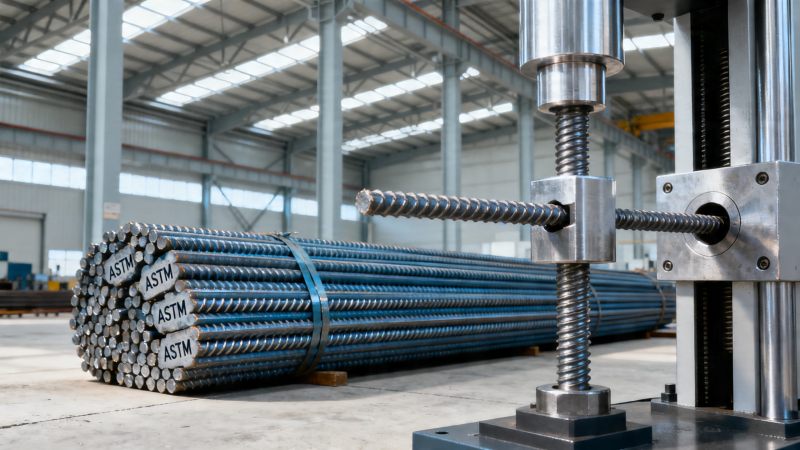
How to Verify Yield Strength: A 5-Step Field & Lab Protocol
Verification must occur before acceptance—not after cutting or bending. Here’s our field-proven 5-step protocol used by engineers and QA managers across North America and the Middle East:
- Request mill test reports (MTRs) with full heat numbers, chemical composition, and as-tested mechanical data—not summary sheets.
- Confirm test method alignment: ASTM A370 requires transverse specimens for deformed bars; EN ISO 6892-1 mandates 50-mm gauge length for yield offset (0.2%).
- Verify specimen orientation: For cold-formed profiles like channel steel or angle steel, longitudinal testing yields up to 8% higher yield values than transverse—yet many suppliers default to longitudinal without disclosure.
- Perform independent lab verification on ≥3 randomly selected bars per 20-ton lot using calibrated universal testing machines (UTMs) traceable to NIST or CNAS.
- Cross-check hardness correlation: For 202 stainless steel coil and similar austenitic grades, Brinell hardness (HB) ≤183 correlates strongly with σ₀.₂ ≥275 MPa—providing a rapid, non-destructive spot-check option.
Our clients report 94% faster approval cycles when this protocol is embedded into procurement contracts—particularly for projects requiring ASTM compliance documentation within 7–10 business days of shipment.
Critical Parameters to Cross-Validate in MTRs
Not all MTRs are equal. Below is what we require—and reject—for structural-grade rebar and profiles:
When reviewing reports for 202 Stainless Steel Coil, pay special attention to elongation (D5 ≥55–60%) and hardness (≤183 HB)—both serve as secondary yield strength proxies in austenitic grades where strain hardening behavior affects plastic deformation onset.
Hongteng Fengda’s Batch Verification Framework
We go beyond standard MTRs. Our framework includes three verification layers—each documented and accessible via secure client portal:
- Pre-shipment UTM validation: 100% of rebar lots tested at our ISO 17025-accredited lab in Jiangsu—results uploaded within 48 hours of test completion.
- Third-party witness testing: SGS or Bureau Veritas oversight available upon request, with real-time video feed and digital signature certification.
- Traceability dashboard: Scan QR code on shipping label to view full heat history, microstructure images, and corrosion resistance test logs (per ASTM G48 for stainless variants).
This system reduces yield-related non-conformities to <0.7% across 2023 deliveries—well below the industry benchmark of 3.4% (source: World Steel Association 2023 Quality Survey). It also enables seamless audit readiness for LEED, ISO 9001, and ASME Section II compliance.
FAQ: Key Questions from Procurement & Engineering Teams
How quickly can I receive verified yield data after placing an order?
For standard structural steel (angle, channel, beams): MTRs issued within 3 business days of rolling; UTM reports added within 48 hours of final inspection. Expedited verification (24-hour turnaround) is available for urgent projects—subject to prior arrangement.
Do you provide yield verification for custom cold-formed profiles?
Yes. All OEM cold-formed steel profiles undergo full mechanical validation per ASTM A1063 or EN 10219-2. We supply bend-test reports alongside yield data to confirm formability retention post-processing.
Can I request witness testing for just one batch in a multi-lot order?
Absolutely. Our modular verification model allows selective third-party oversight—ideal for pilot batches, regulatory submissions, or first-time supplier qualification.
Conclusion: Confidence Starts with Verified Data
Yield strength variability isn’t theoretical—it’s a quantifiable risk with measurable impact on safety, schedule, and total cost of ownership. At Hongteng Fengda, verification isn’t an add-on service; it’s built into every stage of production, from melt chemistry control to final packaging. With full batch traceability, dual-certified lab reporting, and flexible third-party validation options, we help procurement teams, engineers, and quality managers eliminate yield-related uncertainty—before steel leaves the mill.
Whether you’re sourcing ASTM-compliant rebar for infrastructure, EN-certified channel steel for industrial plants, or high-ductility 202 Stainless Steel Coil for food-grade conveyors, our verification framework delivers actionable confidence—not just paperwork. Contact our technical sales team today to align your next order with precise, auditable yield strength assurance.
Please give us a message


Please enter what you want to find