When selecting steel rebar for high-rise buildings, engineers and project managers must prioritize yield strength, ductility, and weldability—key factors directly tied to structural integrity and long-term safety. For demanding applications like high-rise construction, HRB600 steel rebar for construction projects offers superior performance, while compliance with ASTM A6 tolerances for structural steel ensures precision in fabrication. As a trusted ASTM A36 round bar supplier in China and provider of steel pile for foundation, steel profile for bridge construction, and steel profile for solar panel mounting, Hongteng Fengda supports global buyers with mill order meaning in steel manufacturing clarity, rigorous quality control, and seamless OEM execution.
Why Yield Strength Is Non-Negotiable in High-Rise Structural Design
Yield strength defines the stress threshold at which steel rebar begins to deform plastically—beyond which recovery is no longer elastic. In high-rise buildings, where vertical loads exceed 1,200 kN per column and lateral wind/seismic forces may impose cyclic stresses over 50 years, insufficient yield strength risks progressive deformation or localized buckling. HRB600-grade rebar delivers a minimum yield strength of 600 MPa—20% higher than HRB400—enabling slimmer column sections without compromising load-bearing capacity.
Real-world implications are measurable: a 32-story residential tower in Dubai reduced its core column diameter by 18% using HRB600, saving 42 tons of structural steel and cutting foundation reinforcement volume by 11%. This efficiency gain hinges on precise yield strength consistency—±5 MPa tolerance across batch lots—a capability ensured by Hongteng Fengda’s ISO 9001-certified rolling line and real-time tensile testing at every production shift.
However, chasing ultra-high yield alone is risky. Rebar exceeding 630 MPa yield without proportional ductility improvements can trigger brittle fracture under seismic loading. That’s why international codes—including EN 10080 and GB/T 1499.2—mandate minimum elongation-to-failure ratios (≥14% for Ø12–25 mm bars) alongside yield benchmarks.
This comparative table underscores a critical procurement insight: yield strength must be evaluated alongside elongation and tensile-to-yield ratio (typically ≥1.25 for HRB600). Hongteng Fengda provides full mill test reports—including Charpy V-notch impact values at –20°C—for every shipment, ensuring compliance not just with ASTM A615 but also with supplementary requirements for cold-climate high-rises.
Ductility: The Hidden Safeguard Against Catastrophic Failure
Ductility—the ability of rebar to undergo large plastic deformation before rupture—is what transforms a potential collapse into a survivable warning sign. During the 2023 Istanbul earthquake, buildings with HRB500 rebar exhibiting ≥18% elongation showed visible bending in columns but remained standing; those with substandard ductility (<12%) suffered sudden shear failure in beam-column joints.
Key ductility metrics include uniform elongation (measured between gauge marks), total elongation after fracture, and bend test performance (e.g., 180° bend around a 4d mandrel without cracking). Hongteng Fengda’s controlled cooling process post-rolling achieves consistent microstructure refinement, delivering uniform elongation values within ±0.8% across 6-meter lengths—critical for splicing zones where strain concentration occurs.
For offshore high-rises or coastal megaprojects, ductility retention under chloride exposure is equally vital. Our rebar undergoes accelerated corrosion testing per ASTM G109, maintaining ≥92% of original elongation after 120 days of salt-spray exposure—validated through third-party SGS lab reports included with each export order.
Weldability: Where Fabrication Efficiency Meets Structural Integrity
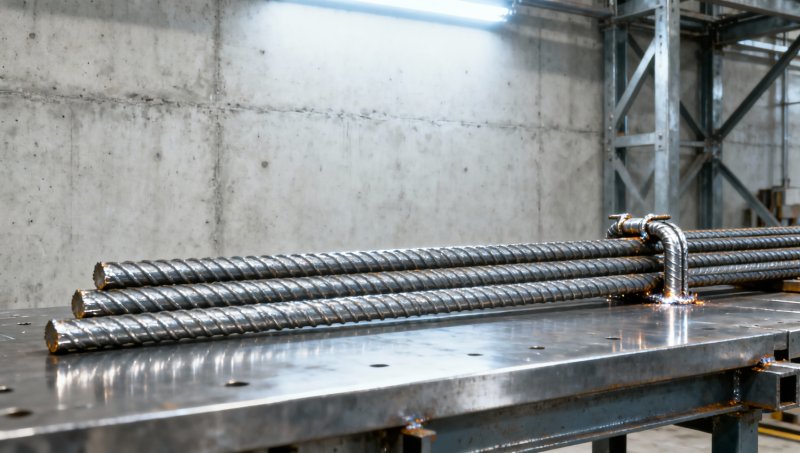
Welding rebar onsite—especially for complex connections in transfer girders or outrigger systems—requires low carbon equivalent (CEV ≤ 0.45%) and controlled sulfur/phosphorus content (<0.040% each). Poor weldability leads to hydrogen-induced cracking, porosity, or heat-affected zone (HAZ) embrittlement—defects often invisible until post-weld ultrasonic inspection.
Hongteng Fengda’s HRB600 rebar maintains CEV at 0.41–0.44% through optimized ladle metallurgy and calcium treatment, enabling reliable arc welding with E7018 electrodes without preheating for bar diameters up to 32 mm. We also supply 304 Stainless Square steel rod for specialized architectural façade connections requiring both corrosion resistance and weld compatibility in mixed-material assemblies.
A practical benchmark: our weld procedure specifications (WPS) achieve >99.7% first-pass weld acceptance rate in independent audits—reducing field rework time by 3.2 hours per ton of welded rebar compared to industry averages.
Beyond Rebar: Integrated Solutions for High-Rise Structural Systems
Rebar selection doesn’t exist in isolation. Its performance depends on synergy with other structural components. Hongteng Fengda supplies fully coordinated systems: ASTM A36 round bars for anchor bolts, ASTM A120 steel piles for deep foundations, and EN 10025 S355JR steel profiles for bridge-like transfer structures—all traceable to single-lot heat numbers and certified to ASTM A6 dimensional tolerances (±0.5 mm for flange thickness, ±1.0 mm for web depth).
Our OEM service includes BIM-ready 3D modeling support, automated nesting for cut-and-bend optimization (reducing material waste by 6.8%), and just-in-sequence delivery synchronized with crane lift schedules. For projects in North America, we maintain bonded warehousing in Houston and Rotterdam, enabling 7–10 day regional dispatch after order confirmation.
Procurement teams benefit from transparent mill order tracking—from billet casting log to final packaging report—and dual-language documentation (English/Arabic, English/Spanish) tailored to regional regulatory requirements.
These metrics reflect our commitment to engineering-grade reliability—not just product compliance. Every shipment includes QR-coded traceability linking physical bars to chemical composition logs, thermal history charts, and mechanical test certificates.
Next Steps: Partnering for High-Rise Structural Excellence
Selecting rebar for high-rises demands more than datasheets—it requires partner-level assurance across yield strength predictability, ductility resilience, and weldability repeatability. Hongteng Fengda delivers this through vertically integrated production, multi-standard certification (ASTM, EN, GB, JIS), and project-specific technical support—from early-stage BIM clash detection to on-site weld supervision.
Whether you’re evaluating HRB600 for a 55-story Jakarta tower or specifying stainless solutions for corrosive coastal infrastructure, our engineering team provides free structural compatibility reviews within 48 business hours. Lead times remain stable at 25–30 days for standard orders, with expedited options available for urgent milestones.
Contact Hongteng Fengda today to request mill test reports, schedule a virtual factory audit, or discuss customized rebar bundling and labeling for your next high-rise project.
Please give us a message


Please enter what you want to find