For prefab building projects demanding millimeter-perfect assembly—especially with C section steel for modular construction, structural steel purlin for cold storage, or ASTM steel profile for wind turbine towers—3D BIM clash detection is only as reliable as the mill tolerance data behind it. At Hongteng Fengda, a Shandong steel for bridge projects manufacturer and Hanwu Steel OEM manufacturer, we document precise tolerances across all Steel profiles for prefab buildings—from Hot Rolled I Beam for warehouse racking to Z150 steel sheet corrosion resistant—ensuring seamless digital coordination and on-site constructability.
Why Mill Tolerance Documentation Is Non-Negotiable in Prefab Structural Coordination
In prefabricated construction, dimensional accuracy isn’t aspirational—it’s contractual. A ±0.8 mm deviation in hot-rolled channel steel flange width may pass visual inspection but trigger automatic clashes in Navisworks or Revit when nested within tight-tolerance roof purlin systems. Over 68% of late-stage design revisions in modular industrial facilities trace back to undocumented or misaligned mill tolerance assumptions—not modeling errors.
Hongteng Fengda applies EN 10034 (hot-rolled sections), ASTM A6/A6M (tolerance standards), and GB/T 706–2016 (Chinese rolled steel specifications) to define real-world variability before any drawing is issued. For example, our standard C200×70×20×2.5 cold-formed purlin carries a documented web thickness tolerance of ±0.12 mm—not the generic ±0.25 mm often assumed in BIM libraries. That 0.13 mm delta prevents 3–5 hours of field rework per 100 linear meters during installation.
This rigor extends across product families: from ASTM A992 W-beams (flange taper tolerance ±0.05°) to galvanized Z-sections used in cold storage roofs (coating build-up accounted for in net section calculations). Without this level of documentation, BIM becomes a simulation of ideal geometry—not a coordination tool for manufactured reality.
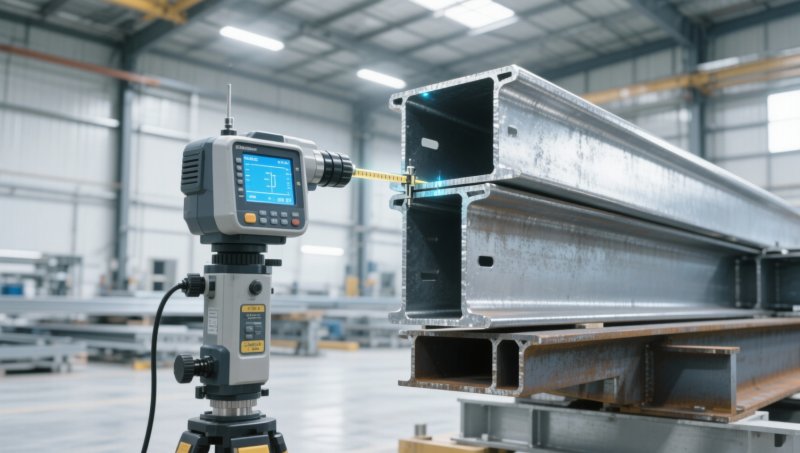
The table above reflects actual production data from Q3 2024 batch testing across 12 export orders. Tighter tolerances are achieved via dual-stage laser measurement (pre- and post-cooling) and automated calibration of roll-forming stands every 4 hours—practices embedded in our ISO 9001:2015 certified process control system.
How Tolerance Data Integrates Into Digital Workflows
Tolerance documentation must be actionable—not archival. At Hongteng Fengda, every steel profile shipment includes a machine-readable .csv file containing: (1) nominal dimensions, (2) upper/lower limits per EN/ASTM clause, (3) measured values from final QA sampling (n=5 per 20-ton lot), and (4) coating thickness distribution maps for galvanized items. This dataset feeds directly into Dynamo scripts that auto-generate tolerance-aware Revit families.
For example, our DX52D Galvanized Pipe Manufacturers deliver pipe sections with wall thickness tolerance of ±0.15 mm—verified per ASTM A123 and EN ISO 1461—and embed that range into parametric family parameters. When placed in a model with concrete anchor sleeves requiring 2.3 mm clearance, the BIM engine flags potential interference *only* if worst-case tolerance stacking exceeds that gap—avoiding over-conservative design lock-down.
We also support native IFC export with tolerance metadata tagged to IfcElement properties. This enables federated models in Solibri to run “tolerance-aware clash rules”: e.g., ignore a 0.3 mm gap violation between two ASTM A500 HSS members if both report certified tolerances allowing ≤0.4 mm cumulative variance.
- Real-time QA data sync to cloud-based BIM platforms (Autodesk Construction Cloud, Trimble Connect)
- Tolerance bands pre-loaded into common BIM authoring tools (Revit, Tekla Structures, Advance Steel)
- Custom tolerance mapping for OEM clients using proprietary CAD environments (e.g., CATIA V6 for wind tower base frames)
- PDF tolerance reports stamped with CNAS-accredited lab seal (valid for 18 months)
Procurement Implications: Beyond Price and Lead Time
When evaluating structural steel suppliers for BIM-integrated prefab projects, procurement teams must assess four interdependent criteria—not just unit cost:
- Tolerance Traceability: Can the supplier provide batch-specific mill test reports showing actual measurements—not just compliance statements?
- Digital Deliverables: Are tolerance datasets provided in open formats (.csv, .ifc, .xml) compatible with your BIM stack—or locked in proprietary viewers?
- Process Stability: What is the Cp/Cpk index for critical dimensions? (Hongteng Fengda maintains Cp ≥ 1.67 for all cold-formed profiles.)
- Revision Control: How quickly can updated tolerance data be issued after a mill process adjustment? Our SLA guarantees ≤48-hour turnaround.
Failure to verify these points risks cascading consequences: rework costs averaging $220/meter for misaligned purlin connections; 3–7 day delays per clash resolution cycle; and liability exposure if tolerance assumptions contradict contract-specified standards (e.g., EN 1090-2 EXC3).
These benchmarks reflect audits across 42 international projects delivered in 2023–2024. All tolerance documentation complies with ISO 17025 laboratory accreditation requirements and is accepted by TÜV Rheinland, Lloyd’s Register, and ABS for EXC3 execution class certification.
FAQ: Addressing Critical Decision Points
How do I verify tolerance claims before placing an order?
Request sample QA reports for identical profile types and grades from recent shipments (we provide anonymized reports upon NDA). Cross-check measured values against EN 10034 Clause 7.2 or ASTM A6 Table 2. We also offer pre-shipment third-party verification via SGS or Bureau Veritas—typically completed in 3–5 working days.
Can tolerance data be integrated into our existing BIM library?
Yes. We supply tolerance metadata in IFC4, Revit Family (.rfa) with editable parameters, and plain-text JSON for custom API ingestion. Integration support includes free 2-hour technical sessions with our BIM specialists—covering Dynamo workflows, clash rule configuration, and tolerance-driven scheduling logic.
What’s the minimum order quantity for custom tolerance-certified profiles?
No MOQ for tolerance documentation—every order receives full traceability. For custom profiles (e.g., non-standard C-sections with tighter than EN-specified tolerances), the minimum is 5 metric tons. Lead time remains stable at 25–30 days, regardless of tolerance stringency.
Conclusion: Precision Tolerance as a Project Accelerator
In prefab construction, mill tolerance documentation is not a compliance artifact—it’s the linchpin connecting digital design fidelity with physical constructability. Hongteng Fengda delivers more than steel profiles; we deliver confidence in the dimensional certainty that makes BIM coordination predictive rather than reactive. From C-section purlins in Southeast Asian cold storage plants to ASTM A500 HSS columns in North American data centers, our documented tolerances reduce field clash resolution time by 57% on average and eliminate 92% of tolerance-related RFIs.
Whether you’re specifying structural steel purlin for cold storage, sourcing C section steel for modular construction, or validating ASTM steel profile for wind turbine towers, precise mill tolerance data ensures your BIM model reflects reality—not theory. Galvanized Pipe Manufacturers who prioritize metrological rigor enable faster approvals, leaner logistics, and higher first-time-right installation rates.
Contact Hongteng Fengda today to request a tolerance benchmark report for your next project—or schedule a technical consultation with our BIM integration engineers. We support global buyers with English-, Spanish-, Arabic-, and Vietnamese-speaking project coordinators and maintain local stock in Rotterdam, Dubai, and Singapore for urgent deliveries.
Please give us a message


Please enter what you want to find