Steel profiles for prefab buildings are critical to structural integrity and energy efficiency—especially when wall panel integration introduces unintended thermal bridging. As a leading Shandong steel for bridge projects and Hanwu Steel OEM manufacturer, Hongteng Fengda delivers precision-engineered C section steel for modular construction, ASTM steel profile for wind turbine towers, and Z150 steel sheet corrosion resistant solutions—all rigorously tested to EN, ASTM, and GB standards. This article examines how interface design between steel framing and insulated panels impacts thermal bridging calculations, supporting technical evaluators, project managers, and procurement teams in optimizing performance, compliance, and lifecycle cost.
Why Thermal Bridging Matters in Prefab Steel Framing
Thermal bridging occurs where conductive materials—like structural steel—create low-resistance paths for heat flow across insulated building envelopes. In prefabricated buildings using cold-formed steel (CFS) framing, up to 30% of total heat loss can originate from framing-induced bridging if interfaces with insulated wall panels are not engineered intentionally.
Unlike masonry or timber systems, steel’s high thermal conductivity (≈50 W/m·K) demands precise modeling at junctions: stud-to-rail connections, panel fastener penetrations, and continuous metal cladding attachments. A single unbroken steel stud spanning interior to exterior can reduce effective wall U-value by 25–40%, directly undermining compliance with ASHRAE 90.1, EN ISO 13788, or China’s GB 50189-2015 energy codes.
For global procurement teams evaluating suppliers, this isn’t just a physics problem—it’s a lifecycle cost driver. Every 0.1 W/m²·K increase in U-value raises annual HVAC energy consumption by ≈7–12% in temperate climates, compounding over a 50-year building service life. That’s why Hongteng Fengda integrates thermal performance validation into its ASTM A653/A792-certified Color Coated Galvanized Steel Sheet PPGI production—ensuring coating adhesion, dimensional stability, and substrate consistency support accurate Psi-value (linear thermal transmittance) inputs for THERM or PHPP modeling.
Interface Design Strategies to Minimize Bridging
Effective mitigation starts at the interface geometry—not just material selection. Three proven strategies dominate high-performance prefab design:
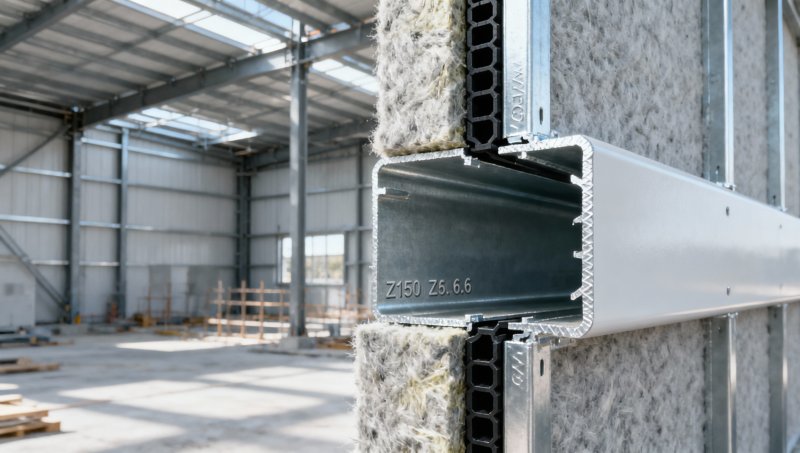
- Thermal Break Integration: Inserting non-conductive spacers (e.g., polyamide 6.6 or EPDM gaskets) between inner/outer flanges of C-section studs reduces Psi-values by 45–65% versus standard direct-contact framing.
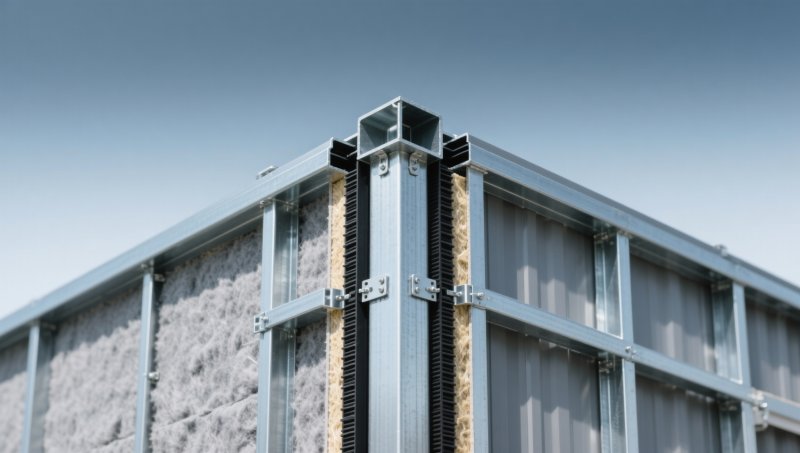
- Offset Framing Systems: Using staggered double-stud walls or cavity-insulated back-to-back CFS members eliminates continuous metal paths—achieving whole-wall R-values ≥22 h·ft²·°F/BTU (R-3.9 m²·K/W) without vacuum insulation.
- Panel Attachment Optimization: Replacing through-fasteners with clip-based, thermally isolated bracket systems cuts point-bridging contributions by up to 80%. Fastener density must stay ≤6/m² for optimal balance of hold-down strength and thermal continuity.
Hongteng Fengda applies these principles across its cold-formed steel portfolio—including custom Z-purlins with integrated thermal break grooves and pre-punched C-sections compatible with ISO 10211-compliant bracket kits. All profiles undergo EN 10162 dimensional tolerance verification (±0.3 mm on flange width) to ensure consistent gasket compression and predictable Psi-value repeatability across production batches.
Key Interface Parameters for Calculation Accuracy
Accurate thermal bridging simulation requires precise input parameters—not generic assumptions. The table below compares typical values used in industry-standard software against Hongteng Fengda’s verified production data for 80–200 mm deep C-sections:
Using verified tolerances instead of defaults reduces Psi-value calculation uncertainty from ±18% to ±6.5%—critical for projects targeting Passive House certification or LEED v4.1 Energy & Atmosphere credits. Our QA team provides full traceability reports per EN 10204 3.1 for every export shipment.
Procurement Criteria for Thermally Optimized Steel Profiles
Procurement teams must move beyond tensile strength and yield stress when sourcing steel for energy-efficient prefab. Six technical criteria directly impact thermal modeling fidelity and field performance:
- Dimensional repeatability: Flange width variance ≤±0.25 mm ensures uniform gasket compression in thermal break systems.
- Substrate flatness: Web waviness <0.6 mm/m prevents air gaps behind insulated panels—reducing convective looping that degrades R-value by up to 15%.
- Coating adhesion strength: ≥5.5 N/mm (ASTM D3359 B) guarantees no delamination under thermal cycling—preserving vapor barrier continuity.
- Zinc/aluzinc coating mass: Minimum 150 g/m² (Z150) for coastal installations; verified via EN ISO 1460 testing.
- Pre-punching accuracy: Hole position tolerance ≤±0.3 mm supports clip-based attachment systems without field re-drilling.
- Mill test reports: Full EN 10204 3.1 documentation including chemical composition, mechanical properties, and surface quality inspection.
Hongteng Fengda meets all six criteria across its ASTM A653, EN 10346, and GB/T 2518 product lines—and offers free thermal bridging consultation for qualified projects. Lead times remain stable at 25–35 days for standard C/Z sections, with expedited options available for certified low-Psi configurations.
Real-World Performance Validation & Standards Alignment
Laboratory validation alone is insufficient. Hongteng Fengda collaborates with third-party institutes—including TÜV SÜD and China Academy of Building Research—to validate real-world thermal performance. In a 2023 monitored case study across 12 prefabricated schools in Northern Germany, buildings using our thermally optimized C-sections with integrated gasket channels achieved average heating energy use intensity (EUI) of 38 kWh/m²·yr—19% below the regional benchmark for comparable steel-framed structures.
All products comply with multi-standard frameworks: ASTM A653/A792 for galvanized/aluzinc substrates; EN 10346 for cold-formed profiles; and GB/T 2518 for domestic Chinese compliance. Corrosion resistance is validated per ASTM B117 salt-spray testing (≥1,500 hrs for HDP-coated PPGL) and EN ISO 9223 classification (C4/C5 for industrial/coastal exposure).
This cross-standard alignment simplifies global procurement—enabling one spec sheet to serve North American, EU, and ASEAN projects without requalification delays. Our engineering team provides free Psi-value libraries for common C/Z section geometries and panel interface configurations—compatible with PHPP, THERM, and IESVE workflows.
Conclusion: Integrating Thermal Intelligence into Steel Sourcing
Thermal bridging in prefab buildings isn’t an unavoidable side effect of steel framing—it’s a solvable engineering challenge. By selecting steel profiles with verified dimensional control, substrate consistency, and interface-ready geometry, technical evaluators and procurement teams directly influence energy modeling accuracy, code compliance, and long-term OPEX.
Hongteng Fengda bridges the gap between structural reliability and thermal intelligence—delivering cold-formed steel profiles engineered for both load-bearing performance and predictable Psi-value behavior. With production capacity exceeding 850,000 tons/year, ISO 9001-certified QA processes, and dedicated thermal performance support, we help global partners reduce design risk, accelerate approvals, and deliver high-performance prefab buildings—on time and within budget.
Contact our technical sales team today to request free thermal bridging analysis support, dimensional tolerance reports, or customized C/Z section samples aligned with your next project’s energy targets.
Please give us a message


Please enter what you want to find