When selecting steel plate for construction, relying solely on thickness is a common—but costly—mistake. Yield strength determines real-world load capacity, safety margins, and long-term structural integrity. As a trusted steel rebar manufacturer and H beam manufacturer from China, Hongteng Fengda emphasizes performance-driven specs over superficial metrics. Whether you're evaluating carbon steel price vs. galvanized steel price, sourcing steel rebar cost-effective solutions, or specifying L angle steel dimensions for critical joints, understanding yield strength helps procurement teams, engineers, and project managers optimize value—not just volume. Explore why it matters more than thickness alone.
Why yield strength—not thickness—defines structural reliability
Thickness measures physical dimension—not resistance to deformation. A 25mm-thick plate with 235 MPa yield strength may buckle under loads where a 16mm plate rated at 355 MPa remains fully elastic. In high-stress zones like bridge girders, seismic braces, or offshore platform foundations, yield strength directly governs the safety factor (typically 1.5–2.0 per EN 1993-1-1) and service life expectancy.
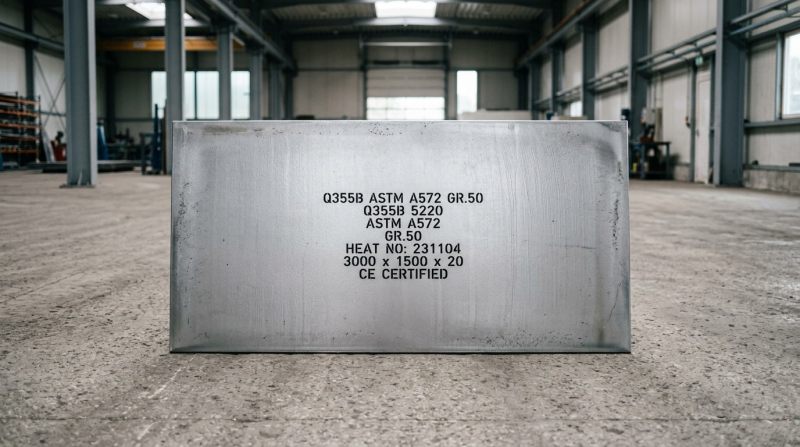
Hongteng Fengda’s structural steel plates comply with ASTM A36 (250 MPa min), ASTM A572 Gr.50 (345 MPa min), and GB/T 1591 Q355B (355 MPa min)—ensuring consistent mechanical performance across batches. Unlike generic mill certificates, our test reports include tensile testing data per ASTM E8, verified by third-party labs in Shanghai and Rotterdam.
For projects requiring fatigue resistance—such as wind turbine towers or crane rails—yield-to-tensile ratio (Y/T) becomes critical. Our Q460D plates maintain Y/T ≤ 0.85, minimizing plastic strain accumulation over 2 million+ stress cycles. This is non-negotiable for infrastructure with 50-year design lifespans.
How yield strength impacts procurement decisions across roles
Procurement officers often benchmark steel plate pricing per tonne—but overlooking yield grade can inflate total installed cost by 12–18%. Higher-grade plates (e.g., S460ML vs. S235JR) allow thinner sections, reducing welding labor (by up to 30%), transportation weight (cutting freight costs by ~$12–$28/tonne), and foundation loading (lowering concrete volume by 8–15%).
Technical evaluators must cross-check yield strength against application-specific thresholds: seismic zones require ≥345 MPa; marine environments demand ≥355 MPa with Charpy V-notch impact ≥27J at –20°C; cold-formed purlins need controlled yield-to-tensile ratios to prevent springback during roll-forming.
Financial approvers benefit from lifecycle costing models. A 12mm S355 plate may cost 9% more upfront than S235—but reduces long-term maintenance by deferring corrosion-induced section loss by 12–15 years in coastal builds. That translates to $420–$680/m² in avoided remediation over 30 years.
This table reflects real-world decision checkpoints used by Hongteng Fengda’s engineering support team when reviewing RFQs from North American general contractors and EU prefabrication firms. We validate every yield claim against mill test reports—and provide digital traceability via QR-coded heat numbers.
Where yield strength meets real-world applications
In modular construction, yield strength dictates connection integrity: S355 plates enable bolted moment connections with M24 Grade 10.9 bolts—reducing field welding by 65% versus S235. For industrial flooring, our 10mm S460NL plates withstand forklift axle loads of 12 tonnes while maintaining ≤0.3mm deflection over 3m spans—critical for automated guided vehicle (AGV) navigation accuracy.
Corrosion-prone environments add another layer: hot-dip galvanized steel conduit requires base material with ≥275 MPa yield to resist coating fracture during bending. That’s why we recommend Electrical Conduit Galvanized made from DX52D-grade steel—offering 275 MPa minimum yield plus 25-micron total zinc coating for 25+ years of service in chemical plants or wastewater facilities.
For heavy machinery frames, yield strength must exceed dynamic load peaks by ≥2.5×. Our cold-formed RHS 200×100×8mm sections—produced to EN 10219 S420MH—achieve 420 MPa yield with ±0.15mm wall thickness tolerance, enabling precise robotic welding without fit-up correction.
How Hongteng Fengda ensures yield strength consistency
We control yield strength at three production stages: (1) chemistry tuning (C: 0.12–0.18%, Mn: 1.2–1.6% for S355); (2) thermo-mechanical rolling (finish temp: 780–820°C, cooling rate: 15–25°C/s); (3) post-rolling normalization (910°C × 45min + air cool). Every heat undergoes ultrasonic testing (UT) per EN 10160 S4 class to eliminate internal laminations that compromise yield uniformity.
Our quality assurance includes batch-level tensile testing on 3 samples per 50 tonnes—with full traceability to ladle number, rolling date, and furnace ID. Delivery lead time averages 2–4 weeks for standard grades (S235–S355), and 6–8 weeks for high-yield variants (S460–S690), with stable capacity of 120,000 tonnes/year.
For buyers requiring rapid validation, we offer pre-shipment sample testing at SGS or Bureau Veritas labs—with reports delivered digitally within 72 hours. All certifications meet ASTM, EN, JIS, and GB standards, and we support OEM labeling, custom packaging, and container loading plans aligned with your port requirements.
Ready to align yield strength with your project’s real demands?
Contact Hongteng Fengda for: (1) Yield grade selection support based on your load calculations and environmental exposure; (2) Cross-referenced compliance documentation for ASTM/EN/GB dual-certification; (3) Lead time confirmation for urgent deliveries (minimum 7-day express production available); (4) Technical review of your fabrication drawings for weldability and forming feasibility; (5) Sample kits with certified test reports for pre-bid evaluation.
We don’t sell steel—we engineer structural confidence. Let’s build your next project on proven performance, not just paper specs.
Please give us a message


Please enter what you want to find