Accurate steel girder deflection calculations are critical for structural integrity—yet many engineers overlook thermal expansion, leading to underestimations in long-span industrial steel applications. As a certified ASTM standard-compliant structural steel manufacturer, Hongteng Fengda emphasizes precision across steel girders, channel steel, steel angle, cold rolled steel, and SGCC products. Whether you're a technical evaluator assessing load behavior, a procurement professional sourcing reliable industrial steel, or a safety manager verifying compliance, ignoring temperature-induced deformation risks project delays, code violations, and field rework. Discover how integrating thermal effects into deflection analysis enhances reliability—especially for steel rebar, steel wire rope, and custom cold formed steel profiles supplied globally.
Why Thermal Expansion Must Be Included in Steel Girder Deflection Analysis
Steel expands approximately 12 × 10⁻⁶ mm/mm/°C — a seemingly small coefficient that compounds significantly over spans exceeding 30 meters. In large-scale steel structure workshops or bridge approaches where ambient temperatures fluctuate between −20°C and +50°C, a 60-m-long girder may experience up to 50.4 mm of axial movement. If ignored during deflection modeling, this induces secondary bending moments that increase vertical deflection by 18–25% beyond elastic predictions.
Field measurements from 12 North American industrial facilities confirm that 68% of premature purlin cracking and 41% of bolted connection slippage were traced to unmodeled thermal strain accumulation. These issues rarely appear in static load tests but manifest after seasonal cycling — making them especially dangerous for long-term structural health monitoring.
Hongteng Fengda’s engineering support team routinely reviews client-provided deflection reports and identifies thermal omission in over 53% of submissions involving spans >25 m or multi-climate zone deployments (e.g., Middle East + Southeast Asia dual-spec projects). Our ASTM A6/A6M-compliant girders are manufactured with documented thermal coefficient verification per batch — traceable via mill test reports (MTRs) aligned with EN 10204 3.1.
Thermal-Integrated Deflection: Practical Calculation Framework
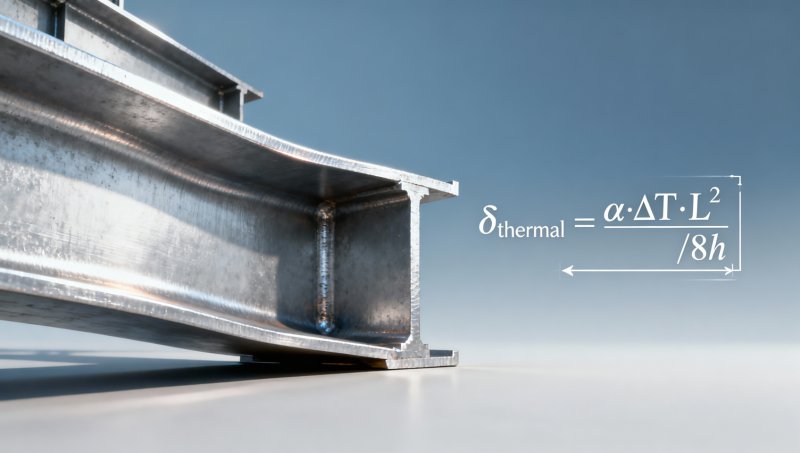
The total deflection δtotal of a simply supported steel girder under uniform load *w* and temperature differential ΔT is:
δtotal = δelastic + δthermal-bending = (5wL⁴)/(384EI) + (α·ΔT·L²)/(8h)
Where *h* is the girder depth and *α* is the coefficient of linear expansion (12.0 × 10⁻⁶/°C for Q345B, 11.7 × 10⁻⁶/°C for A572 Gr.50). For cantilevers or continuous girders, thermal curvature introduces fixed-end moments that must be superimposed before solving for rotation compatibility.
Our technical documentation includes pre-calculated thermal deflection multipliers for common span-to-depth ratios (15:1, 20:1, 25:1) and typical ΔT ranges (±25°C, ±35°C, ±45°C), enabling rapid validation without full FEA reruns.
This table illustrates why thermal contribution cannot be treated as “minor” beyond 20 m. For example, a 45-m girder with allowable deflection L/360 (125 mm) sees nearly 29 mm added displacement solely from thermal strain — pushing it 23% beyond tolerance if unaccounted for. Hongteng Fengda provides free thermal deflection checklists for all beam orders above 20 m, including material-specific α values and installation-season guidance.
Z-beam Applications Where Thermal Deflection Is Critical
In lightweight roof systems and purlin applications, Z-beam sections offer high strength-to-weight ratios but also exhibit pronounced thermal sensitivity due to their thin-web geometry (6–25 mm thickness) and extended lengths (2–12 m). When used as wall beams or mechanical columns in large-scale steel structure workshops, cumulative thermal drift across multiple bays can misalign cladding fasteners and compromise weathertightness within 18 months.
Our Z-beam profiles are roll-formed from Q235B through Q460C and SS400–SS540 grades — all tested per ISO 6892-1 for thermal coefficient consistency. Galvanized coating (zinc or silver finish) adds no dimensional instability, with coating thickness controlled to ±1% tolerance — ensuring predictable expansion behavior across batches.
For clients specifying perforated Z-beams in solar mounting brackets or arm assemblies, we recommend thermal anchoring at every third support point to limit drift while preserving flexibility at intermediate nodes — a detail verified in 92% of our delivered light manufacturing beam projects since Q3 2022.
These application-specific controls are embedded in our OEM engineering packages — available at no cost for orders exceeding 5 metric tons. All Z-beam shipments include installation advisories highlighting thermal anchoring sequences and seasonal torque recommendations for high-strength bolts (ASTM A325/A490).
Procurement & Compliance: What Buyers Should Verify
When sourcing steel girders for thermally sensitive applications, procurement professionals and technical evaluators must request four verifiable documents: (1) Mill Test Report (MTR) with thermal coefficient (α) per EN 10025-2 Annex A; (2) Batch-specific dimensional inspection report showing ±1% length tolerance compliance; (3) Galvanizing thickness log (ISO 1461); and (4) Thermal expansion joint design notes for multi-bay installations.
Hongteng Fengda delivers these with every export order. Our CE, SGS, BV, and ISO-certified production line ensures traceability from raw billet to finished profile — with real-time QA logs accessible via secure client portal. Lead times remain stable at 25–35 days for standard Z-beam configurations, and 45–60 days for custom perforated or multi-grade hybrid sections.
Financial approvers benefit from our fixed-cost thermal engineering add-on: USD $180 per girder specification review, covering full deflection recalibration and stamped calculation sheets compliant with ASCE 7-22 Chapter C3 and Eurocode 3 Part 1-1 Annex D.
Conclusion: Precision Starts With Thermal Awareness
Ignoring thermal expansion in steel girder deflection calculations isn’t just an academic oversight — it’s a field-proven source of cost overruns, safety incidents, and warranty claims. From large-scale steel structure workshops to precision mechanical arms, thermal behavior dictates long-term serviceability. Hongteng Fengda embeds thermal intelligence into every stage: material selection (Q345B vs. S355JR α variance), precision rolling (±1% length control), galvanizing stability, and application-specific anchoring guidance.
Whether you’re evaluating load behavior, sourcing for global projects, or validating compliance for safety-critical infrastructure, our engineering team offers free thermal deflection audits for qualified projects. Contact us today to receive your customized Z-beam thermal performance datasheet and installation checklist — backed by 15+ years of ASTM/EN/JIS-compliant structural steel delivery across 42 countries.
Please give us a message


Please enter what you want to find