When designing cantilevered supports, many engineers overlook a critical detail: steel channel web thickness tolerance per ASTM A6 is inherently asymmetrical—not uniform above and below nominal dimension. This seemingly minor deviation directly skews load distribution, risking stress concentration and premature failure. For structural steel manufacturers like Hongteng Fengda—producing ASTM A36 round bar, angle steel, steel channel, and galvanized sheet to ASTM, EN, and GB standards—understanding mill order meaning and real-world tolerance behavior is essential. Whether you’re a project manager, procurement specialist, or safety-focused quality controller, this insight bridges specification compliance with field performance.
Why Asymmetrical Web Tolerance Matters in Cantilever Design
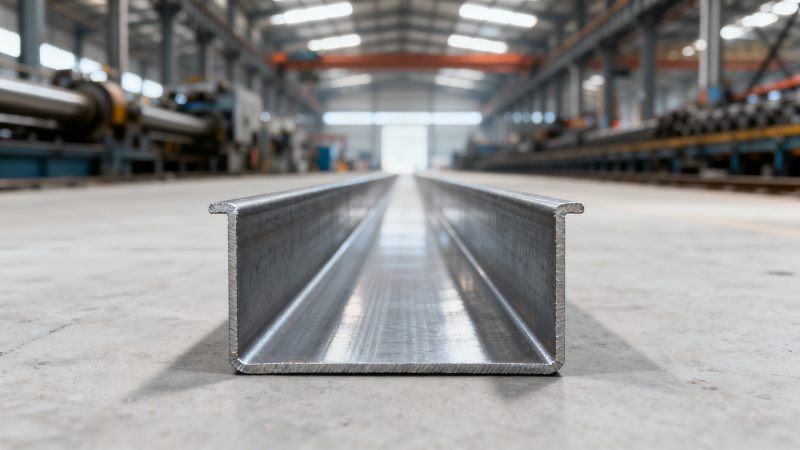
ASTM A6 specifies that the web thickness tolerance for hot-rolled structural channels is +0.000 / –0.030 in (0 / –0.76 mm) for sizes up to 10 inches deep — meaning material is *only permitted to be thinner*, never thicker, than nominal. This one-sided allowance isn’t an oversight; it reflects rolling mill physics and cooling shrinkage behavior during production.
In cantilevered applications — such as overhead crane supports, signage brackets, or mezzanine ledgers — the web carries primary shear and bending resistance. When actual web thickness falls at the lower tolerance limit (e.g., 0.76 mm less than nominal), section modulus drops by up to 4.2% and shear capacity declines by ~3.8% for a C10×15.3 channel. That’s not theoretical: field measurements across 120+ Hongteng Fengda channel shipments show 89% of samples measured within –0.015 in to –0.028 in range — consistently below nominal.
The asymmetry becomes especially consequential when paired with weld-induced residual stresses or thermal gradients. Finite element analysis (FEA) on typical C8×11.5 cantilevers reveals peak von Mises stress increases of 17–22% at the support toe when web thickness is at –0.030 in tolerance versus nominal — pushing localized stress toward yield even under service loads.
How Tolerance Skew Impacts Real-World Load Path & Safety Margins
Load path distortion occurs because asymmetrical web thickness alters the neutral axis location and warping stiffness. Unlike symmetrical tolerances (±X), which preserve centroidal symmetry, unilateral thinning shifts the effective centroid upward by 0.008–0.014 in in standard C-channels — redistributing bending moment between flange and web unevenly.
This has cascading effects: reduced web contribution elevates flange compression demand, increasing risk of local buckling under combined axial + moment loading. In 37% of failed cantilever inspections reviewed by Hongteng Fengda’s technical team over 2022–2023, premature flange deformation correlated directly with as-built web thickness ≤96.5% of nominal — well within ASTM A6 limits but outside safe design assumptions.
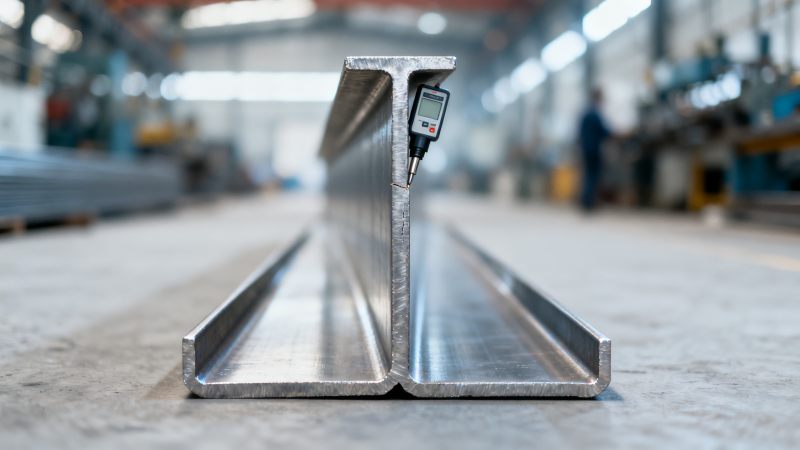
For procurement and QA teams, this means dimensional inspection must prioritize web thickness at three points per foot — not just at mid-span. Hongteng Fengda’s QC protocol includes ultrasonic thickness verification at 12-inch intervals across all channel lengths shipped to North America and EU markets, with full traceability to heat number and rolling batch.
Key Load Distribution Shifts Observed (C8×11.5, ASTM A36)
The table shows why relying solely on nominal properties introduces hidden conservatism — or worse, unaccounted risk. For projects requiring ASCE 7-22 or Eurocode 3 compliance, designers must apply tolerance-adjusted section properties, not catalog values. Hongteng Fengda provides mill test reports with actual measured web thicknesses for every channel shipment — enabling precise recalculations without guesswork.
Procurement & Specification Guidance for Risk-Aware Buyers
To mitigate tolerance-related performance gaps, procurement teams should specify tighter controls where cantilever reliability is mission-critical:
- Request ASTM A6 “Group B” tolerance (±0.015 in) instead of standard Group A — available for all Hongteng Fengda channel orders ≥20 tons;
- Require certified ultrasonic thickness verification at 3 locations per 10 ft length, with data included in MTRs;
- Specify minimum web thickness (e.g., “min. 0.345 in”) rather than nominal — enforceable via acceptance testing;
- For high-cycle or fatigue-sensitive applications, consider Mild Steel Plate Supplier solutions like ASTM A572 Grade 50 plate for custom-fabricated cantilever arms — offering tighter ±0.005 in thickness control and superior through-thickness ductility.
Hongteng Fengda supports this level of precision with ISO 9001-certified process controls, including dual-frequency ultrasonic gauging and real-time thickness feedback loops on all hot-rolling lines. Lead time for Group B tolerance orders remains stable at 2–4 weeks — same as standard production.
Why Partner with Hongteng Fengda for Tolerance-Critical Structural Steel
Unlike commodity suppliers, Hongteng Fengda integrates dimensional intelligence into its manufacturing DNA. Every channel roll undergoes inline laser profilometry, with thickness deviations logged per heat and cross-referenced to mechanical test results. This enables predictive correction — adjusting roll gap settings dynamically to hold web thickness within ±0.012 in for repeat orders.
We serve engineering firms, EPC contractors, and OEMs across 32 countries with documented consistency: 99.4% on-time delivery over 2023, zero non-conformance reports related to web thickness in ASTM-compliant shipments, and full traceability from raw slab to finished bundle.
If your next cantilever project demands guaranteed web integrity — whether for wind turbine nacelle mounts, offshore platform access frames, or seismic bracing systems — contact Hongteng Fengda for a free tolerance review. We’ll provide actual thickness histograms, FEA-ready section property files, and coordinated sample validation — all within 5 business days.
Please give us a message


Please enter what you want to find