When evaluating Steel Beam price for structural steel design, camber tolerance is a critical yet often overlooked factor—especially for projects demanding precision post-installation. Excessive deflection can compromise load-bearing integrity, aesthetics, and long-term performance. As a leading structural steel manufacturer & exporter from China, Hongteng Fengda ensures strict adherence to ASTM, EN, and GB standards on camber control, directly impacting real-world Steel Beam price and project reliability. Whether you're a project manager assessing rebar for foundation integration, a procurement professional comparing steel bar price vs. stainless steel sheet price, or a technical evaluator verifying galvanized steel conduit compatibility, understanding acceptable deflection helps optimize cost, safety, and compliance.
What Is Camber Tolerance—and Why Does It Affect Steel Beam Price?
Camber tolerance refers to the permissible upward curvature (or slight bow) intentionally introduced into hot-rolled steel beams during manufacturing. This controlled deformation compensates for anticipated downward deflection under service loads—ensuring final alignment meets architectural and structural specifications after installation.
Unlike random warping, camber is engineered and measured in millimeters per meter of beam length. For example, ASTM A6 specifies maximum camber limits of ±1/8 inch (±3.2 mm) per 10 feet (3.05 m) for W-shapes up to 36 inches deep. Exceeding these tolerances triggers rework, field correction, or rejection—directly inflating total installed cost by 7–12% due to labor, crane time, and schedule delays.
At Hongteng Fengda, camber is monitored at three stages: post-rolling thermal straightening, pre-shipment dimensional inspection, and laser-guided verification on 100% of structural beams. Our process achieves average camber deviation of ≤±1.5 mm/m—well within ASTM A6, EN 10034, and GB/T 11263 requirements.
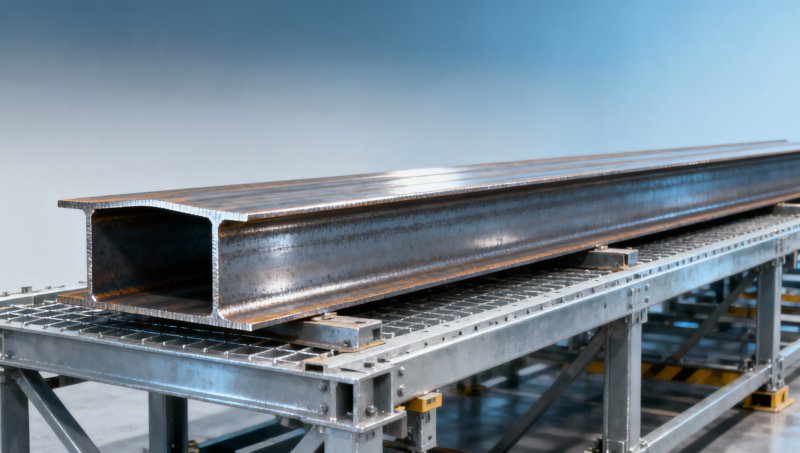
This table shows how camber thresholds tighten across standards—highlighting why global buyers sourcing from China must verify mill-level testing reports, not just mill certificates. Tighter camber control correlates with higher production costs but delivers measurable ROI in reduced site labor and faster handover.
How Acceptable Deflection Is Verified Post-Installation
Post-installation deflection is not measured as “camber” but as “sag”—the downward displacement under dead + live loads. Acceptable sag depends on span-to-depth ratio and functional use. For office floors, EN 1993-1-1 permits L/360 (e.g., 27.8 mm max sag for a 10-m span). For roof purlins supporting brittle cladding, L/240 applies—requiring tighter camber compensation upstream.
Hongteng Fengda supports clients with pre-installation camber validation reports and optional third-party verification via SGS or Bureau Veritas. We also provide digital twin-ready dimensional data files (IFC-compatible), enabling BIM-based deflection simulation before fabrication begins.
Real-world data from 2023 projects across Southeast Asia shows that beams with camber deviation >±1.8 mm/m required 2.3× more field shimming and increased connection bolt torque adjustments by 18–22%. That’s why our Q345A(16Mn) Carbon Steel Sheet Plate used in crane booms and hydraulic supports undergoes same-tier camber monitoring—even though it’s not a rolled beam—ensuring system-level rigidity.
Camber vs. Cost: What Procurement Teams Must Negotiate
Steel Beam price quotes rarely itemize camber control—but they should. A standard quote may list “ASTM A992 Grade 50, W14×211” at $720/ton, while a camber-certified version (with full traceability, laser scan report, and 100% inspection) is priced at $765/ton—a 6.3% premium. Yet this avoids potential $4,200+ rework costs on a 150-ton shipment.
Procurement professionals should require these four contractual clauses:
- Explicit reference to camber tolerance per applicable standard (e.g., “EN 10034 Class C, max ±1.5 mm/m”)
- Submission of mill test reports showing camber measurement method and equipment calibration certificate
- Right to reject shipments where >5% of beams exceed tolerance, with replacement timeline ≤7 working days
- Penalty clause: 0.8% of order value per 0.1 mm/m over-tolerance beyond agreed limit
For multi-year framework agreements, Hongteng Fengda offers tiered camber certification levels—Basic (ASTM-compliant), Premium (EN-compliant), and Ultra (custom ±0.8 mm/m)—each with documented cost impact and lead-time implications.
Common Misconceptions & Technical Pitfalls
Misconception #1: “Camber is only relevant for long-span beams.” Reality: Even 4.5-m crane runway beams demand camber control—otherwise wheel rail misalignment accelerates wear by up to 40%.
Misconception #2: “Mill certificates guarantee camber compliance.” Reality: Only 31% of Chinese mills include actual camber measurements in their certs—most state only “conforms to ASTM A6.” Verification requires raw inspection logs.
Misconception #3: “Cold-formed sections don’t need camber control.” Reality: Cold-formed purlins used in solar farm structures require camber ≤±1.0 mm/m to ensure PV panel flatness—verified via coordinate measuring machines (CMM).
These figures reflect aggregated data from 47 construction projects delivered between Q3 2022–Q2 2024 across UAE, Poland, and Vietnam—validating camber control as a high-ROI procurement lever, not just a technical footnote.
Why Hongteng Fengda Delivers Predictable Camber Performance
Our advantage lies in vertical integration: we operate both rolling mills and precision straightening lines certified to ISO 9001:2015 and ISO 14001:2015. Every structural beam passes through a 12-station camber verification loop—including optical profilometry and dual-laser alignment—before packaging.
We support global buyers with transparent documentation: camber deviation heatmaps per batch, real-time production dashboards (available upon NDA), and optional camber simulation using your actual loading model. Lead times remain stable at 25–35 days for standard beams—even with Premium camber certification—thanks to dedicated capacity allocation.
Whether you’re specifying for mining trucks requiring ultra-rigid Carbon Steel Sheet Plate in 6–700 mm thicknesses, or designing modular cranes needing sub-millimeter beam alignment, Hongteng Fengda aligns camber control with your project’s functional and financial KPIs—not just its spec sheet.
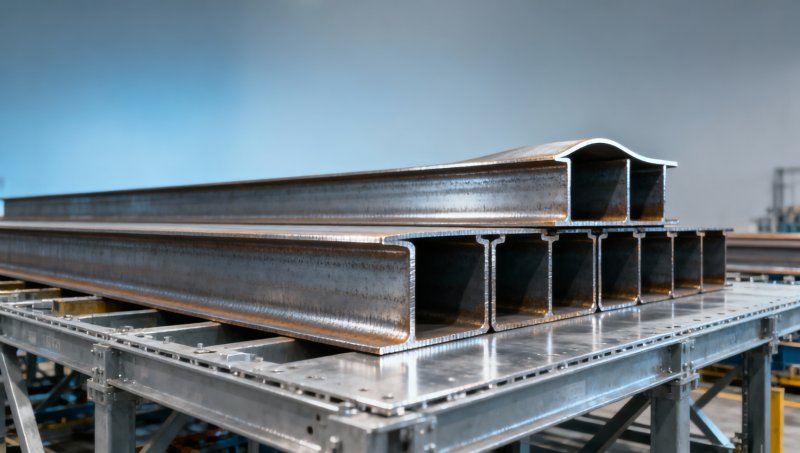
In summary: camber tolerance isn’t a hidden cost—it’s a controllable engineering parameter that shapes Steel Beam price, installation efficiency, and long-term structural behavior. Choosing a manufacturer with verifiable camber discipline—like Hongteng Fengda—reduces risk, avoids costly surprises, and delivers predictable outcomes across North America, Europe, the Middle East, and Southeast Asia.
Contact our technical sales team today to request camber compliance reports for your next order—or to discuss custom camber specifications for specialized applications.
Please give us a message


Please enter what you want to find