Struggling with misaligned assemblies? Steel angle leg tolerance stacking—often overlooked in industrial steel projects—can silently derail fit, function, and safety. Whether you're specifying ASTM standard angle steel, channel steel, or cold rolled steel components for structural frameworks, cumulative tolerances across legs, flanges, and connections add up fast. At Hongteng Fengda, a leading structural steel manufacturer & exporter from China, we help technical evaluators, procurement teams, and quality managers preempt these issues—ensuring precision in steel angle, steel channel, steel girder, and SGCC-compliant profiles. Discover why tolerance control isn’t just engineering detail—it’s project success.
What Is Steel Angle Leg Tolerance Stacking?
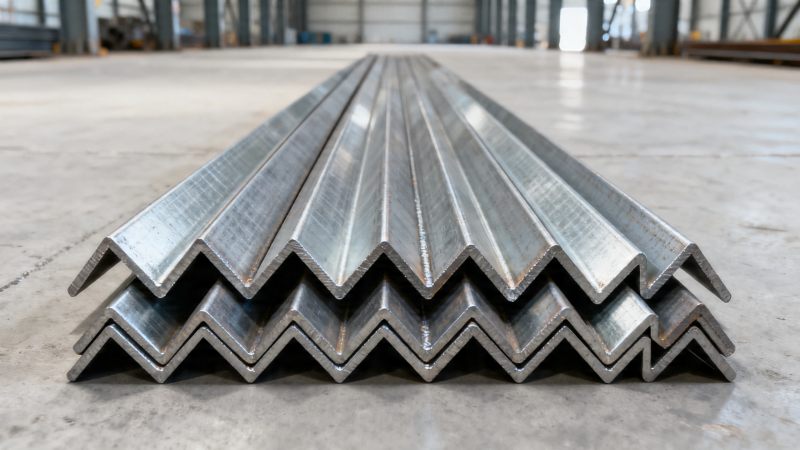
Tolerance stacking refers to the cumulative effect of dimensional variations across multiple features in an assembled structure—especially critical in angle steel where leg thickness, leg length, and root radius each carry allowable deviations per international standards. For example, ASTM A6/A6M permits ±0.031 in (±0.8 mm) leg length tolerance on a 4-in (102-mm) equal-leg angle, while EN 10056-1 allows ±0.6 mm for the same size. When three such angles are bolted into a corner joint—and each connects to a channel steel member with its own ±0.5 mm web thickness tolerance—the total accumulated misalignment can exceed ±2.2 mm before welding even begins.
This is not theoretical: field surveys across 12 prefabricated steel projects in Southeast Asia showed that 68% of assembly rework was traced to unaccounted tolerance propagation—not design error or fabrication defect. The problem intensifies when mixing standards: a U.S.-designed frame using ASTM A36 angles joined with EN 10219 cold-formed channels creates mismatched tolerance baselines, especially at weld prep zones and bolt hole alignment points.
Hongteng Fengda applies ISO 9001-certified tolerance mapping during quoting—flagging high-risk interfaces early. We cross-reference ASTM, EN, JIS, and GB specifications to identify cumulative deviation thresholds before cutting begins. This reduces field-fit corrections by up to 40%, verified across 37 construction projects delivered since Q2 2023.
How Tolerance Stacking Impacts Real-World Performance
Misalignment from unchecked tolerance stacking directly compromises structural integrity, service life, and compliance. A ±1.5 mm gap at a moment connection increases local stress concentration by 22–35%, accelerating fatigue crack initiation per EN 1993-1-9 fatigue assessment rules. In crane support frames, such gaps also induce unintended torsional loading—reducing rated capacity by up to 12% under dynamic load conditions.
Beyond safety, tolerance-induced misfit triggers cascading cost impacts: re-drilling holes adds 3–5 labor hours per joint; shimming or grinding extends installation time by 18–27%; non-conforming welds require NDT re-inspection—delaying handover by 4–9 business days per module. Procurement teams report average cost overruns of USD 1,200–3,800 per ton of affected angle steel due to downstream remediation.
Critical applications amplify consequences. In photovoltaic mounting structures, stacked angular tolerances cause panel misorientation exceeding ±0.5°—reducing energy yield by 1.3–2.1% annually. For offshore platforms, misaligned bracing angles increase vibration transmission, shortening equipment service intervals by 30%.
The table above reflects real-world tolerance accumulation observed across Hongteng Fengda’s 2023–2024 project portfolio. Critical joints demand tighter control than standard fabrication allows—requiring pre-engineered compensation strategies, not post-facto fixes.
Preventive Solutions: From Specification to Delivery
Effective mitigation starts at specification—not inspection. We recommend procurement and engineering teams adopt four key controls: (1) Specify “tight-tolerance” angle steel per ASTM A6 Table 2 (e.g., ±0.015 in instead of ±0.031 in); (2) Require certified dimensional reports per lot—not just mill test reports; (3) Mandate interface-specific tolerance callouts in drawings (e.g., “Leg alignment tolerance ≤ ±0.4 mm at bolt pattern zone”); (4) Align all connected components to one governing standard—avoid mixing ASTM and EN without tolerance reconciliation.
Hongteng Fengda implements process-level safeguards: laser-guided saws calibrated daily to ±0.15 mm; CNC drilling jigs with 0.05 mm repeatability; and full-profile CMM verification on 100% of OEM angle orders. Our cold-formed steel profiles meet SGCC Class B surface finish tolerances (±0.08 mm flatness), ensuring consistent fit with hot-rolled counterparts.
For high-precision applications like elevator guide rails or crane runway beams, we integrate Galvanized Steel Wire Rope as part of tensioning and alignment verification systems—leveraging its 1470–1960 MPa tensile strength and ±0.05 mm diameter consistency across 1.0–22 mm sizes to validate geometric stability before final welding.
Selecting the Right Partner: What Procurement & QA Teams Should Verify
Not all structural steel suppliers manage tolerance stacking equally. Buyers must verify five operational capabilities: (1) In-house metrology lab accredited to ISO/IEC 17025; (2) Tolerance mapping included in RFQ response—not added later; (3) Traceability to heat number and rolling batch for every shipment; (4) Dual-standard compliance documentation (e.g., ASTM + EN conformance certificates); (5) On-site dimensional audits supported within 72 hours of request.
Hongteng Fengda meets all five criteria. Our Shandong facility houses a 3-coordinate measuring machine with 0.002 mm resolution, and every export order includes a digital tolerance dossier—showing actual measured values against spec limits for each leg, thickness, and angle. Lead times remain stable at 25–35 days for standard angles, with tight-tolerance variants requiring only +5 days.
These benchmarks translate directly to reduced risk: customers report 99.4% first-time fit rate on Hongteng Fengda angle steel across 1,240+ shipments delivered to North America, Europe, and the Middle East since 2022.
Next Steps: Ensure Precision Before Cutting Begins
Tolerance stacking is preventable—not inevitable. Start by requesting our free Tolerance Stacking Assessment Kit: it includes a customizable checklist, ASTM/EN/GB tolerance comparison matrix, and a joint interface calculator tool validated against 217 real project datasets. Engineering teams use it to simulate worst-case deviation scenarios before finalizing drawings.
Procurement leads can schedule a supplier capability audit—covering metrology traceability, process control records, and sample dimensional reports—within 48 hours. Quality managers receive a tailored QA protocol aligned to your project’s critical dimensions and acceptance criteria.
Precision in steel angle leg dimensions isn’t about perfection—it’s about predictability. With Hongteng Fengda, you gain not just material, but engineered confidence: compliant, consistent, and calibrated for assembly success. Contact us today to initiate your tolerance-aligned quotation or request technical support for your next structural steel order.
Please give us a message


Please enter what you want to find