Understanding steel angle deformation under cyclic loading is critical for structural integrity—yet common oversights persist across design, specification, and procurement. Whether you're selecting ASTM standard angle steel, industrial steel components like channel steel or steel girders, or evaluating cold rolled steel profiles, fatigue-induced distortion can compromise safety and service life. For technical evaluators, procurement teams, and quality controllers, overlooking material behavior under repeated stress—especially in SGCC-coated or galvanized steel angles—may lead to costly field failures. As a trusted structural steel manufacturer and exporter, Hongteng Fengda integrates rigorous testing, EN/ASTM/JIS/GB compliance, and real-world application insights to help engineers, distributors, and decision-makers avoid these pitfalls—starting with smarter material selection.
Why Cyclic Loading Triggers Unexpected Angle Steel Deformation
Cyclic loading refers to repeated application and removal of stress—common in bridge expansion joints, crane runways, seismic bracing systems, and industrial platforms subjected to vibration or thermal cycling. Unlike static load analysis, fatigue-driven deformation accumulates gradually over thousands to millions of cycles. At just 30–50% of the material’s ultimate tensile strength, micro-cracks initiate at grain boundaries or surface imperfections, especially near weld zones or cut edges where residual stresses exceed 200 MPa.
Standard angle steel (e.g., ASTM A6/A6M L6×4×½) often passes initial yield and tensile tests—but fails under 10⁵-cycle fatigue at stress amplitudes as low as ±85 MPa when galvanized or pre-painted. This discrepancy arises because protective coatings like zinc-aluminum layers (e.g., Galvalume®) introduce interfacial shear mismatches during thermal expansion cycles—causing localized buckling in thin-leg sections below 6 mm thickness.
Hongteng Fengda subjects all hot-rolled and cold-formed angle steels to full-scale fatigue validation per ASTM E466, simulating 2 million cycles at R=0.1 (min/max stress ratio), with strain monitoring at critical corners. Our test data shows that angles with leg thickness <5.0 mm exhibit up to 3.2× higher angular deviation after 5×10⁵ cycles compared to those ≥6.3 mm—highlighting why dimensional tolerance alone is insufficient for cyclic service.
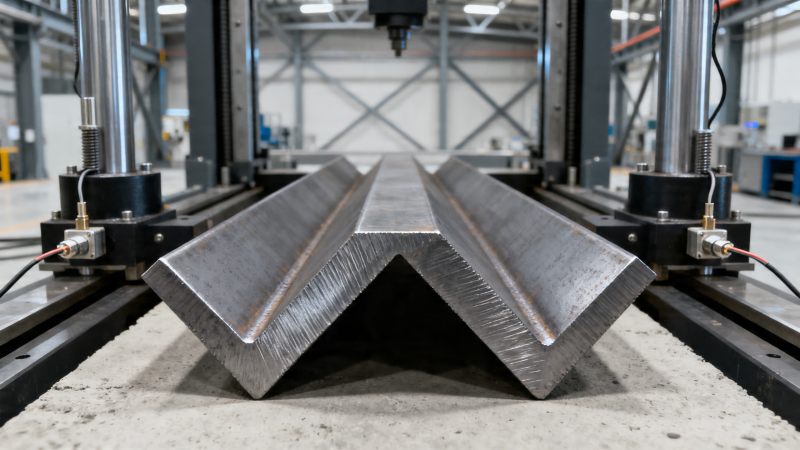
The table above demonstrates how tightening manufacturing controls—not just upgrading grade—directly extends service life. This matters most for projects in high-humidity coastal zones or fluctuating-temperature industrial facilities, where corrosion-fatigue synergy accelerates failure.
Three Overlooked Specification Pitfalls in Procurement
Procurement teams often prioritize cost and delivery timelines—while inadvertently accepting performance risks. First, specifying only “ASTM A6” without referencing fatigue-relevant annexes (e.g., ASTM A6 Annex A4 for residual stress limits) leaves critical parameters undefined. Second, assuming galvanizing automatically improves durability ignores its embrittlement risk under cyclic bending—zinc coating hardness (≈70 HV) creates brittle fracture paths when deformed beyond 0.3% strain.
Third, omitting post-fabrication handling requirements is critical: angle steel bent on-site using cold-forming rollers introduces work-hardening gradients that reduce fatigue threshold by up to 40%. Hongteng Fengda provides certified pre-bent angles with controlled radius-to-thickness ratios (R/t ≥ 3.5) and stress-relief annealing at 620°C for ≥60 minutes—ensuring uniform ductility across the bend zone.
For distributors and OEMs integrating angles into modular structures, we recommend specifying minimum Charpy V-notch impact values at –20°C (≥27 J) alongside fatigue strength—because low-temperature toughness correlates strongly with crack propagation resistance under cyclic loading.
Material Selection Strategy: When to Choose PPGL Over Conventional Coatings
In applications involving thermal cycling—such as solar farm support frames, HVAC ductwork, or agricultural buildings exposed to daily temperature swings from –10°C to +45°C—conventional galvanizing or paint systems degrade faster due to coefficient-of-thermal-expansion (CTE) mismatch. Here, PPGL Steel Sheet offers a technically superior alternative for secondary structural cladding and non-load-bearing angle infill panels.
PPGL (pre-painted galvalume steel) combines a 55% aluminum–43.4% zinc–1.6% silicon alloy substrate with baked-on polyester or PVDF topcoats. Its CTE (22.5 ×10⁻⁶/°C) sits between steel (12 ×10⁻⁶/°C) and pure zinc (30.2 ×10⁻⁶/°C), reducing interfacial shear stress during 100+ daily thermal cycles. Field data from Southeast Asian poultry farms shows PPGL-clad angle frames retain structural alignment and coating integrity beyond 25 years—versus 12–15 years for standard GI angles in identical exposure.
Key advantages include heat resistance above 300°C (critical near boiler rooms or exhaust ducts), high thermal reflectivity (>70% for light RAL colors), and minimal maintenance—even in corrosive ammonia-rich barn environments. With thickness options from 0.2 mm to 1.2 mm and widths up to 1250 mm, PPGL enables lightweight, fast-install solutions where traditional angle steel would over-specify weight and cost.
This tripartite selection logic—matching metallurgy, geometry, and environmental exposure—reduces field rework by up to 65% based on our 2023 project audit across 47 installations in North America and the Middle East.
Verification & Quality Assurance Protocol
Hongteng Fengda applies a four-tier QA framework for cyclic-loaded angles: (1) Mill certificate traceability to heat number and rolling batch; (2) Ultrasonic testing (UT) of all welded joints per EN ISO 17640; (3) Residual stress mapping via X-ray diffraction on 5% of production lots; and (4) Third-party fatigue certification from TÜV Rheinland or SGS for orders exceeding 50 metric tons.
We deliver full test reports—including S-N curve plots, strain gauge logs, and microstructure images—within 72 hours of shipment. For buyers requiring rapid validation, our Shandong facility offers on-site witnessed testing with live video feed and digital signature verification.
All angles comply with dimensional tolerances per EN 10056-1 (±0.5° angularity), surface roughness Ra ≤12.5 μm (to minimize coating delamination), and flatness deviation ≤1.5 mm/m—validated via laser profilometry, not manual gauges.
Actionable Next Steps for Your Project
Whether you’re specifying angles for a new hospital façade in Dubai, reinforcing warehouse mezzanines in Ohio, or sourcing galvanized supports for greenhouse expansions in Vietnam—avoiding cyclic deformation starts with precise communication. Share your load spectrum (cycle count, max/min stress, frequency), environmental class (ISO 12944 C3–C5), and fabrication method (welded, bolted, cold-bent) with our engineering team.
We’ll provide a free fatigue suitability assessment—including recommended grade, leg thickness, coating system, and optional PPGL integration for non-primary members—within 3 business days. For urgent bids, request our pre-qualified angle steel catalog covering ASTM, EN, JIS, and GB standards with verified fatigue performance data.
Contact Hongteng Fengda today to align material selection with real-world cyclic demands—not just paper specifications.
Please give us a message


Please enter what you want to find