Start with diameter, not the gauge number
When people search for steel wire gauge, they usually want one practical answer: how thick is the wire, and what will that thickness change in real use? That is the right starting point. Gauge is only a naming system. Diameter is the physical value that affects strength, bendability, coating weight, winding behavior, and whether the wire actually fits the job.
The first mistake buyers make is assuming a gauge number means the same thing everywhere. It does not. Different systems can assign different diameters to the same gauge label. If a drawing, quote, or purchase order says only “12 gauge steel wire,” you still do not know enough. You need the actual diameter in mm or inches, and you need to know which gauge standard the supplier is using.
For technical review, treat gauge as shorthand and diameter as the control point.
What to check before converting steel wire gauge
Before comparing sizes, run through this short checklist. It saves a lot of back-and-forth later.
- Which gauge system is being referenced? Common wire standards do not always line up.
- What is the actual wire diameter? Ask for mm and inch values if the material will move across markets.
- Is the wire bare or coated? A zinc layer changes the finished diameter and may affect fit in mesh, guides, or automated equipment.
- What matters more in this application: load, flexibility, corrosion resistance, or forming? Gauge alone cannot answer that.
- Which standard documents are controlling the order? If the project follows ASTM, EN, JIS, or GB requirements, the diameter and tolerance fields matter more than the gauge label.
If you do only one thing right, do this: keep the gauge notation and the measured diameter on the same document line. That avoids conversion errors between engineering, purchasing, and production.
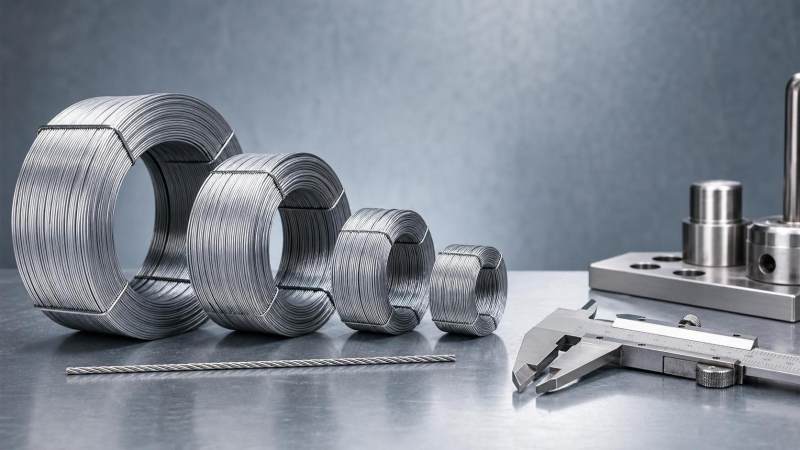
How size changes strength in the real world
As wire diameter increases, the wire generally carries more load and resists deformation better. That part is straightforward. Where people get into trouble is assuming thicker wire is always the safer choice. In practice, the right size depends on how the wire is loaded.
If the wire is used for tying, binding, or temporary securing, oversized wire may create handling problems without giving much benefit. It can be slower to twist, harder to tension consistently, and more tiring for field crews. In wire mesh, fencing, packaging, or light fabrication, a smaller diameter may perform better because it bends cleanly and works faster through tools and fixtures.
On the other hand, when the wire has to keep shape under repeated load, span across openings, or resist pulling and sagging, going too small becomes expensive in another way. You may save on unit cost and then lose time to breakage, distortion, or replacement.
So the check is not “Which gauge is strongest?” It is “What load condition is this wire expected to survive, and for how long?”
How size changes flexibility and forming behavior
Flexibility usually moves in the opposite direction. Smaller wire bends more easily, wraps faster, and is easier to form into tight shapes. That matters in handicrafts, mesh production, decoration, breeding applications, and daily-use items where repeated bending or shaping is part of the process.
But “more flexible” is not automatically “better.” Fine wire can kink during payout, flatten under point pressure, or lose straightness after handling. If a machine relies on smooth feeding, consistent coil memory may matter as much as nominal gauge. For buyers comparing offers, ask how the wire is packed and whether it comes in coil or bobbin form, because packaging affects line performance more than many first-time buyers expect.
A useful rule on the shop floor: if the wire must bend sharply without cracking the surface, look beyond gauge and check material grade, tensile range, and coating condition together.
Do not separate gauge from material and finish
Two wires with similar diameter can behave very differently if the steel grade, tensile strength, or surface treatment changes. This is where buyers sometimes oversimplify the conversion discussion. Gauge tells you size. It does not tell you how the wire will respond to bending, stamping, rolling, or outdoor exposure.
For example, a hot-dip galvanized product may be chosen not because the gauge is different, but because the project needs better corrosion resistance and a surface that can still handle forming operations. In applications such as construction ties, wire mesh, packaging, or barrier isolation, Hot Dipped Galvanized Steel Wire is often evaluated by buyers based on wire diameter, zinc coating thickness, tensile strength, and whether the coating stays intact during bending.
When the available range is broad, such as 0.25 mm to 5.0 mm wire diameter, the practical decision is never about gauge conversion alone. It becomes a balance between flexibility, corrosion resistance, handling method, and the forming or load requirements of the final use.
A simple comparison buyers can use
This is not a substitute for specification review, but it is a good screening tool when comparing wire options early.
Where conversion mistakes usually happen
Most problems show up in the handoff between sourcing and application. Watch these points closely:
- Quote stage: gauge is listed, diameter is missing.
- Drawing stage: the engineer uses one unit system, the supplier quotes another.
- Coating stage: finished diameter is confused with base wire diameter.
- Replacement orders: the old part number is reused even though the original gauge convention is unclear.
- Cross-market purchasing: the buyer assumes a North American reference matches a European or Asian document without checking the actual diameter field.
If you are reviewing a supplier document, the minimum safe line item should include diameter, material, surface condition, tensile requirement if relevant, packaging form, and applicable standard. Gauge can stay on the line, but it should never be the only size reference.
How to choose the right specification without overbuying
A lot of buyers solve uncertainty by moving one or two sizes thicker. That feels safe, but it often creates avoidable cost and processing issues. A better approach is to narrow the decision with four checks.
- Define the job the wire is doing: tying, forming, supporting, weaving, isolating, or resisting exposure.
- Confirm the controlling dimension: base wire diameter, finished diameter, or mesh opening compatibility.
- Check whether failure is more likely to come from overload, corrosion, feed problems, or poor formability.
- Match packaging to use. Coils from 50 kg to 1,000 kg and bobbin packing can behave very differently in manual work versus automated lines.
For low carbon steel wire such as Q195 or Q235, buyers often focus on getting enough ductility for bending while staying within a workable tensile range. If the wire will be galvanized, also check whether the coating thickness and finish are suitable for the environment and for any cold stamping, rolling, or bending that follows.
What experienced buyers ask for on the document set
When steel wire gauge conversion matters, the cleanest purchase files are the ones that remove guesswork early. Ask for the technical sheet or quotation line to show the actual diameter, material designation, tensile strength range where relevant, surface treatment, and packing method. If the product is galvanized, request the zinc coating field as a separate value rather than hiding it inside a general description.
That matters for products like Hot Dipped Galvanized Steel Wire, where the useful comparison points may include a tensile strength range of 350 to 550 Mpa, zinc coating thickness of 8 to 25 g/m2, and whether the wire needs to keep good flexibility during bending or forming. Those fields tell you much more than the gauge label by itself.
Use this decision order before placing the order
Keep the sequence simple. Convert the gauge to actual diameter. Confirm which standard or market convention is being used. Check whether coating changes the effective size. Then judge the wire by the job it has to do: strength, flexibility, corrosion resistance, or forming behavior.
If two options both meet the size requirement, the better choice is usually the one that reduces downstream trouble, not the one that only looks stronger on paper. In steel projects, the expensive mistakes are rarely caused by one missing gauge number. They come from ordering wire whose diameter, finish, and handling characteristics were never lined up with the actual application.
So for anyone comparing steel wire gauge options, the practical rule is this: convert the size, verify the physical diameter, and only then decide whether that wire is strong enough, flexible enough, and appropriate for the environment it will face.
Please give us a message


Please enter what you want to find