Steel Tubing Dimensions That Matter Most in Frame and Support Design
In frame and support design, choosing the right steel tubing dimensions directly affects load capacity, stability, fabrication efficiency, and long-term cost. For technical evaluators, understanding how size, wall thickness, and application requirements work together is essential to selecting reliable structural solutions. This guide outlines the dimensions that matter most and helps you assess steel tubing options for safer, more efficient project performance.
The first mistake in tubing selection usually happens before any calculation starts. A buyer or designer looks at outside size alone and assumes two tubes with the same profile will behave similarly in service. They will not. In frame systems, support racks, equipment bases, access structures, and secondary building members, the dimensions that matter are never limited to width and height. Outside dimensions control fit-up, connection geometry, and available space. Wall thickness changes section properties, local buckling resistance, welding behavior, and even galvanizing results. Length tolerance affects assembly speed more than many procurement teams expect, especially when the structure is bolt-jigged or predrilled.
That is why experienced fabricators often ask a different question from first-time buyers. They do not ask only, “What size tube do we need?” They ask, “Where will this member sit, how will it be connected, and what kind of loading will punish the weak dimension?” The answer shifts depending on whether the tube is carrying vertical gravity load, resisting lateral sway, supporting vibrating equipment, or simply holding alignment in a larger frame.
Where dimensions start to change the design outcome
For light industrial frames and welded support stands, square and rectangular hollow sections are often chosen because they simplify layout and connection detailing. But the dimensions that drive performance are not always intuitive. A wider rectangular tube may look stronger, yet if the wall is too thin for the unbraced span, serviceability becomes the real problem. Deflection, twist, and local denting at clamp or base-plate areas can create failures long before the member reaches theoretical yield.
In machinery support frames, depth usually matters more than width for bending stiffness in the principal direction. That sounds basic, but it gets missed when tube selection is based on stock availability rather than loading direction. A 100 x 50 mm section and a 50 x 100 mm section are not interchangeable once orientation is fixed. In workshops, that difference shows up in motor skid vibration, conveyor alignment drift, and repeated cracking near welded brackets. The nominal dimensions may satisfy a drawing, while the installed behavior tells a different story.
The same issue appears in platform frames and roof support members. If the governing limit is deflection instead of ultimate strength, increasing wall thickness alone may not be the most efficient move. Sometimes stepping up the section depth gives a better result with less added weight than simply using heavier gauge material. This matters when lifting limits, transport efficiency, or installation labor are part of the project economics.
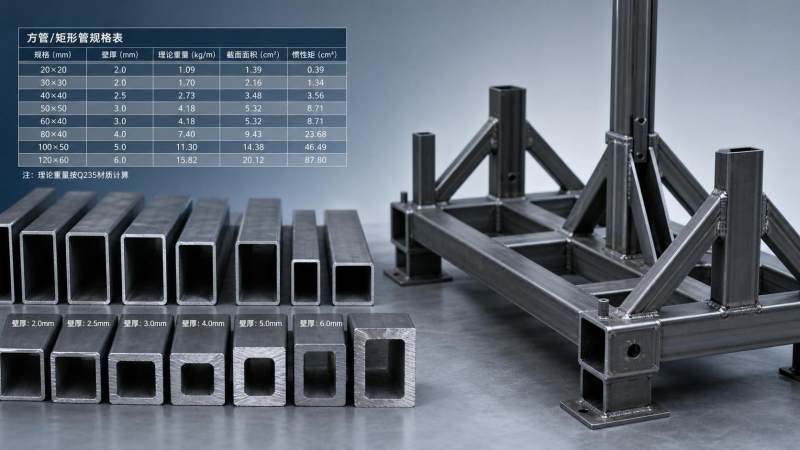
For export projects, another practical dimension issue is standard compatibility. A design team may specify tubing around ASTM dimensions, while the fabrication side is sourcing to EN, JIS, or GB equivalents. The nominal size can look close enough on paper, but corner radii, actual wall range, and tolerances may differ enough to affect connection plates, nesting details, or automated cutting programs. Manufacturers serving multiple markets, including those with ASTM, EN, JIS, and GB compliance requirements, usually spend more time on dimensional confirmation than on the material grade discussion itself. That is often the right priority.
Wall thickness is often the real decision point
In support design, wall thickness tends to decide whether a tube is merely usable or genuinely reliable. Thin-wall tubing may be acceptable for lightly loaded frames, guards, or noncritical bracing, but once concentrated loads enter the picture, thin sections become unforgiving. Forklift contact, anchor bolt tightening, bracket welding, and field modifications all expose the weakness of underbuilt walls.
This is especially visible in base connections. Designers sometimes check global member capacity yet overlook bearing and deformation at the tube end. If the wall is too light, the base plate detail has to compensate with stiffeners, inserts, or end caps. Those additions may solve the structural issue, but they also add fabrication time and welding distortion risk. In many cases, selecting a slightly thicker wall from the start gives a cleaner result than trying to repair an underdesigned connection with extra steel later.
There is also a corrosion angle. In outdoor supports, canopies, utility frames, and plant structures, the effective life of tubing depends not only on coating quality but on the sacrificial thickness available over time. Where internal condensation or cut-end exposure is likely, a section that is structurally adequate on day one may become marginal after years of service if corrosion allowance was ignored. This is one reason why aggressive environments often push dimension decisions beyond pure load calculations.
Why the same tube behaves differently across applications
A tube that works well in a warehouse rack frame may be the wrong choice for a petrochemical pipe support. The loading rhythm is different. The connection philosophy is different. The consequence of movement is different. Static building frames can tolerate certain simplifications that rotating equipment supports cannot. Once vibration, thermal movement, cyclic loading, or accidental impact enters the scene, dimensions have to be judged more conservatively.
Take pipe racks and utility support assemblies. These often look repetitive, which leads some buyers to treat tubing as a commodity line item. But the governing condition may come from a cantilevered branch, maintenance access load, or local torsion at a connection node. In those cases, the dimensions that matter are the ones that reduce instability around the connection region, not just those that satisfy average span calculations.
By contrast, transport frames and modular equipment skids often care as much about fabrication efficiency as about pure structural performance. Consistent tubing dimensions help with jigging, robotic cutting, hole alignment, and packing density in containers. A section that saves a few kilograms but introduces mixed sizes, special end treatments, or slower welding can lose the cost comparison once shop hours are included.
This is also where adjacent steel products quietly enter the discussion. In some assemblies, tubing does not work alone. Tie members, welded accessories, or reinforcement details may use other carbon steel forms chosen for formability and weldability. For projects that combine frame fabrication with downstream processing, products such as Wire Rod can be relevant in complementary manufacturing chains, particularly where formed or welded steel components are part of the broader supply package. That does not replace tubing selection, but it reflects how real sourcing decisions are often made across a group of structural and fabricated steel items rather than one profile in isolation.
What experienced buyers usually verify before confirming steel tubing dimensions
One recurring customer question is whether a larger outer dimension always reduces total project cost because it allows fewer members. Sometimes it does. Sometimes it creates harder welding access, heavier lifting plans, and oversized connection plates. A more useful check is to look at the whole assembly: member count, weld volume, coating area, transport limits, and erection sequence. Tubing dimensions that are structurally efficient but awkward to fabricate can become expensive in practice.
Another question concerns substituting one wall thickness for another when supply timing is tight. This should never be treated as a simple inventory swap. Even when gross capacity appears acceptable, reduced wall thickness may alter hole-edge behavior, weld qualification assumptions, or local crippling resistance. In international projects, substitutions also need to stay consistent with the governing standard specified in the contract documents.
Length and straightness should not be an afterthought. For simple hand-fit structures, moderate variation can be absorbed on site. For preassembled modules, repeating support frames, or automated production lines, dimensional consistency becomes a schedule issue. Fabricators who work across North America, Europe, the Middle East, and Southeast Asia often see that tolerance expectations vary by project type even when the nominal product specification looks familiar. Stable production and inspection discipline matter because a tubing order that is “within standard” may still cause assembly delays if the project relies on tight repetition.
There is a procurement lesson here as well. When buyers compare quotations for steel tubing dimensions, the headline size is only part of the offer. The more serious comparison includes standard compliance, dimensional tolerance control, material traceability, surface condition, and whether the manufacturer is accustomed to export documentation and multi-market requirements. A structural steel supplier with broad production capability can often reduce risk simply by aligning the dimensional details early, before the project reaches the stage where every correction costs field time.
A practical way to judge fit before release
Before locking in a tube size, it helps to test the choice against four questions. What load actually governs: strength, deflection, vibration, or local bearing? Which dimension is controlling the weak direction after the member is oriented in the frame? What happens at the connection, not just in the span? And what site condition could make a nominally acceptable section less reliable, such as corrosion exposure, impact risk, or installation tolerance?
That approach usually leads to better decisions than selecting from a stock list and adjusting details afterward. In frame and support design, steel tubing dimensions are not just catalog numbers. They are a compressed set of decisions about load path, fabrication method, maintenance exposure, and project discipline. When those decisions are made in context, the section size tends to hold up well not only in calculations, but in the workshop and on site, where poorly judged dimensions are exposed very quickly.
Please give us a message


Please enter what you want to find