Choosing the right steel square plate size is essential for safe, stable, and cost-effective base plate applications. For engineers, contractors, and sourcing teams, understanding how dimensions affect load distribution, welding, and installation can prevent design issues and reduce material waste. This guide explains which steel square plate sizes work best for different structural needs and what buyers should consider before placing an order.
Why steel square plate selection is changing in today’s market
The way buyers evaluate a steel square plate for base plates is no longer based only on thickness and price. Across construction, industrial equipment, steel fabrication, and export procurement, demand is shifting toward more accurate sizing, better compliance, and lower total project risk. This change is being driven by tighter structural review, rising steel cost sensitivity, and the increasing use of prefabricated components that require consistent dimensional control.
In the past, many projects accepted oversized plates as a safety margin. Today, that habit is being questioned. Oversizing a steel square plate may increase material cost, welding time, anchor bolt coordination difficulty, and transport weight without delivering proportional structural benefit. At the same time, undersizing can create bearing stress concentration, edge distance problems, and poor alignment during installation. As a result, project teams now pay more attention to fit-for-purpose plate sizes rather than simply choosing the largest available option.
Another important market signal is the growing preference for standardization. Buyers want plate dimensions that are easy to source, cut, weld, galvanize, and inspect. For structural steel manufacturers and exporters, this means base plate discussions increasingly involve not just steel grade, but also stock availability, fabrication allowances, hole layout, and welding access around the connected column or post.
Key signals shaping base plate size decisions
Several practical trends are influencing which steel square plate sizes work best in current projects. These trends matter because they affect both design reliability and supply chain efficiency.
For information researchers and sourcing teams, the main takeaway is clear: the best steel square plate is increasingly the one that balances structural performance with manufacturability and supply certainty.
Which steel square plate sizes are commonly preferred for base plates
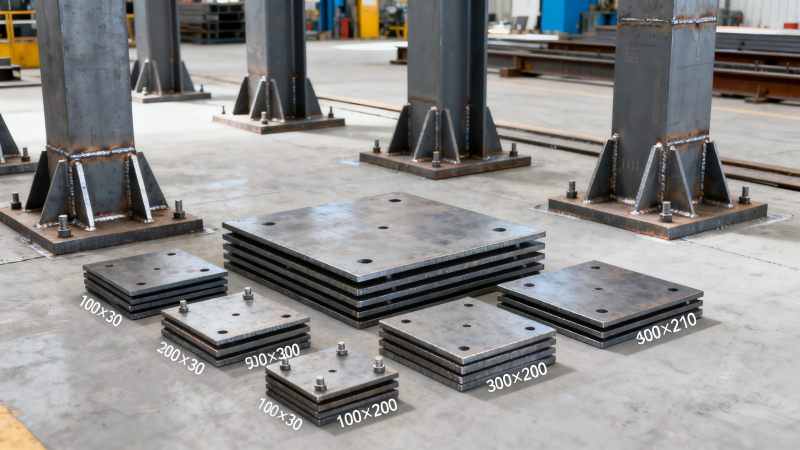
There is no single universal size for every base plate application, but some size ranges are repeatedly preferred because they fit common columns, posts, machines, and support frames. In practical structural work, square plates are often chosen because they provide balanced load distribution and simplify anchor bolt symmetry.
For light-duty supports, sign structures, guard frames, handrail posts, and small fabricated assemblies, a steel square plate in the range of 100 mm x 100 mm to 200 mm x 200 mm is often sufficient, depending on thickness, load, and anchor arrangement. These sizes are easy to fabricate and are commonly used where the connected member is relatively small.
For medium-duty structural columns, equipment supports, and industrial platforms, many buyers evaluate 250 mm x 250 mm, 300 mm x 300 mm, and 350 mm x 350 mm plates. These dimensions usually offer better flexibility for bolt edge distances, weld access, and moderate load spreading without becoming unnecessarily heavy.
For heavy-duty columns, high-load machinery foundations, and larger steel frames, 400 mm x 400 mm and above may be more suitable. In these cases, the steel square plate is often selected not just by footprint, but by the relationship between axial load, moment, concrete strength, grout condition, and base plate thickness. Large plates can improve bearing distribution, but if the design is not coordinated, they may also increase fabrication complexity and distortion risk during welding.
Why “best size” now depends on more than load alone
A major shift in the market is that buyers now judge a steel square plate through a broader lens. Structural load is still the primary design driver, but it is no longer the only deciding factor. Today, the most suitable base plate size is increasingly influenced by six practical considerations.
1. Column or post footprint
The plate must provide enough projection beyond the connected member for welds, stiffness, and anchor bolt layout. A plate that is too close to the member edges may create welding difficulty and reduce installation tolerance.
2. Anchor bolt spacing and edge distance
As design review becomes stricter, edge distance is receiving more attention. The selected steel square plate should allow anchor holes to be placed with sufficient distance from the plate edge to reduce tear-out or cracking risk and improve assembly reliability.
3. Plate thickness interaction
A larger plate is not always better if thickness is too low. Size and thickness work together. In some cases, increasing thickness moderately may be more efficient than increasing footprint excessively.
4. Welding and fabrication access
Modern fabrication shops prefer dimensions that support consistent welding around H-beams, tubes, channels, or custom sections. If a plate is poorly proportioned, production efficiency drops and rework risk rises.
5. Coating and corrosion environment
Galvanized or coated base plates used outdoors, in humid areas, or in industrial facilities may need adjusted detailing. Drainage, hole spacing, edge finishing, and coating behavior all influence the preferred size.
6. Supply chain availability
More buyers now choose dimensions that can be cut efficiently from stock plate widths and lengths. This shortens lead time and helps reduce scrap ratio, which is increasingly important in cost-sensitive global sourcing.
How these changes affect engineers, contractors, and procurement teams
The shift toward optimized steel square plate sizing affects different stakeholders in different ways. For engineers, it means closer coordination between calculation and fabrication reality. For contractors, it means fewer installation conflicts when plate dimensions, anchor bolts, and member orientation are aligned early. For procurement teams, it means asking suppliers not only whether a plate can be produced, but whether the requested size is efficient, standard, and practical.
This is also why experienced structural steel suppliers are becoming more consultative. Instead of simply quoting a requested steel square plate, they often review whether the dimension is aligned with the real application, especially for export projects following ASTM, EN, JIS, or GB requirements.
A practical sourcing signal: integrated steel supply is becoming more valuable
Another market direction worth watching is the preference for suppliers that can support more than one steel product category. Base plate projects often connect to wider procurement packages that include beams, channels, profiles, anchor assemblies, wire products, or fabricated accessories. This integrated approach can reduce coordination errors and shorten procurement cycles.
For example, some projects that use structural base plates also require binding, mesh production, packaging support, or light industrial wire applications. In those cases, a supplier offering Mild Steel Wire Rod alongside structural steel products can simplify sourcing. Typical options include Q195 and Q235 low carbon steel grades, wire diameters from 0.25 mm to 5.0 mm, tensile strength of 350 to 550 Mpa, and zinc coating thickness from 8 to 25 g/m2. Such material is widely used in construction, wire mesh, packaging, barrier isolation, fencing, and other industrial support scenarios, making it a practical complementary product in broader steel procurement planning.
This does not change how a steel square plate is engineered, but it does reflect a broader trend: buyers increasingly prefer dependable manufacturing partners that combine stable quality, flexible specifications, and coordinated export service.
What sizes often make the most sense in different application stages
When evaluating a steel square plate, it helps to think in terms of application stage rather than only nominal size. Early design, fabrication planning, and installation all place different demands on the plate.
This stage-based view is becoming more common because it helps teams avoid the classic mistake of optimizing the plate for one step while creating problems in another.
How buyers can judge whether a steel square plate size is future-ready
As industry expectations continue to evolve, buyers should adopt a broader review checklist. A future-ready steel square plate is not simply strong enough. It should also fit the direction of modern procurement and fabrication practice.
First, confirm whether the plate dimension is based on verified load paths and realistic anchor placement. Second, ask whether a nearby standard size can achieve the same result with easier sourcing. Third, review fabrication details such as hole tolerance, weld access, plate flatness, and surface treatment. Fourth, evaluate whether the supplier can support international standards and export packing without causing schedule uncertainty. Finally, compare total installed cost instead of unit plate cost alone.
For many projects, the best-performing steel square plate is not the biggest or the cheapest. It is the size that produces stable structural behavior, efficient fabrication, smooth installation, and predictable delivery.
Final judgment: what to focus on before you place an order
The market is clearly moving toward more rational and coordinated base plate selection. That means steel square plate decisions should be made with attention to changing design expectations, fabrication efficiency, and sourcing risk. Commonly preferred sizes often fall into practical ranges such as 100 mm to 200 mm for light duty, 250 mm to 350 mm for medium duty, and 400 mm or more for heavier applications, but the final choice should always be tied to the full project context.
If your business wants to judge which steel square plate sizes work best for a specific base plate application, focus on five questions: What loads must be transferred? How much plate projection is needed around the member? What anchor bolt spacing and edge distance are required? Can the size be fabricated and coated efficiently? And is the dimension aligned with available stock and delivery timing? These are the questions that increasingly separate a workable specification from a costly one.
For companies reviewing structural steel procurement trends, this is the key signal to keep watching: better size selection is becoming both a technical advantage and a commercial advantage. The earlier that judgment is made, the more value it creates across design, production, shipment, and installation.
Please give us a message


Please enter what you want to find