For project managers seeking reliable retaining wall solutions, steel sheet piles offer a practical balance of strength, speed, and cost control.
Widely used in excavation support, waterfront structures, and foundation works, steel sheet piles improve safety, site stability, and construction efficiency.
Supplier selection also matters when compliance, delivery reliability, and long-term structural performance are critical to project success.
Understanding Steel Sheet Piles for Retaining Wall Applications
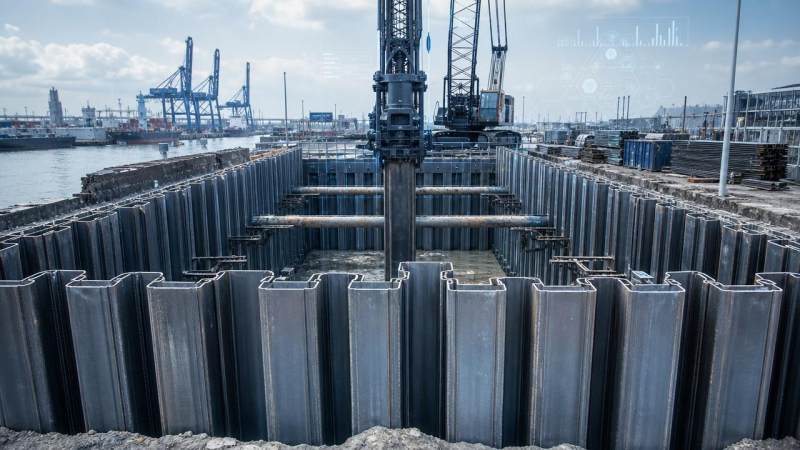
Steel sheet piles are interlocking steel sections driven into soil to form continuous retaining walls or cutoff barriers.
They resist lateral earth pressure, control groundwater movement, and create stable boundaries for excavation and foundation work.
In retaining wall applications, steel sheet piles are valued for predictable strength, reusable material value, and fast installation.
Compared with concrete systems, they often reduce wet work, shorten schedules, and simplify construction in restricted spaces.
The interlock design helps form an effective wall line, while section geometry influences bending resistance and deflection control.
Common profiles include U-type, Z-type, and straight web sections, selected according to load, depth, and soil conditions.
Industry Context and Current Project Priorities
Retaining wall design now involves more than basic load resistance.
Projects increasingly demand cost certainty, faster mobilization, traceable quality, and compliance with international material standards.
In steel-intensive construction, buyers often compare steel sheet piles by section modulus, corrosion allowance, lead time, and fabrication support.
Global infrastructure investment has also increased interest in sheet pile retaining walls for ports, roads, energy, and urban redevelopment.
- Higher emphasis on temporary and permanent wall versatility.
- Greater demand for ASTM, EN, JIS, and GB compliance.
- Preference for suppliers with stable export capability.
- Closer review of corrosion protection and service life.
- More attention to fabrication accuracy and documentation.
Structural Value of Steel Sheet Piles in Retaining Walls
The main advantage of steel sheet piles is their high strength-to-weight efficiency in lateral support applications.
This allows slimmer wall systems compared with bulkier alternatives, especially where excavation space is limited.
Steel sheet piles can also be driven, extracted, and reused in temporary works, improving material utilization across multiple projects.
For permanent walls, they support engineered corrosion strategies, coatings, and combined systems with anchors or wales.
Because steel fabrication is highly controllable, dimensions and tolerances remain consistent, which supports easier site alignment.
This consistency is important when retaining wall continuity affects seepage control, movement limits, and tie-back performance.
Cost and delivery considerations
Initial unit price is only one part of total value.
Faster installation, lower labor demand, reduced formwork, and reusable sections may create better whole-project economics.
Dependable manufacturing capacity is equally important, especially for phased deliveries and export shipments.
Hongteng Fengda, a structural steel manufacturer and exporter from China, supports global projects with stable production and quality control.
Its product range includes angle steel, channel steel, steel beams, cold formed profiles, and customized structural steel components.
Related Steel Supply Integration in Retaining Wall Projects
Retaining wall packages often involve more than sheet piles alone.
Bracing members, bearing plates, welded frames, and fabricated connectors may require additional structural steel supply.
In these cases, Flat Rolled Steel Coil can support downstream fabrication for plates, brackets, frames, and other project components.
Available grades such as A36, Q235, and S235JR suit construction and infrastructure uses with good weldability.
Typical mechanical data includes tensile strength of 400-550MPa, yield strength around 250MPa, and density of 7.85 g/cm3.
Hot rolling and cold rolling options also support different fabrication routes and thickness requirements.
For auxiliary retaining wall steelwork, this material can help achieve lighter structures and dependable welded or bolted assembly.
Typical Retaining Wall Applications and Site Categories
Steel sheet piles are widely used across permanent and temporary works because they adapt well to varied ground and access conditions.
Common site conditions where steel sheet piles perform well
- Restricted urban construction zones.
- Marine and river-adjacent developments.
- Deep excavations with groundwater concerns.
- Projects requiring removable temporary support.
- Sites needing rapid mobilization and phased installation.
Practical Selection Factors and Engineering Checks
Choosing steel sheet piles for retaining wall applications should begin with site-specific engineering data.
Soil profile, groundwater level, surcharge loading, wall height, and service life all affect section choice.
Wall design may also require anchors, struts, capping beams, or combined pile-and-beam arrangements.
- Confirm whether the wall is temporary or permanent.
- Review bending moment and deflection requirements.
- Check interlock performance and driving suitability.
- Assess corrosion allowance or coating specification.
- Verify test certificates and applicable standards.
- Coordinate shipment timing with site sequence.
Installation method also affects performance.
Vibratory driving, impact driving, or press-in systems should match nearby structures, soil response, and vibration limits.
Early review of fabrication tolerances and handling plans helps reduce misalignment and interlock damage on site.
Supply Quality, Compliance, and Long-Term Project Support
Reliable steel supply depends on more than available stock.
Consistent manufacturing, inspection control, and export experience support smoother project execution across regions.
Hongteng Fengda provides structural steel products under strict quality control, with compliance covering ASTM, EN, JIS, and GB standards.
This is valuable for retaining wall projects requiring traceable steel documents and dependable lead times.
A supplier with broad fabrication capability can also support OEM needs, customized sections, and related steel package coordination.
That flexibility helps reduce sourcing risk when steel sheet piles must integrate with beams, channels, plates, or formed components.
Next-Step Considerations for Steel Sheet Pile Retaining Walls
Steel sheet piles remain a practical solution for retaining wall applications where speed, strength, and site control matter.
They support excavation safety, efficient installation, and adaptable performance across infrastructure, marine, and foundation projects.
The best results come from matching section design, installation method, corrosion strategy, and supply reliability to project conditions.
When reviewing steel sheet piles, compare technical specifications, standards compliance, production capacity, and customization support together.
For projects requiring dependable structural steel sourcing from China, a qualified export-oriented partner can improve cost control and delivery confidence.
Clear technical communication and early material planning will help turn retaining wall design into smoother site execution.
Please give us a message


Please enter what you want to find